
Canada Food Safety Certification Practice Exam
$69.00
- Buy to unlock unlimited access to all Quiz questions.
- After purchase you can print a PDF of the whole quiz at any point. The PDF will contain the questions and the correct answers.
About this Exam
The Canada Food Safety Practice Test is the essential first step towards achieving a government-approved Food Handler Certification, a legal requirement in most of Canada for anyone who handles, prepares, stores, serves, or distributes food in a commercial or institutional setting. This includes a wide range of roles from restaurant chefs, line cooks, and servers to dietary aides in healthcare, grocery deli workers, and food manufacturing personnel. The primary certification, often known as "FOODSAFE Level 1" in British Columbia or "Food Handler Certification" in other provinces, is designed to ensure that food service workers have the core knowledge to prevent foodborne illness and maintain a public safety standard. A strong performance on the practice test is the key indicator that you are ready for the official, proctored final exam and a successful career in the food industry.
Ready to test your knowledge?
Buy Now to Access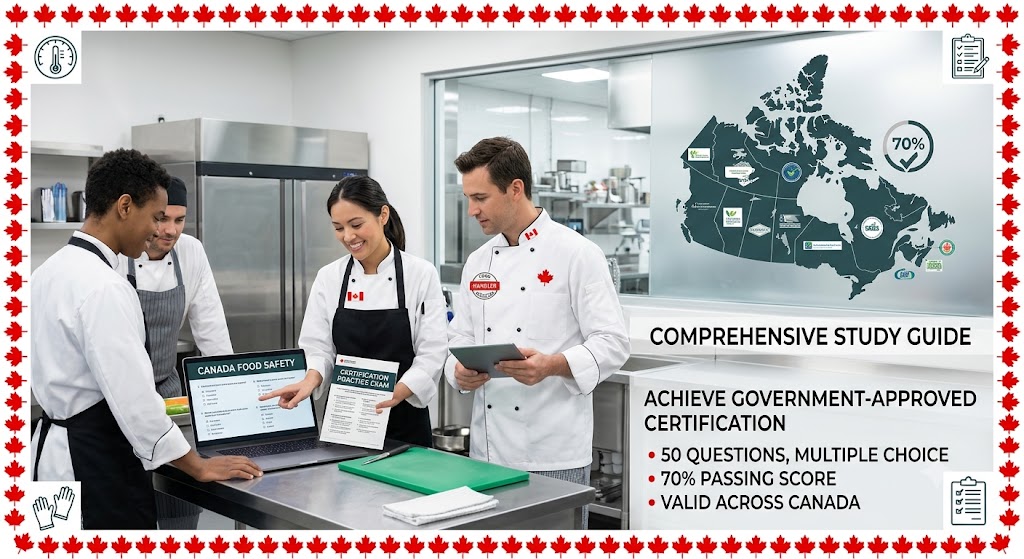
Additional Information
What the Course Entails and Exam Details
Achieving certification begins with a comprehensive training course that covers foundational food safety principles. The curriculum is meticulously structured to provide you with a practical understanding of safe food handling, sanitation, and Canadian legislative requirements. The practice test, consequently, covers all of these vital areas.
Core topics in the syllabus typically include:
Introduction to Food Safety and Foodborne Illness: Understanding pathogens, bacteria, viruses, and the conditions they need to multiply.
Contamination, Hazards, and the Danger Zone: Identifying biological, physical, and chemical hazards, with a heavy emphasis on the time-temperature relationship and the specific temperature ranges (4°C to 60°C or 40°F to 140°F) where bacteria grow most rapidly.
Safe Food Handling Practices: Learning the proper techniques for receiving, storing, thawing, cooking, cooling, and reheating various food types.
Personal Hygiene for Food Handlers: Masterful understanding of correct handwashing, dress code, and illness policies to prevent self-contamination.
Allergen Management and Awareness: Understanding your legal obligations and best practices for preventing cross-contact between common food allergens.
Cleaning and Sanitizing: Distinguishing between cleaning and sanitizing, and mastering the procedures for utensils, equipment, and surfaces.
Introduction to HACCP (Hazard Analysis Critical Control Point): An overview of the proactive system used to identify, evaluate, and control food safety hazards.
What to Expect in the Final Exam
While the exact number of questions can vary by provincial authority or private provider, the standard Canadian final exam is designed to be comprehensive but not overly complex. Its goal is to confirm your practical application of the knowledge learned.
Typical details of the final exam include:
Exam Format: Multiple choice is the near-universal format. You will be presented with a scenario or question and four potential answers.
Number of Questions: 50 multiple-choice questions is a standard across many provinces.
Time Limit: Candidates are typically given between 60 to 90 minutes to complete the final exam.
Passing Score Requirements: To earn your Food Handler Certification, you must achieve a score of at least 70%.
Exam Type: For online courses, the final exam is increasingly webcam-proctored to maintain academic integrity. This means you will need a device with a working camera to take the exam from home. Physical exam locations will have an in-person proctor.
Validity and Retakes: Upon passing, the certificate is valid for five years across Canada. Many online providers offer unlimited free retakes of the final exam if you do not pass on your first attempt.
How to Study and Exam Centers
Effective preparation is the difference between a simple pass and a confident mastery of food safety.
Actionable Study Strategies:
Complete the Full Training Course First: Do not skip directly to the practice test. Read all course materials, watch all videos, and complete all non-graded module quizzes.
Focus on 'The Big Three': While all information is important, prioritize mastering the Temperature Danger Zone, Correct Handwashing Procedure, and Cross-Contamination Prevention (including allergen cross-contact). These form the core of food safety and are most frequently tested.
Utilize the Practice Test Until You Achieve 90%+: Your score on this practice test is the most accurate reflection of your readiness for the final exam. Do not schedule your final exam until you are consistently scoring above 90% and understand why the other multiple-choice options are incorrect.
How and Where to Take the Exam:
Online Portals: The majority of Canadians now complete their training and final exam through authorized, government-approved private online training providers such as the Canadian Institute of Food Safety (CIFS), SafeCheck, and Probit. This allows you to study at your own pace and take the exam from home.
Authorized Schools and Institutions: Colleges, universities, community centers, and many career schools (such as culinary institutes) offer the government-approved curriculum and in-person final exams.
Specific Physical Testing Centers: In certain provinces, like Manitoba and British Columbia, you can register for an "in-person challenge exam" at specific government-authorized locations, especially if you have an expiring certificate or have significant prior experience.
Job Opportunities from the Course
Earning your government-approved Food Handler Certification unlocks a multitude of career paths. It is often the minimum professional qualification required for both entry-level roles and upward mobility within the food and hospitality sector.
Job opportunities and career paths unlocked include:
Culinary Arts: Chef, Sous Chef, Line Cook, Prep Cook, Baker.
Hospitality and Service: Food and Beverage Server, Bartender, Banquet Staff, Host/Hostess, Hotel Food Service Personnel.
Management and Supervision: Restaurant Manager, Food Service Supervisor, Kitchen Manager, Banquet Manager.
Grocery and Retail: Deli Worker, Meat Department Worker, Produce Clerk, Grocery Store Manager, Fishmonger.
Healthcare and Institutional: Dietary Aide (Long-Term Care/Hospital), School Cafeteria Worker, Childcare Center Food Handler.
Food Manufacturing and Production: Production Line Operator, Quality Control Technician, Plant Superintendent, Plant Maintenance Manager, Sanitary Welder.
Mobile and Entrepreneurial: Food Truck Operator, Caterer, Farmers' Market Vendor.
Frequently Asked Questions
Reviews
5.0
Based on 0 reviews
Leave a Review
No reviews yet. Be the first to review!