
Canada 6th Grade Social Studies Practice Exam
$69.00
- Buy to unlock unlimited access to all Quiz questions.
- After purchase you can print a PDF of the whole quiz at any point. The PDF will contain the questions and the correct answers.
About this Exam
The Canada 6th Grade Social Studies Practice Exam is a valuable educational resource designed specifically for students across Canada preparing for their pivotal sixth-grade assessments in this core subject area.
This guide and its accompanying practice material are crafted to help students (and support parents or educators) assess their current understanding of essential social studies concepts covered within the unique Canadian curriculum framework. It is not an official, nationally mandated exam but rather a powerful, engaging tool to build knowledge, boost confidence, and identify areas for further study before crucial school or provincial tests. The material is tailored to the general learning outcomes and key themes common in Canadian middle school education, fostering a deeper connection to history, geography, citizenship, and global awareness.
Ready to test your knowledge?
Buy Now to Access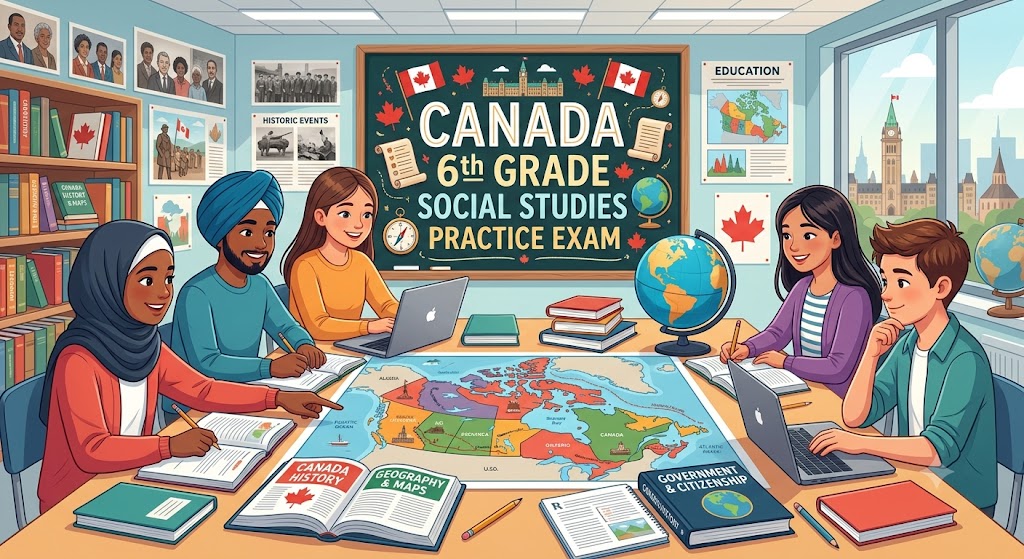
Additional Information
What the Course Entails and Exam Details
While exact curricula can vary slightly between Canadian provinces and territories, the core themes and concepts evaluated by a Canada 6th Grade Social Studies practice exam generally encompass several key pillars:
Canadian Government & Citizenship: Understanding Canada's structure of government (municipal, provincial/territorial, federal), the democratic process, the role of political parties, and the fundamental rights and responsibilities of Canadian citizens (including the Charter of Rights and Freedoms).
Identity & History: Exploring the diverse origins and experiences of the Canadian people, including the histories, cultures, and contributions of First Nations, Métis, and Inuit populations, early European explorers, and successive waves of immigrants. Students learn about significant historical events, figures, and developments that have shaped modern Canada.
Geography & Regional Studies: Gaining knowledge about Canada's diverse physical and political geography, its provinces and territories, major landforms, resources, climate zones, and how geography influences human activity, culture, and economy across the country.
Global Awareness & Interdependence: Developing an understanding of Canada's place in the international community, its global relationships, participation in major international organizations (like the UN and Commonwealth), and recognizing connections between local and global issues.
Core Skills: Cultivating critical thinking, research skills, the ability to analyze different historical and contemporary perspectives, interpret various types of data (maps, graphs, primary sources), and effectively communicate ideas and findings in writing and orally.
As a practice exam, specific details are generally flexible and determined by the individual resource provider:
Format: A balanced practice test often includes a mix of:
Multiple-Choice Questions: Assessing precise factual recall and fundamental understanding.
Short Answer: Demonstrating ability to explain concepts, describe events, or interpret basic information.
Matching/True-False: Quick checks for key terms, dates, and historical figures.
Potentially open-ended questions asking for short paragraphs on key topics.
Passing Score: There is no universal official "passing score" for a practice test. Their primary goal is for self-assessment and learning, allowing you to see which topics require more focus. Achieving a high score (e.g., 80% or higher) is an encouraging sign, but use incorrect answers as direct learning opportunities.
Time Limits: While practice tests can sometimes have suggested time limits to simulate an exam experience, they are often self-paced to allow for thoroughly reading questions and reviewing material. When simulating a real test, try setting a realistic timer (e.g., 45-60 minutes) to practice efficient question management.
Rules: There are no strict official rules for self-guided practice exams. Students are encouraged to take them honestly – ideally, with books closed – to truly measure current understanding, and then with books open to reinforce and correct knowledge.
What to Expect in the Final Exam
It's crucial to distinguish between a practice test and the actual final 6th grade social studies assessments you will take at school. While the structure can vary by province and school board, typically, you can expect the following in your official end-of-year or provincial social studies tests:
Formal Assessment Environment: The official final exam will likely be administered by your teacher(s) within your classroom or a designated school area. It will be scheduled and proctored.
Strict Adherence to Curriculum: The actual test will be directly based on the comprehensive curriculum you've covered throughout the school year.
Various Formats: Final exams often mirror the practice test style, incorporating a mixture of:
Multiple-Choice: Checking for specific knowledge and definitions.
Short Answer: Evaluating brief explanatory skills and data interpretation.
Matching/True-False.
Essay or Extended Response: Potentially testing in-depth understanding, synthesis of information, and critical thinking on broader themes.
Passing Score Requirements: The official passing grade will be set by your school, district, or province, usually within the typical passing range for all school subjects.
Time Limits: You will be given a specific, non-negotiable amount of time (often a class period or more, potentially split into sections) to complete the entire official assessment.
Official Rules: There will be strict academic integrity and potential restriction on materials allowed during the test (e.g., no textbooks or notes, unless a section explicitly allows specific resources like a designated atlas).
How to Study and Exam Centers
Effective preparation is key to both understanding social studies and succeeding on any related assessments. Here's how you can study proactively:
Study Strategies
Review Class Materials Consistently: Regularly review your social studies notes, textbooks, class assignments, and any supplemental materials provided by your teacher. Make sure you understand the key concepts and dates.
Practice Active Learning: Don't just read. Summarize major events or government structures in your own words. Create flashcards for important historical figures, dates, geographical terms, and government roles.
Utilize Visual Aids: Study maps of Canada, historical timelines, and governmental structure diagrams. Understanding location, chronological order, and how various bodies interact can make learning significantly easier.
Engage in Discussion: Talk about historical events, current Canadian issues, and government functions with parents, siblings, or friends. Explaining concepts to someone else is a powerful way to reinforce your own understanding.
Read for Context: Read age-appropriate books about Canadian history, indigenous cultures, geography, and current events to broaden your perspective and deepen your knowledge beyond your textbook.
Take Multiple Practice Tests: Find other reputable 6th grade social studies practice tests or quizzes online to expose yourself to different question styles and identify potential weak spots from multiple angles.
Accessing Practice Tests and Exam Centers
Educational Websites & Platforms: Numerous websites offer interactive practice quizzes, downloadable worksheets, and full practice tests for Canadian 6th Grade Social Studies. Look for reliable resources that specify alignment with Canadian curricula. ( [Note: Specific examples could be added here, like educational publishers' websites or common curriculum-aligned platforms, if appropriate and known, but keeping it general avoids recommending specific, potentially non-authoritative sources. Let's keep it general as requested.] )
School Resources: Your teacher or school website may have sample questions, study guides, or links to reputable practice materials.
Within the Classroom: Teachers frequently use practice quizzes and assessments as learning checks within the regular classroom environment throughout the year.
For practice tests, there are no official, external "exam centers" like you might find for professional certifications or high school standardized tests (such as Pearson VUE centers). You will typically access and take these:
Online Portals/Websites: Accessing practice tests directly from a computer, tablet, or smartphone at home, school, or the public library.
In-Class Activities: Teachers often facilitate practice tests or quizzes directly during class time.
For your official, final, curriculum-based exam, the "exam center" is simply your own school classroom or designated school area. These are administered by your regular school staff, ensuring they adhere to local educational guidelines and requirements.
Job Opportunities from the Course
A sixth-grade social studies practice test, or even the underlying curriculum itself, is fundamentally an educational building block and not a standalone professional certification that directly unlocks specific job roles.
However, the foundational knowledge, critical thinking, research, and communication skills cultivated through strong performance and engagement in social studies at this level are incredibly valuable. Mastery of these concepts creates a strong basis for:
Future Academic Success: A strong social studies foundation is essential for succeeding in high school courses like history, political science, geography, sociology, and economics.
Post-Secondary Studies: It can spark interest and provide prerequisite knowledge for university or college programs in social sciences, humanities, political science, law, international relations, Canadian studies, education, and journalism.
Civic Engagement: Creates informed and engaged citizens, a critical skill and responsibility that is fundamental to many careers that require strong communication, critical analysis, and community involvement.
A Wide Range of Career Paths: Ultimately, the skills developed in social studies (thinking critically, understanding systems, analyzing evidence, communication) are highly sought after by employers across numerous fields. Strong social studies foundations can serve as a stepping stone towards careers such as:
High School or University Educator (specializing in history, geography, social sciences)
Government Service and Administration (municipal, provincial, federal positions)
Politician/Elected Official
Civil Servant or Researcher in government bodies
Lawyer, Paralegal, Judge (requiring deep knowledge of systems, rights, and responsibilities)
Journalist, Writer, Communications Professional (analyzing and reporting on social issues and history)
Librarian, Archivist, or Museum Curator
NGO Worker or Activist in social or political causes
Historian, Anthropologist, Sociologist
Town Planner or Urban Planner (linked to geography and community studies)
Tourism & Heritage Work (linked to history and culture)
Frequently Asked Questions
Reviews
5.0
Based on 0 reviews
Leave a Review
No reviews yet. Be the first to review!