
Camp Butler OIC/RSO Practice Exam
$69.00
- Buy to unlock unlimited access to all Quiz questions.
- After purchase you can print a PDF of the whole quiz at any point. The PDF will contain the questions and the correct answers.
About this Exam
The Camp Butler Officer in Charge (OIC) and Range Safety Officer (RSO) qualification is a mandatory certification for all personnel responsible for supervising live-fire training events within the Marine Corps Base Camp Smedley D. Butler, Okinawa, Japan. This critical certification ensures that all range activities are conducted in strict compliance with U.S. Marine Corps Order 3570.1C and the specific Range Regulations (Base Order 3570.1) unique to the Camp Butler installation. The exam is designed for Officers, Staff Non-Commissioned Officers (SNCOs), and designated Non-Commissioned Officers (NCOs) who will assume the legal and safety responsibilities of directing a range or ensuring its safe execution. Successful completion signifies that an individual is qualified to manage risk, prevent accidents, and maintain absolute control over the range and all personnel within its boundaries.
Ready to test your knowledge?
Buy Now to Access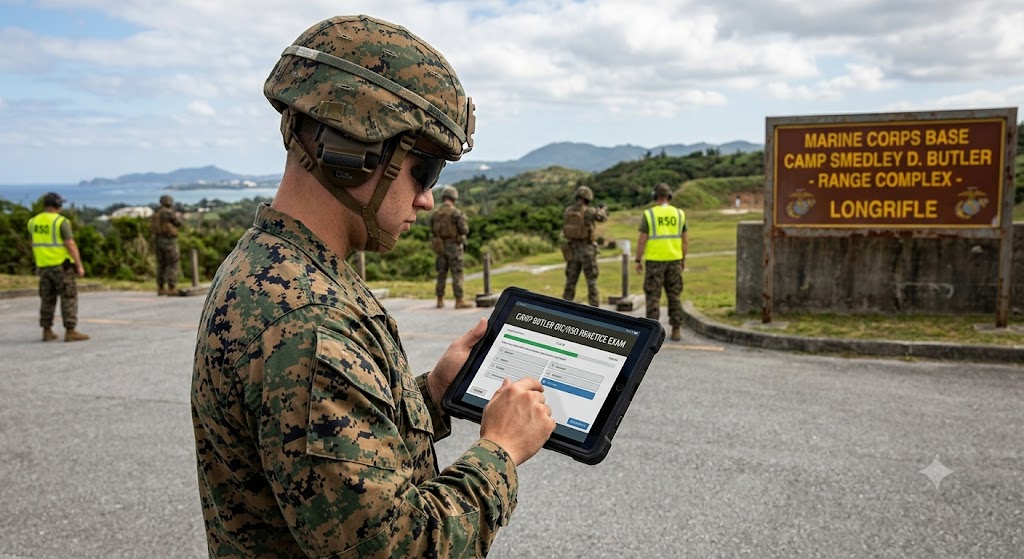
Additional Information
What the Course Entails and Exam Details
The qualification pathway is structured to ensure comprehensive knowledge. It generally consists of two distinct but related online components hosted on MarineNet:
The USMC Range Safety Course (Basic): This course provides a standard foundation, covering universal Marine Corps range safety principles, types of ranges, basic weapon surface danger zones, and fundamental safety procedures. It is a prerequisite for the installation-specific course.
The Camp Butler Installation OIC/RSO Certification Course: This specialized module focuses exclusively on the unique operations of Camp Butler. It covers:
Specific Range Regulations for Camp Butler (BO 3570.1): Understanding the detailed local policies and maps.
OIC and RSO Roles and Responsibilities: Differentiating the duties of the Officer in Charge (legal, administrative) and the Range Safety Officer (safety, operational).
Range Request and Scheduling (RFMSS): Familiarity with the Range Facility Management Support System.
Range Inspection and Preparation: How to properly check and set up a specific range.
Standard Operating Procedures (SOPs): Reviewing specific SOPs for various weapons and training scenarios (e.g., small arms, crew-served weapons, demolitions, air-to-ground).
Communications Protocols: Proper radio procedures (e.g., calling "Longrifle") and use of Range Control channels.
Emergency Procedures: Medical, fire, and unexploded ordnance (UXO) protocols.
Surface Danger Zones (SDZs): Application of specific SDZs and risk mitigation.
Ammunition Handling: Storage, transport, and safety rules for ammunition on Camp Butler.
What to Expect in the Final Exam
The final certification exam is a critical check of your knowledge, administered entirely online through MarineNet. The exam for the Camp Butler Installation Course is computer-based and primarily multiple-choice. Candidates must have successfully completed both the USMC Range Safety Course (Basic) and the entire Camp Butler module to unlock and launch the final test. This ensures that only well-prepared individuals attempt the exam. The test is typically "open book," allowing you to reference official regulations during the exam, but it is time-limited. A high passing score is required, usually 80% or 90%, reflecting the critical nature of the safety information. If you do not pass, you must re-study and may have to retake portions of the course material before re-attempting the exam.
How to Study and Exam Centers
Preparation for the Camp Butler OIC/RSO exam is entirely online and user-driven, maximizing flexibility. You do not visit an external center like Pearson VUE; instead, you log in to MarineNet. Here is a proven strategy:
Access MarineNet: Ensure you have an active MarineNet account. Search for the required courses: first, the USMC Range Safety Course (often listed with a code like RTAMRSOCAA), and then the Camp Butler Installation OIC/RSO Course.
Complete Prerequisites: You must pass the USMC Range Safety Course (Basic) before the installation-specific course will activate on MarineNet.
Engage with the Material: The MarineNet system monitors your engagement. You must read all slides in the course, and it is crucial to spend adequate time on each page. Simply skipping to the end will prevent the final test from launching. Download and save all linked reference documents, especially BO 3570.1 (Camp Butler Range Regulations), maps, and SOPs.
Use Practice Methods: While there isn't a separate, official practice test, you can effectively use the course reviews. After completing the course content, revisit key slides, take notes on critical steps, and quiz yourself on the specific regulations of individual ranges at Camp Butler. The course includes self-test questions that are highly reflective of the final exam. Practice scenarios based on hypothetical emergency calls to Range Control.
Final Exam Location: You can take the exam from any computer with internet access that can connect to MarineNet, whether at your unit, a learning center, or at home. Be sure you are in a quiet, distraction-free environment, as the safety information requires absolute focus.
Job Opportunities from the Course
While "Range Safety Officer" or "Officer in Charge" are not standalone civilian job titles in this context, this certification is a critical, mandated requirement for various military billets. It directly unlocks the ability for personnel within a unit to perform their duties and is an essential line item for career progression. Within the Marine Corps, holding this qualification is required to fill specific roles during training:
Unit Range Safety Officer (RSO)
Unit Officer in Charge (OIC)
Unit Range Coordinator / Training NCO
Unit Operations Chief / Officer
Combat Instructor / Drill Instructor
Civilian Range Specialist (with specific qualifications and base access)
Civilian Range Control Officer (CRCO)
For individuals leaving the service, this certification provides strong, verifiable evidence of leadership, safety management, regulatory compliance, and risk assessment, making it highly attractive for careers in:
Civilian Range Management
Corporate Safety and Compliance
Emergency Management
Law Enforcement Training
Logistics and Operations
Frequently Asked Questions
Reviews
5.0
Based on 0 reviews
Leave a Review
No reviews yet. Be the first to review!