
Call for Fire (CFF) Practice Exam
$69.00
- Buy to unlock unlimited access to all Quiz questions.
- After purchase you can print a PDF of the whole quiz at any point. The PDF will contain the questions and the correct answers.
About this Exam
The Call for Fire (CFF) certification and its associated practice tests are designed for personnel within the United States military, most notably the U.S. Army's 13F Military Occupational Specialty (MOS), the Joint Fire Support Specialist (Forward Observer). This skill is also essential for Marine Corps equivalents (0861), Joint Terminal Attack Controllers (JTACs), and any leader responsible for requesting and directing indirect fires (artillery, mortars, and naval gunfire). The CFF is a high-pressure, mission-critical skill. Forward Observers are the "eyes and ears" of the artillery, operating from the front lines to observe the enemy and coordinate devastating fire support to neutralise them.
Ready to test your knowledge?
Buy Now to Access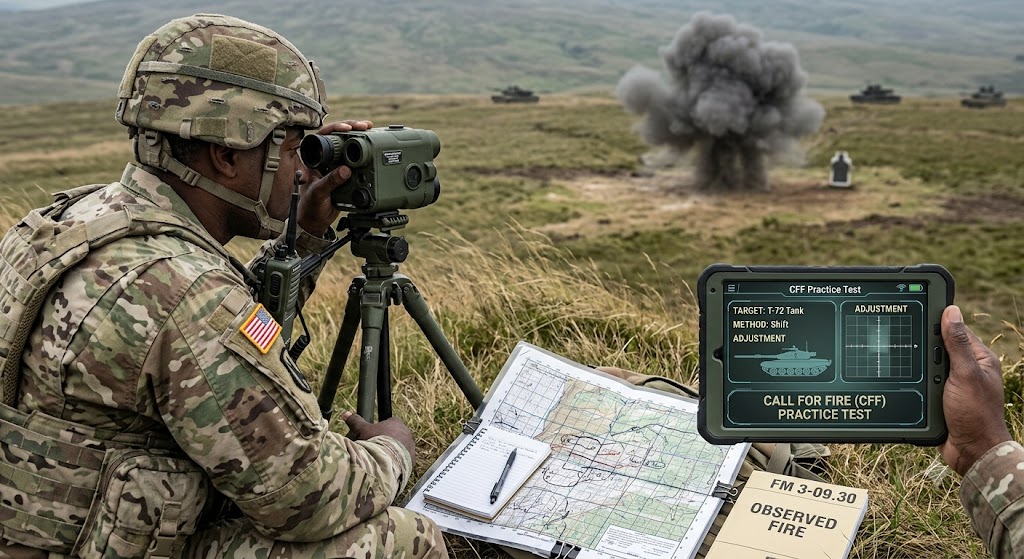
Additional Information
What the Course Entails and Exam Details
A comprehensive CFF course or training program moves beyond theory, focusing heavily on a simulation-based and practical application of skills. For 13F students, this is a core component of their Advanced Individual Training (AIT) at Fort Sill, OK. The curriculum provides a deep dive into the technical aspects of indirect fire support, covering the following essential topics:
Self-Location: Instantly and accurately identifying your own position on a map using grid coordinates.
The Six Elements of a Call for Fire: Mastering the standard, two-transmission radio communication format:
Observer Identification
Warning Order
Target Location
Target Description
Method of Engagement
Method of Fire and Control
Methods of Target Location: Becoming proficient in the three main methods for finding a target:
Grid: Using a minimum of a six-digit grid coordinate.
Polar Plot: Sending direction and distance from your known location.
Shift from a Known Point: Giving adjustments from an established reference point.
Adjustment of Fire: Learning the iterative process of correcting a "spotting" (observing the first round) to move subsequent rounds onto the target using techniques such as successive bracketing or creeping fire.
Fire for Effect (FFE): Transitioning from adjustment to a massive, massed fire mission to achieve destruction on the target.
Types of Ammunition and Fuzes: Understanding the appropriate use of standard HE (High Explosive), smoke, illumination, and precision-guided munitions.
Simulators and Technology: Training primarily on the Call For Fire Trainer (CFFT), a highly realistic simulator that provides instant feedback.
What to Expect in the Final Exam
The final Call for Fire exam is a dual-component assessment that evaluates both technical knowledge and practical performance. Candidates should be prepared for the following structure:
Written Examination: This part focuses on the academic and conceptual foundation. It typically includes multiple-choice and fill-in-the-blank questions on the Six Elements of a CFF, radio procedures, map reading, weapon system capabilities, and safety regulations. You must demonstrate a detailed, memorized understanding of the exact wording for transmissions.
Practical Simulator Examination: The core of the CFF exam is a practical, timed scenario on the CFFT or a live-fire exercise. A standard practical exam task might require a candidate to self-locate within three minutes, locate a target within two minutes, and then, using a specific method (like Shift from a Known Point), adjust the first round of artillery onto the target. The "pass" standard often requires the candidate to achieve a first-round effect or successfully establish a 100-meter bracket to commence "Fire for Effect" within a strict time limit and without error in the six elements. Any safety violation or critical failure in the communication loop is an automatic failure.
How to Study and Exam Centers
Studying for the CFF requires a unique mix of rote memorization and dynamic, visual practice. It is not an exam you can pass through textbook study alone.
Actionable Study Strategies:
The "Six and Fifteen" and the "30": The most critical, non-negotiable step is the 100% memorization of the Six Elements of a Call for Fire and the 15 standard, subsequent fire corrections. Candidates are tested on their ability to recite these in sequence under stress. Memorize the exact template and use it for all practical training.
Visual Simulation: While official simulators (CFFT) are restricted to military facilities, candidates can find alternative methods. Some modern military simulation games, particularly Arma 3, have robust CFF mods and plugins that offer a faithful approximation of the procedures and the visual feedback required to practice adjustments.
Pen-and-Paper Scenarios: A proven, low-tech method is to draw a map and observation post on a page, write down a specific target description and location method, and then physically act as the FDC (Fire Direction Center) to determine where the imaginary rounds would land. This builds a strong mental link between map reading and spatial adjustments.
Terrain Model Kit: Set up a small terrain model using available materials (a tile floor can represent grid squares). Place target representations and use a laser pointer or marker to show where an initial round lands, then practice adjusting.
Review Official Publications: The foundational texts are the Department of the Army Pamphlets and Field Manuals, specifically FM 3-09.30 (Observed Fire), which contains the authoritative standards and procedures.
Exam Centers:
The CFF is an official military certification and is only available through military-authorized channels. It cannot be taken at standard civilian centers like Pearson VUE or online portals. The primary location for the initial qualification is at the U.S. Army Field Artillery School at Fort Sill, OK. Other exams and proficiency assessments are conducted at specific, authorized Regional Training Centers, National Guard training grounds, or at a unit's own specialized CFF trainer facility, administered by certified instructors.
Job Opportunities from the Course
A CFF certification is a pivotal qualification that defines a career. While its primary applications are military, the skills developed open pathways across various professional environments.
Military Roles:
13F Joint Fire Support Specialist (U.S. Army)
0861 Forward Observer (U.S. Marine Corps)
Joint Terminal Attack Controller (JTAC) / Tactical Air Control Party (TACP)
Fire Support Team (FIST) Leader
Fire Direction Officer (FDO)
Related Contracting / Civilian Work:
Military Training Simulator Instructor
Unmanned Aerial System (UAS) Operator
Explosive Ordnance Disposal (EOD) Support
Disaster Management / Search and Rescue Coordinator (using high-stress communication and map skills)
High-Altitude, Technical Security Operations
This comprehensive guide, coupled with the proper dedication, will prepare you to master the Call for Fire skill, an essential tool for any Forward Observer and tactical leader.
Frequently Asked Questions
Reviews
5.0
Based on 0 reviews
Leave a Review
No reviews yet. Be the first to review!