
California Water Issues Practice Exam
$69.00
- Buy to unlock unlimited access to all Quiz questions.
- After purchase you can print a PDF of the whole quiz at any point. The PDF will contain the questions and the correct answers.
About this Exam
The "California Water Issues Practice Test" is not a standalone exam but a vital preparatory tool for individuals seeking certification to work in California’s complex and highly regulated water industry. This comprehensive practice resource is specifically designed for aspiring and current professionals preparing for the various operator certifications administered by the State Water Resources Control Board (SWRCB). These licenses are essential for ensuring the safety and reliability of California’s drinking water, the effective treatment of wastewater, and the sustainable management of our water resources, especially in the face of unique challenges like drought, seismic activity, and strict quality standards. This tool is for those aiming to become Water Treatment, Water Distribution, or Wastewater Treatment Operators.
Ready to test your knowledge?
Buy Now to Access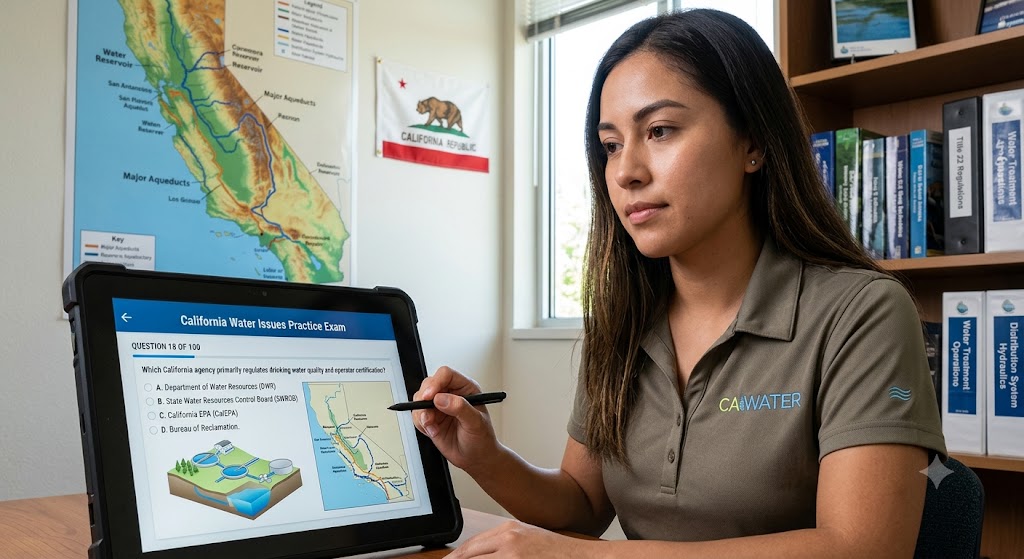
Additional Information
What the Course Entails and Exam Details
This practice test is an integrated study aid that synthesizes the critical knowledge areas required for multiple California SWRCB certification paths. While the final official exams are specific to the license and grade level (e.g., T1–T5 for Treatment, D1–D5 for Distribution, and Grade I–V for Wastewater), this practice test focuses on the shared foundational and advanced topics unique to the California landscape.
The core syllabus and skills covered include:
California Water Laws and Regulations: Deep dive into Title 22 (Social Security) Water Recycling Criteria, the California Safe Drinking Water Act, NPDES permits, CEQA, and the roles of the SWRCB and regional water boards.
Water Source and Supply: Understanding California’s hydrology, including groundwater, surface water (e.g., State Water Project, Colorado River), and the management of drought and water scarcity.
Water and Wastewater Treatment Processes: Detailed knowledge of coagulation, flocculation, sedimentation, filtration, and disinfection (including CT values and emerging contaminant control like PFAS).
Water Distribution and Collection Systems: Comprehensive understanding of hydraulics, pumps, VFDs, storage facilities, leak detection, and mandatory cross-connection control/backflow prevention.
Safety, Laboratory, and Operations: Mastery of required safety protocols (confined space, chemical handling, cybersecurity), lab testing procedures (BOD, TSS, pH, chlorine residual), and general facility operations and maintenance.
What to Expect in the Final Exam
While each grade level increases in complexity and specific focus, the final SWRCB exams generally follow a standardized format.
Format: All official California operator certification exams are multiple-choice.
Time Limit: Candidates are typically allotted 3 hours to complete the examination.
Passing Score: A minimum score of 70% is required to pass any grade-level exam.
Specific Rules: Final exams for Grades T1–T4 and D1–D5 are administered on computers. The Grade T5 (the highest treatment grade) exam is a unique, semi-annual written examination held in specific northern and southern California locations.
How to Study and Exam Centers
Effective preparation requires a combination of structured study and hands-on practice.
Actionable Study Strategies:
Utilize Official Resources: The SWRCB publishes an "Expected Range of Knowledge" (ERK) for every exam. Make this document your primary study outline.
Specialized Training: Enroll in SWRCB-approved specialized training courses, which are often required for higher grade eligibility and provide targeted instruction.
Continuous Practice: Use a high-quality practice test tool to identify knowledge gaps, practice with the same formulas and equivalent sheets provided during the actual exam, and build test-taking stamina.
Exam Centers and Registration:
Computer-Based Testing (T1–T4, D1–D5): After receiving an exam admission letter from the SWRCB, you will schedule your computerized exam through an authorized testing vendor, such as Pearson VUE. These centers are located throughout California.
T5 written exam: This is a physical, in-person exam held only twice a year. The SWRCB provides specific details on locations (e.g., Sacramento and Santa Ana) and application deadlines.
Job Opportunities from the Course
Earning a California Water Operator certification unlocks clear, stable, and essential career paths within public utilities, municipalities, and private water companies. The certifications are required by state law for specific operational roles.
Water Treatment Operator:
Water Treatment Plant Operator (Grades T1–T5)
Water Quality Specialist
Superintendent of Water Treatment
Water Distribution Operator:
Water Distribution Operator (Grades D1–D5)
Water Service Worker / Crew Leader
Cross-Connection Control Specialist
Distribution System Supervisor
Wastewater/Advanced Water Treatment Operator:
Wastewater Treatment Plant Operator (Grades I–V)
Wastewater Collection System Worker
Recycled Water Coordinator
Advanced Water Treatment Operator (AWT3–AWT5)
Frequently Asked Questions
Reviews
5.0
Based on 0 reviews
Leave a Review
No reviews yet. Be the first to review!