
CAA Frto Practice Test & Exam Prep | New Zealand
$69.00
- Buy to unlock unlimited access to all Quiz questions.
- After purchase you can print a PDF of the whole quiz at any point. The PDF will contain the questions and the correct answers.
About this Exam
The CAA Flight Radiotelephony Operator (FRTO) certification is a mandatory requirement for any pilot in New Zealand wishing to operate an aircraft radio.
This essential qualification ensures all aviators possess the necessary skills to communicate clearly, concisely, and effectively with Air Traffic Control (ATC) and other aircraft.
Clear communication is vital for maintaining situational awareness and safe separation in both controlled and uncontrolled airspace throughout New Zealand.
The exam is primarily designed for student pilots working toward their Private Pilot License (PPL) or Commercial Pilot License (CPL), but it is also required for other personnel who need to use aeronautical radios, such as certain ground crew and drone operators.
Ready to test your knowledge?
Buy Now to Access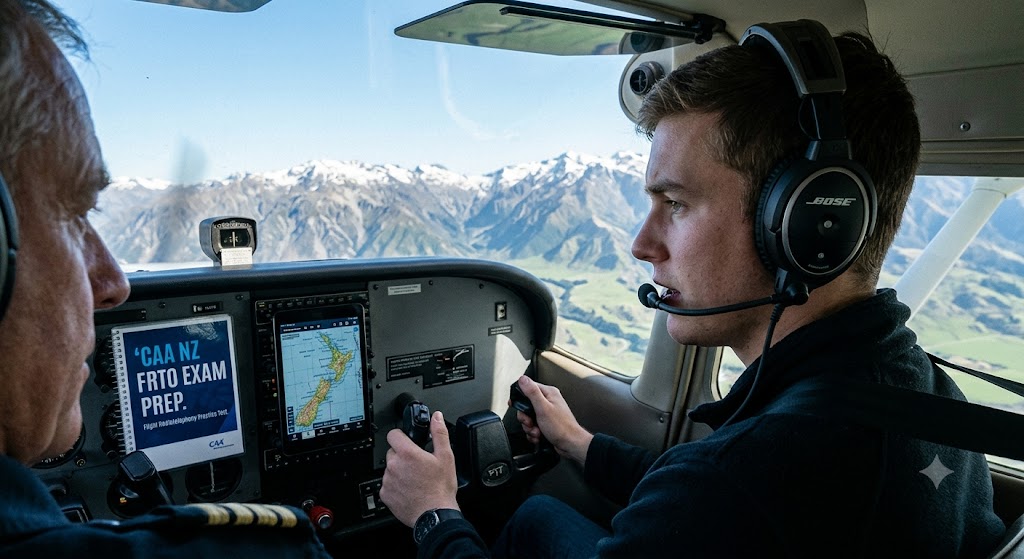
Additional Information
What the Course Entails and Exam Details
To prepare for the FRTO qualification, candidates usually undergo a period of study covering the theoretical and practical application of standard phraseology.
The syllabus, set by the Civil Aviation Authority of New Zealand (CAA NZ), focuses on established international (ICAO) standards adapted for the NZ environment.
The core topics include:
Standard Phraseology: Learning the precise words and phrases used for common flight phases, including taxi, takeoff, departure, en route, arrival, and landing.
Aeronautical Alphabet and Numbers: Master communication precision using the phonetic alphabet (Alpha, Bravo, Charlie) and standard number transmission.
Radio Procedures: Understanding correct microphoning techniques, readability scales, and established procedures for making and acknowledging calls.
Emergency and Urgency Communication: Crucial training on how to declare distress (MAYDAY) or urgency (PAN-PAN) conditions, and the priority of these communications.
Loss of Communication Procedures: Protocols to follow when your aircraft radio transmitter or receiver fails.
New Zealand Specifics: Understanding unique aspects of flying in NZ, including the use of Common Frequency Zones (CFZ) and specific local procedures.
What to Expect in the Final Exam
The New Zealand FRTO licensing process typically involves two separate components that must both be passed.
The first component is a theory-based examination.
This is usually a computer-based, multiple-choice exam administered by Aspeq on behalf of CAA NZ.
Candidates are tested on their knowledge of rules, procedures, and phraseology. The passing score is 70%, and you are generally allowed 60 to 90 minutes to complete the test.
The second component is the practical demonstration of skill.
This section is assessed by an approved Flight Examiner, often during your final PPL or CPL flight test.
During the flight, the examiner will simulate different ATC scenarios, emergencies, and standard procedures.
You will be assessed on your ability to maintain clear, accurate communication while simultaneously piloting the aircraft, demonstrating that your radio work enhances, rather than detracts from, flight safety.
How to Study and Exam Centers
Preparation for the FRTO should combine theoretical knowledge with consistent practical application.
You cannot learn standard phraseology solely from a book; you must practice speaking it.
Here are actionable study strategies:
Utilize Official Resources: Your primary study guide should be the CAA Advisory Circular AC61-3 and the New Zealand Aeronautical Information Publication (AIP), which contains the definitive guide to NZ phraseology.
Engage in Mock Exams: Use online "NZ CAA FRTO Practice Test" portals to normalize the multiple-choice format and identify gaps in your knowledge.
Role-Play Scenarios: Practice with your flight instructor or a fellow student. Simulate entire flights, from startup to shutdown, exchanging calls as both the pilot and ATC.
"Chair Flying": Visualize a flight and speak the correct radio calls aloud at each stage.
LiveATC: Listen to live Air Traffic Control feeds from busy New Zealand airports (e.g., Auckland, Wellington, Christchurch) to familiarize yourself with the cadence and real-world application of standard phraseology.
The theoretical FRTO written exam is booked through Aspeq and can be taken at authorized testing centers located at major airports and flight schools across New Zealand.
The practical component is arranged directly with your flight training organization and is conducted by a CAA-approved Flight Examiner.
Job Opportunities from the Course
A Flight Radiotelephony Operator qualification is not just a regulatory hurdle; it is the key that unlocks professional and recreational aviation opportunities.
It is a core competency that directly supports a wide range of career paths within the industry.
This certification is required for the following roles:
Private Pilot (PPL Holder): Flying recreationally for pleasure or personal business.
Commercial Pilot (CPL Holder): Operating charter flights, scenic tours, agricultural aviation, or flight instruction.
Airline Pilot (ATPL Holder): A foundational skill required before progressing to advanced multi-crew coordination and airline operations.
Flight Instructor: Teaching students correct radio procedures.
Remotely Piloted Aircraft Systems (RPAS) Operator: Required for certain commercial drone operations that interact with controlled airspace.
Air Traffic Controller (ATC): While ATC requires extensive specialist training, a strong understanding of pilot communication is essential background knowledge.
Ground Crew/Flight Service: Specific roles at aerodromes that require communication with aircraft on the ground.
Frequently Asked Questions
Reviews
5.0
Based on 0 reviews
Leave a Review
No reviews yet. Be the first to review!