
CAA Cpl Practice Test & Exam Prep | New Zealand
$69.00
- Buy to unlock unlimited access to all Quiz questions.
- After purchase you can print a PDF of the whole quiz at any point. The PDF will contain the questions and the correct answers.
About this Exam
The New Zealand Civil Aviation Authority (CAA) Commercial Pilot License (CPL) is a pivotal qualification for aviators aiming to transition from recreational flying to a professional career. This license validates that a pilot has achieved the advanced knowledge, skill, and experience required to operate aircraft for compensation or hire. It is specifically designed for Private Pilot License (PPL) holders who meet the prerequisite flight hours and are ready to command aircraft in a commercial environment, adhering to the high safety standards of the New Zealand aviation sector.
Ready to test your knowledge?
Buy Now to Access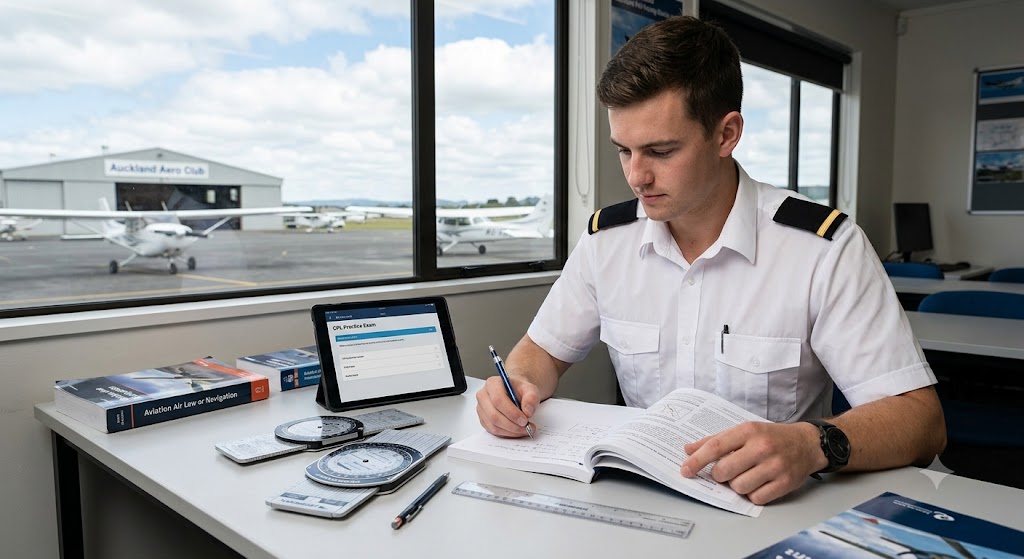
Additional Information
What the Course Entails and Exam Details
Preparing for the CPL is a rigorous process involving both theoretical knowledge and practical flight training. Candidates must master a broad syllabus that covers complex aviation concepts and regulatory requirements. The core theory subjects you will need to master include:
Aviation Air Law: Navigating the legal framework and rules of the air in New Zealand.
Meteorology: In-depth study of weather systems, forecasting, and their impact on flight operations.
Navigation & Flight Planning: Mastering chart work, flight planning, and advanced navigation techniques.
Aircraft General Knowledge (Aeroplane): Understanding aircraft systems, engines, and structures.
Principles of Flight: The aerodynamics and mechanics of how an aircraft flies.
Human Factors: Studying the physiological and psychological aspects of pilot performance and decision-making.
In addition to theory, candidates must complete a minimum of 200 hours of flight time (or 150 hours in an approved integrated course), which includes specific requirements for cross-country navigation, instrument flying, and night operations.
What to Expect in the Final Exam
The culmination of your CPL training is the practical Flight Test, conducted by a CAA-approved Flight Examiner. This is not a written test but a comprehensive evaluation of your piloting skills and decision-making.
During the flight test, you must demonstrate proficiency in all phases of flight, including pre-flight planning, advanced aircraft handling, navigation, emergency procedures, and instrument flight maneuvers. The examiner will assess your ability to operate the aircraft safely, efficiently, and to commercial standards.
You must pass the flight test within specific timeframes after completing your written exams. While there isn't a single "passing score" like a written test, you must meet the performance criteria outlined in the CAA Flight Test Standards Guide for the CPL to achieve a pass.
How to Study and Exam Centers
Achieving success in the CPL requires a disciplined and comprehensive study strategy. It is crucial to utilize official CAA advisory circulars, dedicated CPL textbooks, and consider enrolling in a ground school course offered by a flight training organization.
Leveraging mock exams and practice papers is highly recommended. These tools help you familiarize yourself with the structure of ASL (Aviation Services Limited) exams and identify areas where you need further study.
The six CPL theory exams are computer-based and administered by ASL at various testing centers throughout New Zealand. You must book these exams through the ASL website. The practical flight test is arranged directly with a Flight Examiner, often coordinated through your flight training organization.
Job Opportunities from the Course
Earning your Commercial Pilot License opens the door to a wide array of professional paths in the aviation industry. This qualification allows you to work as a pilot for remuneration. Key career opportunities include:
Charter Pilot: Flying passengers or freight on non-scheduled flights.
Scenic Tour Pilot: Conducting aerial sightseeing tours over New Zealand's stunning landscapes.
Flight Instructor: Teaching aspiring pilots (requires an additional Instructor Rating).
Agricultural Pilot: Operating aircraft for topdressing, spraying, and related farming activities.
Air Ambulance Pilot: Conducting medical evacuation and emergency transport flights.
First Officer (Co-pilot): Working for regional airlines or corporate flight departments.
Frequently Asked Questions
Reviews
5.0
Based on 0 reviews
Leave a Review
No reviews yet. Be the first to review!