
BSEB Matric Sil Practice Test & Exam Prep | India
$69.00
- Buy to unlock unlimited access to all Quiz questions.
- After purchase you can print a PDF of the whole quiz at any point. The PDF will contain the questions and the correct answers.
About this Exam
The BSEB Matric (Class 10) examination, conducted by the Bihar School Examination Board, is a pivotal milestone in the academic journey of students in Bihar, India. This comprehensive assessment determines a student's eligibility for higher secondary education (11th & 12th grade) and serves as a foundation for future career paths. It is designed to test knowledge and understanding of core subjects covered throughout secondary schooling, ensuring students are prepared for the next level of academic rigor.
Ready to test your knowledge?
Buy Now to Access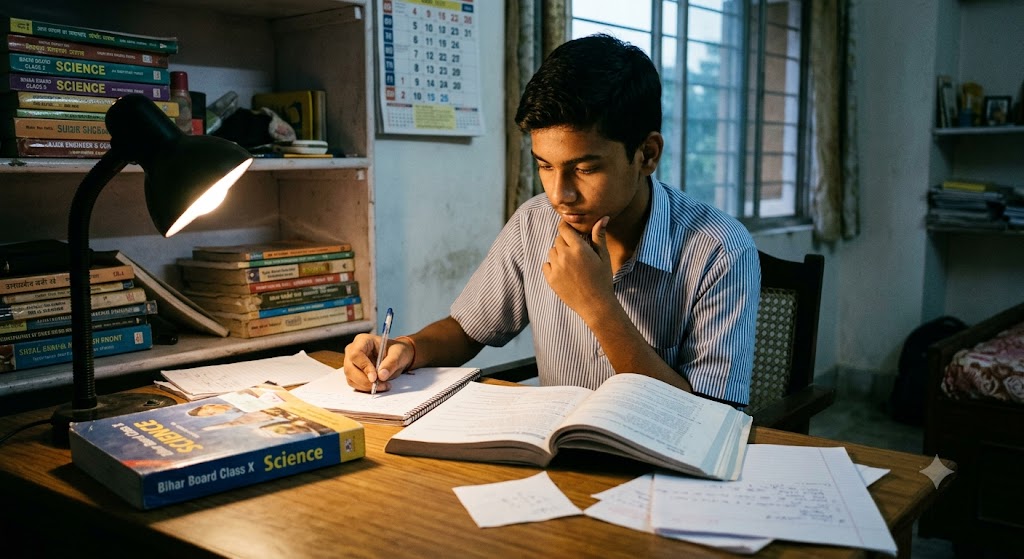
Additional Information
What the Course Entails and Exam Details
The BSEB Matric SIL curriculum focuses heavily on language structure, literature, and communication skills based on the prescribed textbooks by the Bihar State Textbook Publishing Corporation.
While the specific content varies depending on the chosen language (e.g., Hindi vs. Maithili), the core areas covered typically include:
Literature (Prose & Poetry): Detailed study of selected short stories, essays, and poems from the prescribed textbook. Students must understand the themes, context, and stylistic elements of these works.
Grammar: Fundamental rules of the language, including parts of speech (nouns, pronouns, verbs, adjectives), tense, sentence structure (syntax), voice (active/passive), and idioms and phrases.
Composition & Writing Skills: This section evaluates a student's ability to express ideas clearly and correctly in the written form. It includes essay writing on current or reflective topics, letter writing (formal and informal), and précis writing or summary generation.
Reading Comprehension: Understanding and analyzing unseen passages and answering questions based on them.
What to Expect in the Final Exam
The final BSEB Matric SIL exam is a comprehensive written test typically lasting three hours. The exam structure usually combines objective and subjective questions to thoroughly assess the student’s language skills.
Here’s a general breakdown of what to expect:
Format: The paper is generally divided into multiple sections:
Section A (Objective): This often consists of multiple-choice questions (MCQs) covering grammar and direct questions from the literature textbooks. In recent years, BSEB has included a high percentage of objective questions in the Matric exams.
Section B (Subjective): This section requires detailed answers. It includes explanatory questions from prose and poetry, essay writing, letter/application writing, and grammar exercises requiring sentence formation or transformation.
Total Marks: The exam is typically out of 100 marks.
Passing Score: Students must secure the minimum passing marks, as defined by the BSEB (usually 30-33%), in the SIL subject to be declared pass overall in the Matric examination.
How to Study and Exam Centers
Preparing for the BSEB Matric SIL exam requires consistent effort and a focus on both literature and language mechanics. Here are effective study strategies:
Study Strategies:
Thorough Textbook Review: The prescribed textbooks are your primary resource. Read every chapter and poem multiple times. Understand the context, character motivations, and central themes of the literary works.
Master the Grammar Fundamentals: Dedicate time daily to practicing grammar exercises. Focus on understanding the rules rather than just memorizing examples. Practice converting sentences, identifying parts of speech, and using idioms correctly.
Practice Writing: Regularly write essays and letters on various topics. Pay attention to structure, spelling, grammar, and vocabulary. Time yourself to improve your writing speed for the subjective section.
Solve Previous Year Question Papers: This is perhaps the most crucial step. It helps you understand the exam pattern, mark distribution, and the types of questions that frequently appear. Practicing these papers under timed conditions will build exam stamina.
Exam Centers:
The final Matric examinations are conducted offline by the BSEB.
The board establishes numerous exam centers in government and affiliated private schools across all districts in Bihar. Students do not choose their centers; instead, the BSEB assigns an exam center to each student based on their school's location.
The exact location and details of your assigned exam center will be clearly printed on your Admit Card, which is issued by the school a few weeks before the commencement of the examinations.
Job Opportunities from the Course
Passing the BSEB Matric exam, which includes successfully clearing the SIL subject, is the foundational requirement for nearly all future career paths in India. It does not provide direct "job readiness" on its own but is the key that unlocks further educational and professional opportunities.
Completing this course is a prerequisite for the following paths:
Higher Secondary Education: Admission into Intermediate (Class 11 & 12) in Arts, Science, or Commerce streams.
Polytechnic & ITI Courses: Eligibility for various technical and vocational diploma courses that offer direct entry into technical jobs.
Government Jobs (Group D & Certain Group C): The Matric certificate is the minimum qualification for many entry-level government positions, including:
Indian Army/Navy/Air Force (certain trades)
Police Constable
Post Office Staff
Railway Group D employees
Clerical and administrative support roles in state departments.
Private Sector Jobs: Entry-level positions in retail, hospitality, data entry, and basic administration often require a minimum of a Class 10 qualification.
Frequently Asked Questions
Reviews
5.0
Based on 0 reviews
Leave a Review
No reviews yet. Be the first to review!