
BSEB Matric Optional Practice Test & Exam Prep | India
$69.00
- Buy to unlock unlimited access to all Quiz questions.
- After purchase you can print a PDF of the whole quiz at any point. The PDF will contain the questions and the correct answers.
About this Exam
The BSEB Matriculation (Class 10) examination in Bihar, India, is a pivotal milestone for students, serving as a comprehensive assessment of their knowledge and skills across multiple core subjects. Beyond these mandatory areas, students have the opportunity to choose optional subjects that allow them to explore areas of interest, practical vocational skills, or different academic paths. This includes a wide range of choices from languages, advanced mathematics, fine arts, vocational trades, physical education, and more. Effective preparation, particularly through structured practice tests, is crucial for success in these optional exams. This article is designed for BSEB Matric students across India looking for optimal strategies and resources, including practice exams, to excel in their chosen optional subjects.
Ready to test your knowledge?
Buy Now to Access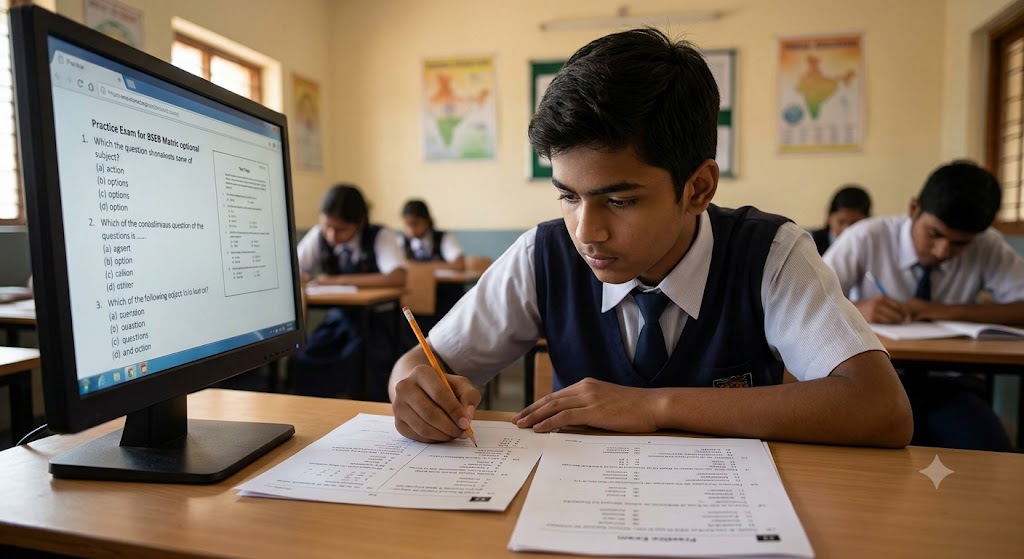
Additional Information
What the Course Entails and Exam Details
As optional subjects are incredibly diverse, the specific curriculum and course content vary significantly for each choice. However, the overreaching goal of each optional subject course is to provide in-depth knowledge or practical competence in a particular field. The syllabus for each subject is defined by the Bihar School Examination Board (BSEB).
For academic subjects like Advanced Mathematics or optional languages (e.g., Sanskrit, Urdu, Arabic), the course will cover advanced concepts, literature, and grammatical rules specific to that field. Vocational subjects like IT-ITES, Healthcare, Electrical Technology, or Trade & Commerce will focus heavily on practical application, industry knowledge, and often include hands-on training components alongside theoretical learning. Creative subjects like Fine Arts (Music, Dance, Painting) develop aesthetic understanding, historical context, and practical performance/creation skills.
Students select their optional subjects based on interests, aptitude, or future educational/career aspirations. Detailed specific syllabuses for all BSEB Matric subjects, including optionals, are typically available on the official BSEB website.
What to Expect in the Final Exam
While the exact structure will depend on the chosen subject, here is a general overview of what students can typically expect in a BSEB Matric Optional Exam:
Exam Format: Most BSEB Matric optional exams are written, paper-based tests conducted in a specified examination hall.
Question Types: Exams typically feature a mix of question formats, including:
Multiple Choice Questions (MCQs): Assessing basic knowledge, definition recall, and quick application.
Short Answer Questions: Requiring brief explanations, definitions, or calculations.
Long Answer/Essay Questions: Demanding in-depth explanations, analysis, or performance/creative writing for appropriate subjects.
Practical Components (if applicable): For vocational or performance-based optional subjects (like Music, Dance, Science with practicals), a separate practical examination is often conducted to assess hand-on skills or performance abilities.
Passing Score: To clear the BSEB Matric examination overall and the specific optional subject, students are generally required to secure a minimum passing percentage (typically around 30-33%) as per board regulations, which might differ slightly depending on overall assessment models.
Time Limit: Written exams for each subject typically last for 3 hours. Practical exam durations will vary by subject.
Specific Rules: Students must follow all standard BSEB examination rules regarding hall tickets, prohibited items, and exam integrity.
How to Study and Exam Centers
Effective preparation for BSEB Matric Optional Exams involves several key strategies:
Understand the Syllabus Thoroughly: Download and carefully review the official BSEB syllabus for your chosen optional subject. Ensure you understand all the topics, weightages, and the exam pattern.
Utilize Textbooks & Resources: Rely primary on the prescribed BSEB textbooks and recommended learning materials. Supplemental study guides or reputable online resources, including those focused on Indian education systems, can provide additional clarity and practice.
Regular Practice & Practice Tests: This is crucial. Dedicate consistent time each day or week to study and practice solving questions. Actively seek out and take full-length BSEB Matric Optional Practice Exams under simulated test conditions. This helps with time management, familiarity with the exam format, and identifying weak areas. Analyze your performance in these practice tests to focus your study efforts.
Focus on Concepts & Application: Don't just memorize; understand the underlying concepts, especially in analytical or practical subjects. Practice applying these concepts through solving problems or, where relevant, practicing the required skills.
Seek Clarification: If you have difficulties understanding a topic, don't hesitate to ask your teachers, subject experts, or utilize online educational forums tailored to Indian students.
Review Past Exam Papers: Analyze previous years' BSEB question papers (if available for optional subjects) to understand recurring themes and popular question types.
Exam Centers: The final BSEB Matriculation examinations, including optional subject tests, are conducted at designated examination centers primarily in physical schools across Bihar. Students will be assigned a specific center and will need to travel there to take their written exams. Details regarding the exact center will be provided on the student’s admit card issued by the BSEB. Practical exams are often held in the student's respective school, but this can also vary, and specific instructions will be provided.
Job Opportunities from the Course
While a BSEB Matriculation is an essential foundation rather than a terminal qualification for specific high-level careers, choosing strong or relevant optional subjects can pave the way towards future educational and career paths in specific fields. Here is a list showing generic potential job directions and fields that students can progress towards, with further education or vocational training, linked conceptually to common optional subject areas:
Advanced Mathematics / Science optionals: Leads towards further studies in engineering, technology, medicine, science research, and related fields.
Languages / Arts optionals: Progression to studies in literature, linguistics, journalism, teaching, fine arts, design, media, and communication.
Vocational Optionals (e.g., IT, Healthcare, Technology, Commerce): Direct progression into specialized vocational training (ITI, diploma courses) for skilled trades, IT support roles, healthcare assistant roles, administrative positions in commerce/finance, and entry-level positions in various technical or service sectors.
Home Science: Foundation for further studies/careers in nutrition, child development, interior design, hospitality, and related fields.
Physical Education: Studies in sports science, physical therapy, coaching, and potential athletic careers.
Frequently Asked Questions
Reviews
5.0
Based on 0 reviews
Leave a Review
No reviews yet. Be the first to review!