
BSEAP SSC Practice Test & Exam Prep | India
$69.00
- Buy to unlock unlimited access to all Quiz questions.
- After purchase you can print a PDF of the whole quiz at any point. The PDF will contain the questions and the correct answers.
About this Exam
The Board of Secondary Education, Andhra Pradesh (BSEAP), administers the Secondary School Certificate (SSC) examination, a momentous academic milestone for students completing their tenth grade within the state board curriculum in Andhra Pradesh, India.
This examination is designed for students enrolled in affiliated schools across the state, marking the culmination of their primary and secondary education journey.
Passing this rigorous test is the indispensable gateway to all forms of higher education in India, including Intermediate studies (Class 11 & 12), vocational courses, and various polytechnic diplomas.
A strong performance in the BSEAP SSC exam serves as a prestigious foundation stone for a student's entire professional future.
Ready to test your knowledge?
Buy Now to Access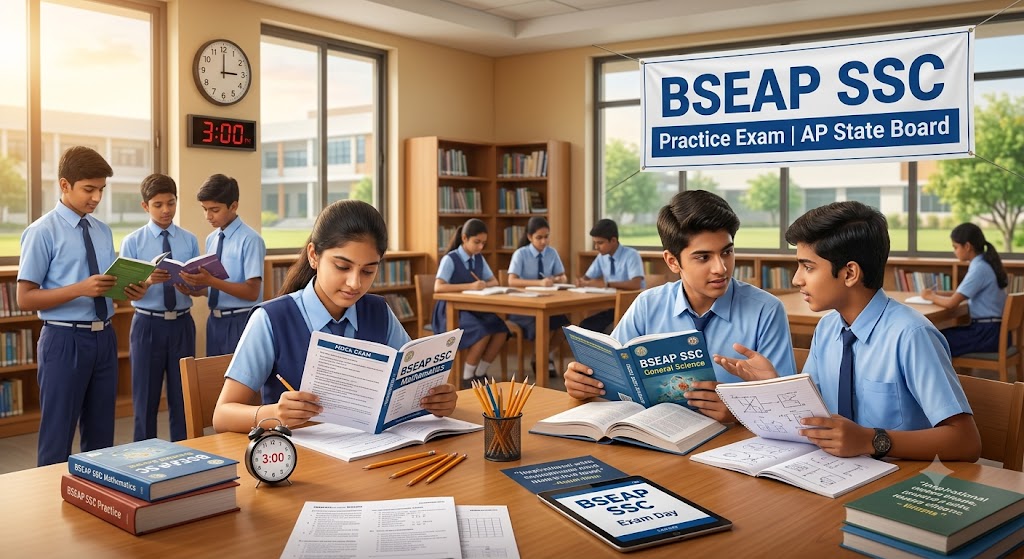
Additional Information
What the Course Entails and Exam Details
The BSEAP SSC exam is not a single course but a comprehensive assessment of the entire standard Class 10 syllabus prescribed by the Andhra Pradesh state government.
The core subjects that every candidate must prepare for typically encompass six distinct areas.
These areas include First Language (such as Telugu, Hindi, or Urdu), Second Language (usually Hindi or English), Third Language (English), Mathematics, General Science (split into Physical Science and Biological Science), and Social Studies.
For subjects like English and Mathematics, the syllabus is extensive, focusing on reading comprehension, grammar, composition, and literature, or algebra, geometry, trigonometry, and statistics respectively.
The exam details are crucial: it is a pen-and-paper, offline examination conducted simultaneously across hundreds of authorized centers in Andhra Pradesh.
The total duration and marking scheme are standardized by the board to ensure fairness and consistency for all students.
What to Expect in the Final Exam
The final BSEAP SSC examination is a standardized, written assessment that typically takes place in physical exam halls over a period of two to three weeks.
Each subject's exam is a dedicated session, with a standard time limit, often around 3 hours, allowing students ample time to read the paper and answer the questions.
The paper format consists of a blend of objective and subjective question types, ensuring a holistic assessment.
Students can expect to encounter Multiple Choice Questions (MCQs), Very Short Answer questions, Short Answer questions, and Long Answer/Descriptive questions that require critical thinking and detailed explanation.
To achieve a passing grade, a student must secure a minimum percentage, generally 35%, in each individual subject to be declared as 'passed' overall.
Strict invigilation and board rules, including protocols for hall tickets, prohibited items, and conduct within the hall, are enforced to maintain the integrity of the examination.
How to Study and Exam Centers
Actionable study strategies are paramount for success.
Begin your preparation by thoroughly understanding the official BSEAP syllabus and prioritizing the primary state board textbooks as your foundation.
Create a structured study timetable that allocates specific hours to each subject, balancing weaker areas with your strengths.
Consistency is key; regular, dedicated study sessions are far more effective than last-minute cramming.
One of the most effective techniques is practicing with previous years’ BSEAP SSC question papers and taking timed mock/practice tests.
This familiarizes you with the question patterns, marking schemes, and, crucially, improves your time management skills under exam conditions.
Regarding logistical details, the final BSEAP SSC exams are held at physical, board-authorized examination centers located within schools across every district in Andhra Pradesh.
The exact examination center for each student is allocated by the board and is clearly stated on the Hall Ticket, which is an indispensable document for entry into the exam hall.
Job Opportunities from the Course
While the primary value of the BSEAP SSC certificate is educational advancement, it also unlocks a surprising number of immediate career paths and entry-level positions.
A passed Class 10 certificate is the minimum educational qualification required for many vital government and private sector roles across India.
Clerical Assistant/Lower Division Clerk (LDC) in various state government departments.
Multi-Tasking Staff (MTS) in Central Government organizations and defense sectors.
Gramin Dak Sevak (GDS) or Postman positions within the India Post department.
Police Constable and equivalent positions in the state police forces.
Entry-level positions within the Indian Army, Navy, and Air Force as non-commissioned officers or technical trade roles.
Jobs in the manufacturing and service sectors such as machine operator, delivery associate, or data entry operator.
A passed Class 10 certificate is often required for apprenticeship training in numerous trades, bridging the gap to technical vocational careers.
This certification is truly the essential first step toward a vast landscape of opportunity in both higher education and the workforce.
Frequently Asked Questions
Reviews
5.0
Based on 0 reviews
Leave a Review
No reviews yet. Be the first to review!