
BSE Odisha Madhyama Practice Test & Exam Prep | India
$69.00
- Buy to unlock unlimited access to all Quiz questions.
- After purchase you can print a PDF of the whole quiz at any point. The PDF will contain the questions and the correct answers.
About this Exam
The BSE Odisha Madhyama Examination is the secondary level board examination conducted by the Board of Secondary Education (BSE), Odisha, specifically for students enrolled in traditional Sanskrit tolls (schools) across the state. Equivalent to the High School Certificate (HSC) or Class 10 examination, the Madhyama qualification is crucial for students pursuing classical Sanskrit education alongside modern subjects.
This exam is designed for students who have completed their secondary education curriculum within the specialized environment of Sanskrit tolls, validating their academic achievements and proficiency in both traditional Sanskrit texts and core modern disciplines.
Ready to test your knowledge?
Buy Now to Access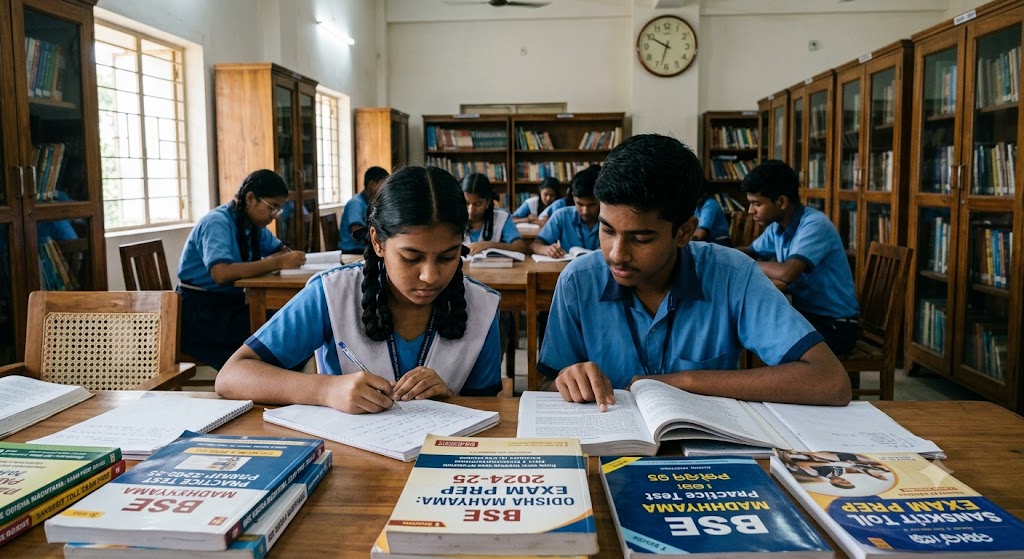
Additional Information
What the Course Entails and Exam Details
The Madhyama curriculum offers a unique blend of traditional and modern subjects. The core focus remains on Sanskrit language and literature, encompassing Vedic studies, grammar (Vyakarana), classical literature (Kavya), and darsana (philosophy). Students develop a strong foundation in reading, writing, and interpreting Sanskrit texts.
In addition to deep Sanskrit studies, the course also entails compulsory modern subjects essential for a well-rounded secondary education. This includes Odia (as the regional language), English, Mathematics, General Science, and Social Science (History, Civics, Geography). The syllabus for these modern subjects is aligned with the standards set by the BSE Odisha for secondary education.
What to Expect in the Final Exam
The final BSE Odisha Madhyama examination is typically conducted in a pen-and-paper format. The exam structure includes multiple question types, primarily consisting of subjective long-answer questions, short-answer questions, and objective-type questions.
The examination assesses students across several papers, covering both the Sanskrit subjects (like Veda, Vyakarana, Sahitya) and the modern subjects (Odia, English, Math, Science, Social Science). Each paper usually carries 100 marks, and the duration is typically 2.5 to 3 hours.
Students must secure a minimum passing percentage (usually 33%) in each subject, as well as an overall aggregate score, to successfully clear the Madhyama exam.
How to Study and Exam Centers
Consistent practice and a thorough understanding of the syllabus are key to succeeding in the Madhyama exam. Prioritize practicing with BSE Odisha Madhyama practice tests and previous year question papers. This helps familiarize you with the exam format, question types, and effective time management strategies.
Develop a structured study timetable that allocates sufficient time to both traditional Sanskrit subjects and modern disciplines. Focus on strengthening your foundation in Sanskrit grammar and literature while ensuring consistent revision of key concepts in Mathematics and Science. Group study with peers from your toll can also be beneficial for discussing complex topics in Sanskrit philosophy and literature.
The BSE Odisha Madhyama exams are conducted annually. They are held at designated physical examination centers across Odisha. These centers are typically established within recognized high schools or authorized educational institutions. Students will receive information regarding their specific exam center and schedule through their respective Sanskrit tolls and on their official admit cards issued by the BSE Odisha.
Job Opportunities from the Course
Successfully completing the BSE Odisha Madhyama exam opens up various academic and professional pathways for students. While many choose to pursue further studies, the qualification itself is recognized for entry-level opportunities.
Job titles and career paths available include:
Pursuing Higher Secondary Education (+2) in Arts, Science, or Commerce streams.
Enrolling in specialized higher education courses focused on Sanskrit studies (e.g., Shastri, Acharya).
Teacher training programs (like C.T. or D.El.Ed) after completing higher secondary education.
Entry-level positions in the Odisha state government that require a Class 10 qualification.
Clerical roles in various public and private sector organizations within Odisha.
Working as a Sanskrit teacher or tutor (often requires further qualification or specialization).
Opportunities within religious and cultural institutions requiring knowledge of Sanskrit texts and traditions.
Frequently Asked Questions
Reviews
5.0
Based on 0 reviews
Leave a Review
No reviews yet. Be the first to review!