
BLS PreTest Questions and Answers 2026
$69.00
- Buy to unlock unlimited access to all Quiz questions.
- After purchase you can print a PDF of the whole quiz at any point. The PDF will contain the questions and the correct answers.
About this Exam
The Basic Life Support (BLS) certification is a foundational credential for healthcare professionals and emergency responders. This course is meticulously designed to provide the essential knowledge and hands-on skills needed to recognize and effectively respond to life-threatening emergencies. The BLS PreTest is your critical first step, allowing you to gauge your readiness and identify key areas for focused study before attempting the official certification exam. It is an invaluable tool for anyone entering, or currently working in, the healthcare field, including nurses, doctors, EMTs, and paramedics, as well as allied health professionals.
Ready to test your knowledge?
Buy Now to Access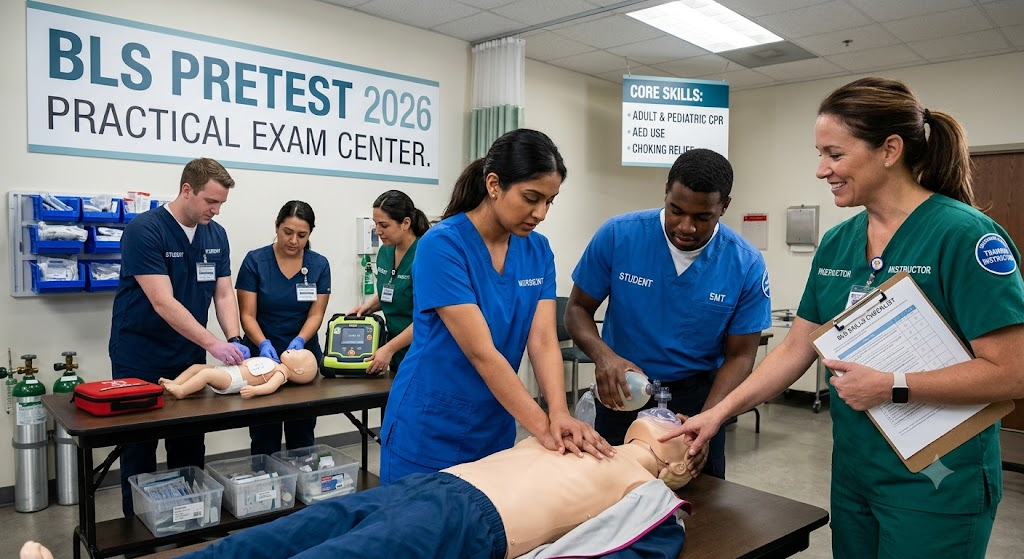
Additional Information
What the Course Entails and Exam Details
The comprehensive BLS coursework and the corresponding pretest questions and answers for 2026 focus on high-quality cardiopulmonary resuscitation (CPR) and cardiovascular care algorithms. Key topics include:
The American Heart Association (AHA) Guidelines for CPR and Emergency Cardiovascular Care (ECC).
The Chain of Survival for both in-hospital and out-of-hospital provider scenarios.
Performing high-quality CPR for adults, children, and infants, including both single-rescuer and multi-rescuer techniques.
The critical differences between adult, child, and infant rescue techniques.
Effective ventilation using a barrier device and bag-mask device.
The proper and safe operation of an Automated External Defibrillator (AED).
Relief of foreign-body airway obstruction (choking) for all age groups.
Special considerations, including team dynamics and opioid-associated life-threatening emergencies.
The pretest mirrors the actual exam, covering these core topics through scenario-based questions to ensure practical application of knowledge.
What to Expect in the Final Exam
While the BLS PreTest focuses on theoretical knowledge, the final, official BLS certification process consists of two primary components: a cognitive (written) exam and a psychomotor (practical) skills test.
The written portion typically includes 25 to 50 multiple-choice questions that assess your understanding of the core concepts, algorithms, and guidelines. You are usually required to achieve a passing score of at least 84% to move forward. The time limit for this section is generally ample, often around 60 to 90 minutes.
The practical skills check is an equally vital part of the final exam. Under the direct supervision of a certified instructor, you must demonstrate proficiency in essential skills, such as performing high-quality compressions, delivering effective breaths, using a bag-mask, and operating an AED on a manikin. Success in both portions is required for official certification.
How to Study and Exam Centers
Effective preparation for the BLS exam involves a combination of theoretical study and practical practice. Utilize the official AHA provider manual and review the BLS algorithms repeatedly. Maximize your readiness by taking multiple practice exams, such as the BLS PreTest Questions and Answers 2026, to become familiar with the question format and identify weaknesses.
For official certification, you must enroll in a course. The cognitive portion is often available via online portals as a blended learning option. This is paired with a scheduled in-person practical skills session.
Authorized training centers are the only locations where you can complete your skills check and receive your certification card. These locations include dedicated medical training schools, hospitals, community colleges, and authorized physical testing centers. You can find authorized providers near you directly through the American Heart Association or other reputable certification bodies like the Red Cross.
Job Opportunities from the Course
Earning a BLS certification is a fundamental requirement for numerous career paths in the medical and emergency services sectors. This credential is your key to unlocking a wide range of job opportunities, including:
Certified Nursing Assistant (CNA)
Medical Assistant
Patient Care Technician
Emergency Medical Technician (EMT)
Paramedic
Dental Assistant
Registered Nurse (RN) and Licensed Practical Nurse (LPN)
Respiratory Therapist
Physician Assistant (PA)
Lifeguard
Physical Therapist
Phlebotomist
Home Health Aide
Healthcare Facility Security Staff
Having a current BLS certification demonstrates to employers that you possess the vital, life-saving skills necessary for a critical, high-performance environment. Good luck with your studies!
Frequently Asked Questions
Reviews
5.0
Based on 0 reviews
Leave a Review
No reviews yet. Be the first to review!