
BLS Pretest Chapter 7 AED for Airway Management Qui
$69.00
- Buy to unlock unlimited access to all Quiz questions.
- After purchase you can print a PDF of the whole quiz at any point. The PDF will contain the questions and the correct answers.
About this Exam
The Basic Life Support (BLS) certification is a vital credential for healthcare professionals and public safety personnel. This practice exam is specifically designed to help you prepare for the Chapter 7 assessment, focusing on the critical integration of an Automated External Defibrillator (AED) and advanced airway management during a resuscitation event.
Designed for individuals in medicine, nursing, EMS, and other healthcare roles, this practice test will refine your knowledge and confidence before the final exam. Mastering these skills is essential for improving patient outcomes in cardiac arrest scenarios where airway obstruction is also present.
Ready to test your knowledge?
Buy Now to Access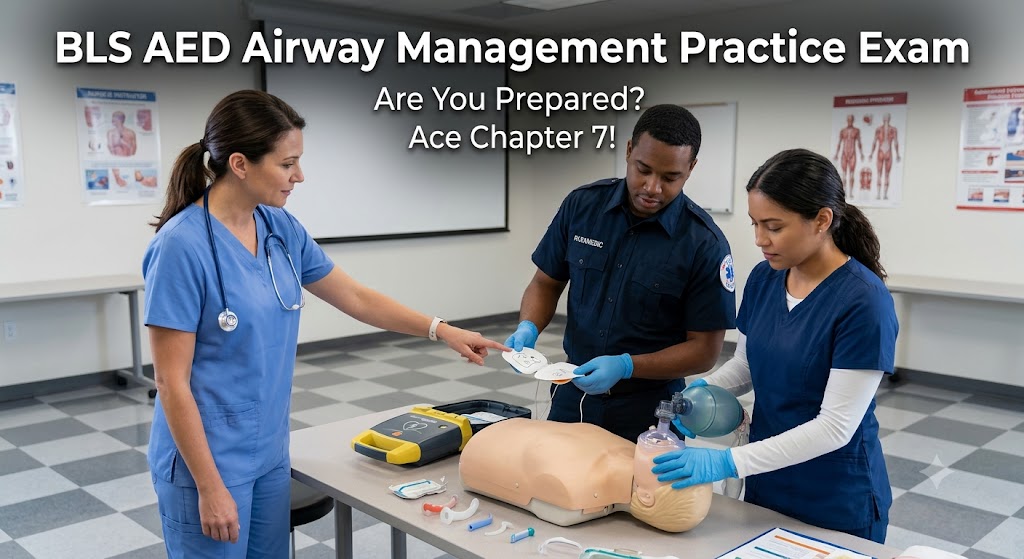
Additional Information
What the Course Entails and Exam Details
This section of the BLS curriculum covers the synchronized approach required when managing both a potential cardiac rhythm that needs defibrillation and an obstructed or challenging airway. The primary topics included are:
Recognizing the signs of cardiac arrest and a simultaneous airway obstruction.
Correct placement and safe operation of an AED on a simulated patient.
Integrating basic and advanced airway management techniques (like using a bag-valve-mask or inserting an adjunct) while minimizing interruptions to chest compressions and AED analysis.
The appropriate timing and sequence of AED prompts, rhythm analysis, shock delivery, and resumption of CPR with a focus on high-quality ventilation.
This pretest mirrors these topics to ensure comprehensive review and skill reinforcement.
What to Expect in the Final Exam
The full BLS final exam is usually a two-part process consisting of a cognitive written test and a practical skills evaluation. This pretest addresses the cognitive portion related to AED use for patients with airway management considerations.
On the official exam, the cognitive section typically consists of multiple-choice questions with a required passing score (often 84% or higher, depending on the specific provider). You can expect limited time, emphasizing the need for quick, accurate decision-making. The practical skills test will require you to demonstrate correct AED application, safe operation, and effective integration of ventilation and compressions on a CPR manikin under observation.
How to Study and Exam Centers
Effective preparation is key. Leverage official BLS provider manuals and textbooks. Utilize reputable online practice exams, like this one, to simulate the test-taking experience, identify weak points, and learn from detailed explanations of correct answers. Form a study group to practice hands-on skills together with a feedback loop. Rehearsing the practical procedures on a CPR manikin is strongly recommended.
When you are ready to take the official exam, you can find local training centers and authorized providers (such as the American Heart Association or American Red Cross) through their national websites. Many organizations offer hybrid courses with an online cognitive component and an in-person, hands-on skills session at their designated facilities. Physical test centers and affiliated schools are widespread, making it easy to schedule your certification.
Job Opportunities from the Course
A current BLS certification, including proficiency in AED use and airway management, is mandatory or highly preferred for a wide variety of job roles across many industries:
Registered Nurse (RN) and Licensed Practical Nurse (LPN)
Emergency Medical Technician (EMT) and Paramedic
Physical Therapist and Occupational Therapist
Physician and Physician Assistant
Respiratory Therapist
Dental Hygienist and Dentist
Police Officer, Firefighter, and Security Personnel
Life Guards, Flight Attendants, and Childcare Providers
This credential opens doors and proves your readiness to respond effectively in life-threatening situations.
Frequently Asked Questions
Reviews
5.0
Based on 0 reviews
Leave a Review
No reviews yet. Be the first to review!