
BLS Pretest Chapter 4 BLS for Children Quiz Questions Answer
$69.00
- Buy to unlock unlimited access to all Quiz questions.
- After purchase you can print a PDF of the whole quiz at any point. The PDF will contain the questions and the correct answers.
About this Exam
The Basic Life Support (BLS) certification is a vital credential for healthcare professionals and public safety personnel, equipping them with the essential skills to save lives in life-threatening situations. Designed for doctors, nurses, EMTs, lifeguards, and other rescuers, this course provides a comprehensive foundation in life-saving techniques for adults, children, and infants, focusing on quick recognition and effective intervention for cardiac arrest, choking, and respiratory arrest. Successfully completing the BLS exam demonstrates proficiency in high-quality CPR and the use of automated external defibrillators (AEDs), enabling individuals to act decisively and confidently as part of a resuscitation team or as a single rescuer.
Ready to test your knowledge?
Buy Now to Access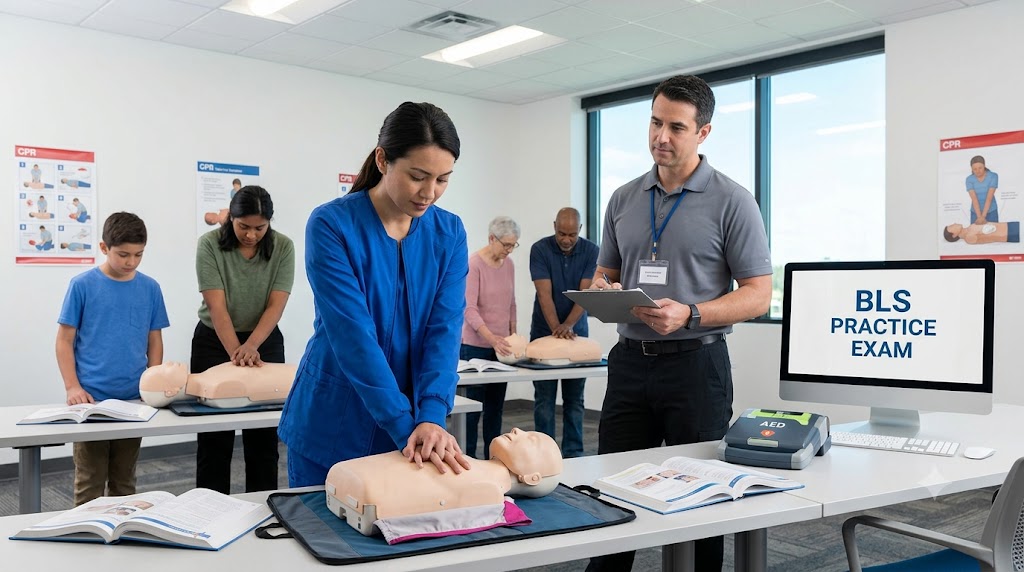
Additional Information
What the Course Entails and Exam Details
A standard BLS course, such as those offered by the American Heart Association (AHA) or the Red Cross, is typically a hands-on, instructor-led or blended learning experience that takes around 4-5 hours to complete. The curriculum is extensive, covering key life-saving procedures for victims of all ages.
Core topics include:
Recognizing the signs of cardiac arrest and activating the emergency response system.
Performing high-quality chest compressions and rescue breaths for adults, children, and infants.
Demonstrating proficiency with single-rescuer and multi-rescuer resuscitation techniques.
Understanding and operating an automated external defibrillator (AED) in various scenarios.
Effectively relieving choking (foreign body airway obstruction) in conscious and unconscious individuals.
Team dynamics and effective communication during resuscitation attempts.
Scene safety and assessment.
Special considerations such as opioid-associated emergencies.
Specifically for children and infants, the course emphasizes modifications in technique, compression depth, and ventilation compared to adults, reflecting their unique physiological needs. Chapter 4 (as mentioned in your original idea) would typically detail these child-specific guidelines, focusing on techniques for rescuers to handle pediatric emergencies with confidence and precision. Success in the course is measured through both a multiple-choice written exam and a hands-on skills test, ensuring a complete grasp of both knowledge and practical application.
What to Expect in the Final Exam
The final BLS assessment consists of two distinct components that candidates must successfully complete to achieve certification.
1. The Written Exam: This part typically involves 25-50 multiple-choice questions that evaluate your understanding of the core concepts, protocols, and best practices. It covers all aspects of BLS, from adult and pediatric life support to AED usage and choking relief. You will likely need to recall compression-to-ventilation ratios, identify standard practices for different age groups, and make correct decisions in real-world scenarios. A passing score is generally around 84% or higher, and the time limit is usually set at approximately one hour.
2. The Skills Session (Hands-on): This practical test requires you to demonstrate your proficiency in the critical skills covered in the course. Under the direct observation of a certified instructor, you will be required to perform high-quality CPR (both compressions and rescue breaths) on adult, child, and sometimes infant manikins, accurately and with proper technique. You will also need to effectively demonstrate the safe and correct use of an AED in a controlled environment. Your instructor will evaluate your performance based on pre-defined criteria, such as compression depth and rate, hand placement, and effective teamwork.
How to Study and Exam Centers
Preparation is key to succeeding in the BLS exam, and several effective strategies can help you feel confident and ready on test day.
Actionable Study Strategies:
Read the Textbook: Thoroughly study the provided course material and textbooks, focusing on key concepts, algorithms, and treatment protocols.
Take Practice Tests: Actively engage with multiple practice quizzes and exams. Many online platforms offer free or paid BLS practice exams that simulate the structure and difficulty of the actual test, helping you identify areas for improvement.
Review Instructional Videos: Watch high-quality demonstration videos to reinforce your visual understanding of correct CPR techniques and AED operation.
Practice Hands-on Skills: While limited in some online-only study formats, whenever possible, practice compressions, breaths, and AED steps on a manikin. Attend skill practice sessions if your course offers them. Understanding the feel of proper technique is crucial.
Focus on Key Ratios: Memorize critical numbers, such as compression-to-ventilation ratios (e.g., 30:2 for adults and most multi-rescuer pediatric scenarios) and compression depth guidelines for different age groups.
Study in Groups: Collaborating with classmates can provide diverse perspectives and help reinforce learning through discussion.
Where and How to Take the Exam:
Authorized Training Centers: The most common way is to enroll in an in-person or hybrid course at an authorized training center, often located at hospitals, community colleges, fire stations, or dedicated medical training facilities. These centers conduct both the instruction and the practical skills session and written exam.
Major Organizations: Locate courses through well-known providers like the American Heart Association (AHA) or the American Red Cross using their official online course finders. These organizations have networks of authorized instructors and centers across the country.
Workplace Training: Many employers, especially in healthcare, provide BLS training for their staff on-site.
Fully Online Options (Limited): Be cautious with fully online courses, as most comprehensive BLS certifications that are widely accepted by employers require an in-person hands-on skills session. Make sure any program you choose meets the requirements of your specific employer or licensing board.
Job Opportunities from the Course
A current BLS certification opens doors to a wide range of rewarding career paths in healthcare and public safety. This credential is often mandatory for various positions, demonstrating a commitment to safety and the ability to act effectively in emergencies.
Registered Nurse (RN)
Licensed Practical Nurse (LPN/LVN)
Emergency Medical Technician (EMT)
Paramedic
Certified Nursing Assistant (CNA)
Medical Assistant
Dental Hygienist
Dentist
Physician Assistant (PA)
Physical Therapist
Occupational Therapist
Respiratory Therapist
Surgical Technologist
Lifeguard
Flight Attendant
Security Guard
Firefighter
Childcare Provider
Fitness Instructor
Teacher (especially in schools with specific requirements)
Workplace Safety Coordinator
Frequently Asked Questions
Reviews
5.0
Based on 0 reviews
Leave a Review
No reviews yet. Be the first to review!