
BLS Pretest Chapter 3 Use of Automated External Defibrillator
$69.00
- Buy to unlock unlimited access to all Quiz questions.
- After purchase you can print a PDF of the whole quiz at any point. The PDF will contain the questions and the correct answers.
About this Exam
Basic Life Support (BLS) certification equips healthcare professionals and other individuals with essential skills to respond effectively in life-threatening emergencies.
A key component of BLS training is understanding and proficiently using an Automated External Defibrillator (AED).
These portable devices can dramatically improve survival rates for victims of sudden cardiac arrest.
The BLS course is designed for nurses, doctors, paramedics, emergency medical technicians, firefighters, police officers, and other individuals who require a certification that meets certain job requirements or for personal readiness in emergencies.
Mastering AED use is a critical skill set in saving lives.
Ready to test your knowledge?
Buy Now to Access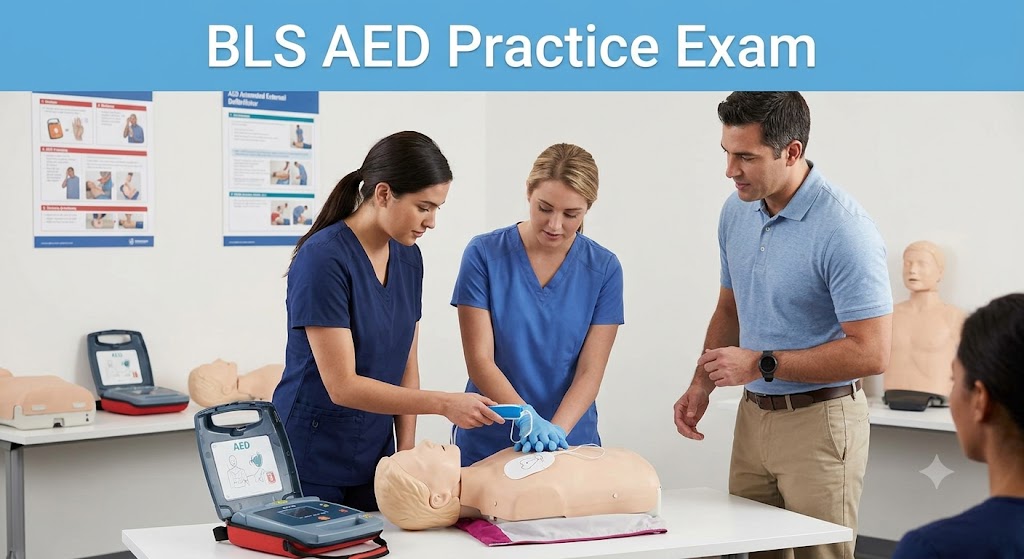
Additional Information
What the Course Entails and Exam Details
The comprehensive BLS course covers fundamental life-saving techniques, focusing heavily on modern resuscitation standards.
Participants learn critical steps such as immediate recognition of cardiac arrest, rapid response activation, high-quality cardiopulmonary resuscitation (CPR) for adults, children, and infants, and effective team dynamics during a resuscitation attempt.
A significant portion of the syllabus is dedicated specifically to the correct use of an Automated External Defibrillator.
This includes proper pad placement for adults and children, understanding the prompts provided by the machine, safety considerations, and coordinating AED use with ongoing CPR.
This practice exam specifically tests knowledge related to Chapter 3, covering the intricacies of AED operations and protocols.
What to Expect in the Final Exam
The final BLS certification exam typically consists of both a cognitive evaluation and a practical skills test.
The cognitive component is often a written multiple-choice exam assessing theoretical knowledge of BLS guidelines and algorithms, including scenarios testing judgement and sequence, which frequently involve AED usage.
A passing score, often around 84%, is required to successfully complete this section.
Students generally have a set time limit to complete the written test.
The practical skills evaluation involves demonstrating proficiency in CPR techniques and the proper, seamless use of an AED on a manikin, often in a team context.
Candidates are assessed on their ability to perform high-quality compressions, rescue breaths, and correctly operate the AED according to safety protocols.
How to Study and Exam Centers
Effective preparation for the BLS exam, especially regarding the AED component, requires a combination of reviewing official materials and hands-on practice.
Reviewing the designated BLS manual or course textbooks thoroughly is essential.
Watching official training videos that demonstrate correct CPR techniques and AED implementation can reinforce the cognitive and visual learning.
Taking practice exams, such as this BLS AED Practice Exam focusing on the AED specific chapter, can help identify areas that need more attention and get you comfortable with the type of questions asked.
Additionally, enrolling in a practical skills training session is crucial, allowing for supervised practice with feedback using feedback devices and trainer AED units.
Authorized training centers often offer these courses and administer exams.
You can locate accredited providers through organizations like the American Heart Association (AHA) or the Red Cross.
Many hospitals, community colleges, and vocational schools serve as authorized training and testing sites.
Some portions of the written exam might be available online through official portals, but the hands-on skills test typically must be completed in person at an authorized location.
Job Opportunities from the Course
Obtaining Basic Life Support certification is a mandatory requirement for numerous positions across healthcare and public safety.
Some common career paths where this certification is essential include:
Nurses (Registered Nurses, Licensed Practical Nurses)
Emergency Medical Technicians (EMTs)
Paramedics
Firefighters
Police Officers
Physicians and Physicians Assistants
Respiratory Therapists
Lifeguards
Medical Assistants
Certified Nursing Assistants (CNAs)
Physical Therapists
Occupational Therapists
Dental Professionals
Security Personnel
Frequently Asked Questions
Reviews
5.0
Based on 0 reviews
Leave a Review
No reviews yet. Be the first to review!