
AWHONN Fetal Monitoring Practice Test
$69.00
- Buy to unlock unlimited access to all Quiz questions.
- After purchase you can print a PDF of the whole quiz at any point. The PDF will contain the questions and the correct answers.
About this Exam
The Association of Women's Health, Obstetric and Neonatal Nurses (AWHONN) Fetal Monitoring Program is the gold standard for perinatal education in the United States. This exam is not a single certification, but rather a critical validation component of AWHONN’s highly respected Perinatal Continuing Education Program (PCEP) and the Intermediate and Advanced Fetal Heart Monitoring Workshops.
This program is specifically designed for registered nurses (RNs), physicians, and other healthcare professionals working in labor and delivery, antepartum testing, and neonatal intensive care units. It assesses a clinician's competency in interpreting fetal heart rate patterns, understanding uterine activity, and implementing appropriate clinical interventions. Passing the AWHONN Fetal Monitoring Exam demonstrates a mastery of essential, evidence-based knowledge required to ensure the safety of both mother and baby during childbirth.
Ready to test your knowledge?
Buy Now to Access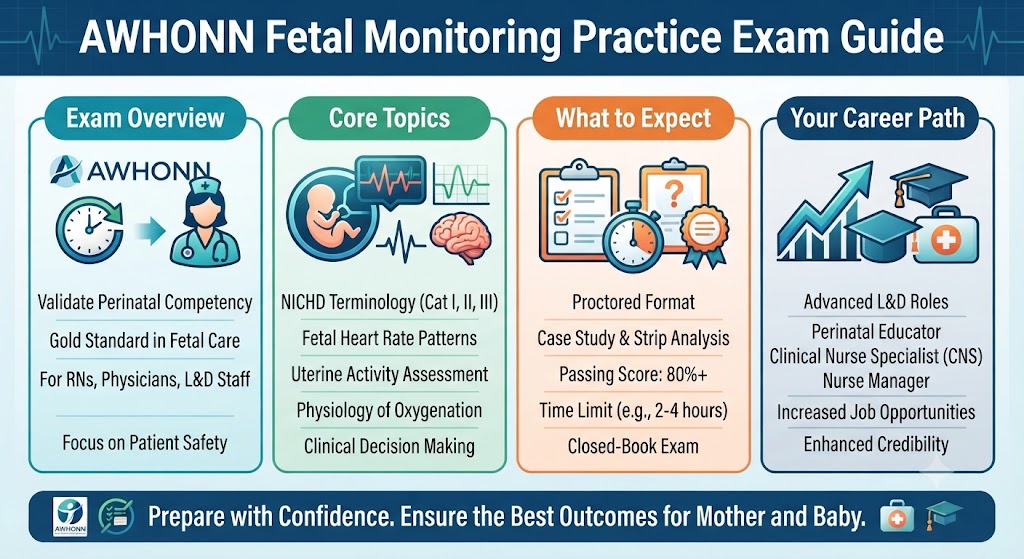
Additional Information
What the Course Entails and Exam Details
The AWHONN Fetal Monitoring curriculum is comprehensive and
structured to build upon existing knowledge. The course material—typically
covered in a workshop format prior to the exam—delves deeply into the
physiology of fetal oxygenation, placental function, and the pathophysiology of
complications.
Key topics covered in the course and tested on the exam
include:
- Standardized
Terminology: Mastery of the NICHD (National Institute of Child Health
and Human Development) three-tier fetal heart rate interpretation system
(Category I, II, and III).
- Fetal
Heart Rate Patterns: Detailed analysis of baseline rate, variability,
accelerations, and decelerations (early, late, variable, and prolonged).
- Uterine
Activity Assessment: Evaluation of contraction frequency, duration,
intensity, and resting tone, including the identification of tachysystole.
- Clinical
Decision Making: Application of the AWHONN "Fetal Heart
Monitoring Principles and Practices," focusing on appropriate
physiological responses to specific fetal heart rate patterns (e.g.,
intrauterine resuscitation measures).
- Legal
and Documentation Standards: Understanding the nurse's role in
accurate documentation, communication with the healthcare team, and
adhering to AWHONN’s professional standards of practice.
What to Expect in
the Final Exam
The AWHONN Fetal Monitoring Exam is a rigorous, standardized
assessment. While the specific format can vary slightly depending on whether
you are taking the Intermediate or Advanced course, the core components remain
consistent.
The exam is typically administered electronically, either
immediately following an in-person workshop or via an online portal for blended
learning formats. It consists of a series of multiple-choice questions, often
requiring the analysis of real-world case studies and fetal monitor tracings.
- Format:
Proctored multiple-choice exam, often utilizing case scenarios with linked
strips.
- Number
of Questions: This can vary, but exams generally contain between 75
and 150 questions.
- Time
Limit: You are typically allotted 2 to 4 hours to complete the exam,
which is sufficient for careful review of the questions and strips.
- Passing
Score: The required passing score is high, usually 80% or greater,
reflecting the critical nature of the material.
- Rules
and Regulations: The exam is closed-book. You will not be allowed to
use notes, textbooks, or outside resources. In a workshop setting,
proctors will strictly monitor the testing environment.
How to Study and
Exam Centers
Success on the AWHONN Fetal Monitoring Exam requires
dedicated preparation. Relying solely on the workshop lectures is often
insufficient.
Actionable Study Strategies:
- Master
the Textbook: Thoroughly read the required AWHONN textbook (often Fetal
Heart Monitoring: Principles and Practices). Pay close attention to
the charts, definitions, and case examples.
- Practice
with Strips: This is the most critical study method. Utilize the
practice modules provided by AWHONN. Review hundreds of fetal monitor
strips, categorize them (I, II, or III), and practice identifying the
physiological cause of each pattern.
- Understand
the Physiology: Don't just memorize patterns; understand why
they occur. Focus on how maternal conditions (hypotension, fever) and
fetal conditions (cord compression, hypoxia) affect the heart rate.
- Join
Study Groups: Discussing complex strips and case studies with
colleagues can reveal gaps in your knowledge and reinforce key concepts.
- Utilize
the AWHONN Online Resources: Access any additional practice quizzes or
resources available through your AWHONN learning portal.
Where and How to Take the Exam:
The AWHONN Fetal Monitoring Exam is not taken at generic
testing centers like Pearson VUE. It is exclusively administered through
AWHONN-approved channels.
- In-Person
Workshops: Most commonly, the exam is taken on-site at the conclusion
of a live, two-day AWHONN Intermediate or Advanced Workshop hosted by a
hospital or educational facility.
- Blended
Learning: If your facility uses the AWHONN online blended learning
program, you will complete the coursework online and then take the final
proctored exam either online (using a secure proctoring service) or at a
designated testing location within your hospital (often the education
department).
Job Opportunities from the Course
Holding a current AWHONN Fetal Monitoring Certification is a
powerful credential that validates your expertise and opens doors to advanced
roles in perinatal nursing. This certification is often a requirement for
experienced nurses and is highly valued by employers across the United States.
Specific Job Titles and Career Paths:
- Labor
and Delivery (L&D) Staff Nurse (Intermediate/Advanced Level):
Demonstrates competency to care for high-risk patients and interpret
complex fetal monitoring strips.
- Antepartum
Nurse: Validates skills in monitoring fetal well-being in high-risk
pregnancies.
- Perinatal
Clinical Nurse Specialist (CNS): An advanced practice role focused on
educating staff, developing protocols, and improving patient outcomes.
- Nurse
Manager/Director (Maternal-Child Health): Provides essential clinical
credibility and expertise for leadership roles.
- Travel
Nurse (L&D): An AWHONN Fetal Monitoring certificate is almost
always required for high-paying travel contracts in major medical centers.
- Legal
Nurse Consultant (Perinatal): Utilizes expert knowledge to review
medical records in malpractice cases involving birth injury.
- Perinatal
Outreach Educator: Develops and teaches fetal monitoring classes to
nurses in smaller or rural hospitals.
Frequently Asked Questions
Reviews
5.0
Based on 0 reviews
Leave a Review
No reviews yet. Be the first to review!