
Avionics Practice Test & Exam Prep
$69.00
- Buy to unlock unlimited access to all Quiz questions.
- After purchase you can print a PDF of the whole quiz at any point. The PDF will contain the questions and the correct answers.
About this Exam
The Aircraft Electronics Technician (AET) certification, often administered by organizations like NCATT (National Center for Aerospace and Transportation Technologies), is a benchmark credential for aspiring avionics professionals.
This certification is designed specifically for individuals seeking entry-level positions in aviation electronics, as well as experienced technicians looking to validate their foundational knowledge. It acts as a primary gateway, proving to employers that you possess the core understanding required to work on critical aircraft systems.
Ready to test your knowledge?
Buy Now to Access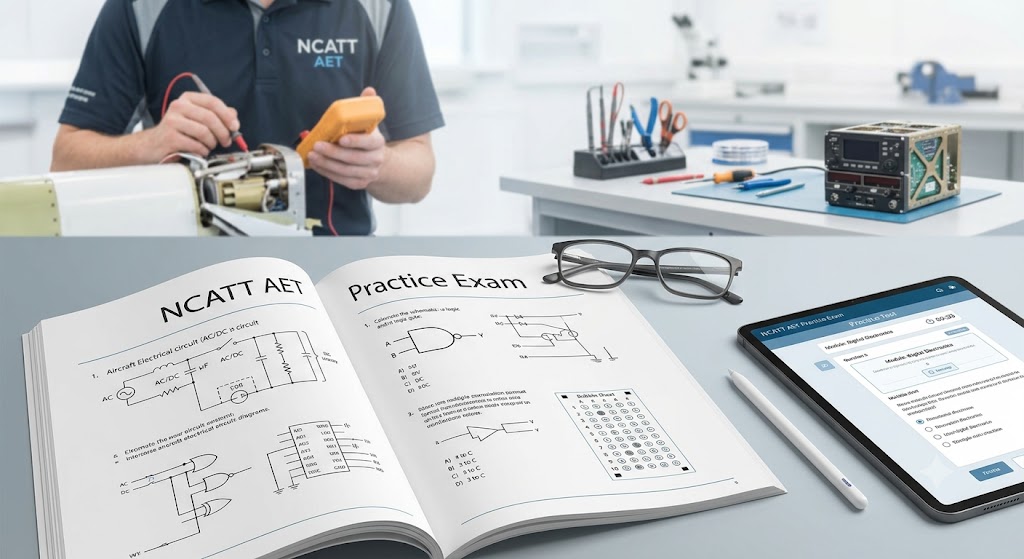
Additional Information
What the Course Entails and Exam Details
The AET examination focuses intensely on the fundamental principles of electronics and their application within an aviation context. The syllabus is rigorous and covers a wide range of essential topics that form the daily toolkit of an avionics technician.
Candidates must demonstrate proficiency in several key domains, including:
Basic Electrical Theory: Comprehensive understanding of AC and DC circuit principles, formulas, and analysis.
Electronic Circuit Components: Knowledge of resistors, capacitors, inductors, transformers, and semiconductor devices.
Digital Electronics: Fundamentals of logic gates, flip-flops, memory systems, and microcontroller theory.
Avionics Systems: Basic overview of communication, navigation, surveillance, and flight control systems.
Aircraft Wiring and Hardware: Best practices for installation, termination, and routing of aircraft wiring harnesses.
Test Equipment and Measurement: Proper use of multimeters, oscilloscopes, and specialized avionics test sets for diagnostics.
Maintenance Procedures and Regulations: Understanding of relevant FAA/regulatory standards, safety protocols, and documentation.
What to Expect in the Final Exam
The final AET certification exam is a multiple-choice assessment designed to test both your recall of facts and your ability to apply theoretical knowledge to practical scenarios.
While specific formats may vary by testing authority, you can generally expect the following:
Format: 100 multiple-choice questions.
Time Limit: Approximately 90 to 120 minutes is typical, encouraging efficient time management.
Passing Score: Usually requires a minimum score of 70% to pass.
Delivery Methods: The exam is increasingly administered via secure, remote-proctored online portals. It is also available at authorized physical testing centers worldwide, including specific aviation schools and recognized technology institutes.
Restrictions: The exam is typically "closed-book," and no external reference materials are allowed during the session.
How to Study and Exam Centers
Preparation is the absolute key to success in the AET exam. As an entry-level test covering broad foundational concepts, regular study and practical application are essential.
Here are actionable strategies to prepare:
Utilize Practice Exams: This is the single most effective study method. High-quality practice tests simulate the real exam’s difficulty, timing, and question style, identifying your weak areas before the actual test day.
Study Official Guides and Handbooks: Review relevant material from the standard FAA Handbooks (such as the Aviation Maintenance Technician Handbook—General and Airframe) and official study guides provided by the certifying body (e.g., ASTM/NCATT).
Engage in Hands-on Training: If you are enrolled in an avionics program, maximize your laboratory time. Practical experience with wiring, soldering, and using test equipment makes theoretical concepts concrete.
Join Study Groups: Discussing complex topics with peers can clarify difficult concepts and offer new perspectives on troubleshooting.
For official exam centers, check the certifying authority's official website (e.g., AEA or ASTM) for a list of authorized testing locations, which include dedicated computerized testing centers and accredited avionics schools. Remote proctoring is also a common option that allows you to take the exam from a secure location of your choice.
Job Opportunities from the Course
Earning your AET certification unlocks numerous career paths within the aerospace and technology sectors. This credential serves as clear proof of your technical competence and dedication to the field.
Upon successful completion, you will be qualified for a range of specialized roles, including:
Avionics Technician: Installing, inspecting, testing, and repairing complex electronic systems in aircraft.
Aircraft Electronics Installer: Focus on the precision integration of wiring harnesses and hardware components.
Aerospace Bench Technician: Component-level troubleshooting and repair of avionics units in a workshop environment.
Quality Control Inspector (Avionics): Ensuring that all avionics work complies with regulatory standards and manufacturer specifications.
Unmanned Aerial Vehicle (UAV) Technician: Applying avionics knowledge to the rapidly growing drone and autonomous systems industry.
This certification often acts as a prerequisite for more advanced endorsements and specialized training in areas like autonomous navigation or advanced communication systems, allowing for continued career growth and increased earning potential.
Frequently Asked Questions
Reviews
5.0
Based on 0 reviews
Leave a Review
No reviews yet. Be the first to review!