
ATPL Airframe Practice Test
$69.00
- Buy to unlock unlimited access to all Quiz questions.
- After purchase you can print a PDF of the whole quiz at any point. The PDF will contain the questions and the correct answers.
About this Exam
Welcome to your comprehensive guide for mastering the ATPL Airframe Systems exam. This critical assessment is a mandatory milestone for aspiring airline transport pilots aiming to secure their frozen ATPL (Airline Transport Pilot License). Designed for commercial pilots advancing their careers, this exam rigorously tests your theoretical knowledge of the complex structures, systems, and handling procedures required to operate large, multi-engine commercial aircraft safely and efficiently. Achieving a high score not only demonstrates competence but also builds the foundational knowledge necessary for advanced type ratings and a successful career in the cockpit.
Ready to test your knowledge?
Buy Now to Access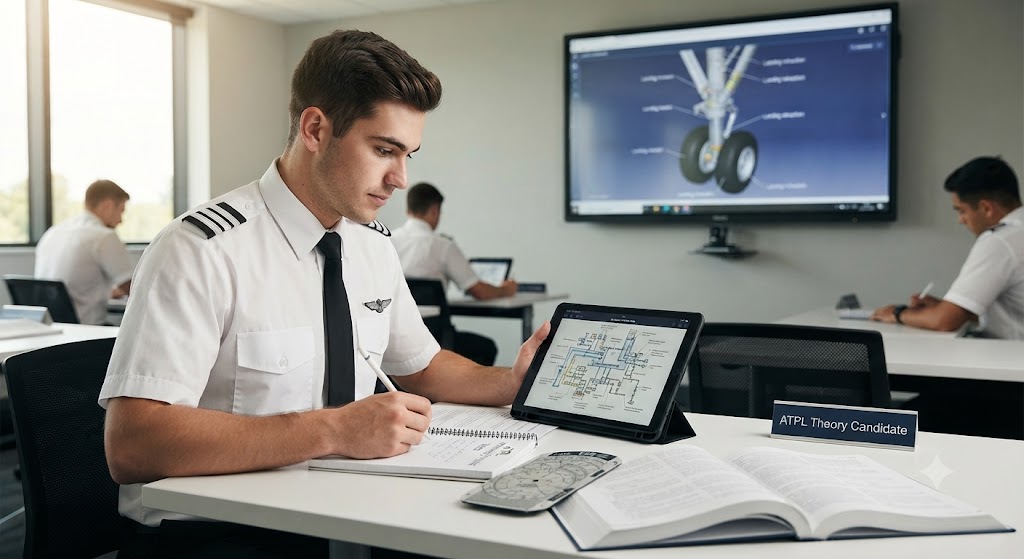
Additional Information
What the Course
Entails and Exam Details
The ATPL Airframe syllabus is extensive and delves deep into
the anatomy of modern aircraft. To succeed, candidates must develop a profound
understanding of several core technical areas. The curriculum typically covers:
- Airframe
Structure: Understanding fuselage design, wings, empennage, flight
control surfaces, and the materials used in modern aircraft construction,
including composite materials and metal fatigue concepts.
- Hydraulics
and Pneumatics: Studying the principles of high-pressure hydraulic
systems, fluid types, pumps, reservoirs, and pneumatic systems used for
de-icing and environmental control.
- Landing
Gear and Brakes: Mastering the operation of retractable landing gear,
braking systems, anti-skid mechanisms, and tire requirements.
- Flight
Controls: Learning the mechanics of primary and secondary flight
control systems, including fly-by-wire technology, trim systems, and
artificial feel.
- Electrical
Systems: Comprehending AC and DC generation, distribution networks,
batteries, circuit protection, and emergency power sources.
- Emergency
Equipment: Knowledge of fire detection and suppression systems, oxygen
systems, evacuation slides, and emergency lighting.
- Fuel
Systems: Understanding fuel storage, tank types, pumps, cross-feeding,
and fuel management procedures.
- Ice
and Rain Protection: Studying systems designed to combat structural
icing, engine icing, and windshield obscuration.
What to Expect in the Final Exam
The ATPL Airframe exam is a demanding theoretical
assessment. While the exact format may vary slightly depending on the aviation
authority (e.g., EASA, FAA, UK CAA), the standard format consists of a timed,
multiple-choice question (MCQ) paper.
- Number
of Questions: The exam typically features between 50 and 80 questions,
carefully selected to cover the breadth of the syllabus.
- Time
Limit: Candidates are usually allotted between 1.5 to 2.5 hours to
complete the exam. This requires efficient time management, as you will
have roughly 1.5 to 2 minutes per question.
- Passing
Score: The universally required passing score is 75% or higher. This
high threshold reflects the critical safety nature of the knowledge being
tested.
- Exam
Rules: The exam is strictly closed-book. Electronic devices,
smartwatches, and study materials are prohibited. Candidates are usually
permitted to use an approved aviation calculator, navigation ruler (E6B),
and authorized navigation charts.
How to Study and Exam Centers
Preparing for the ATPL Airframe exam requires a structured
and disciplined approach. Relying solely on ground school lectures is often
insufficient.
Actionable Study Strategies:
- Master
the Official Syllabus: Use the relevant aviation authority's learning
objectives as your primary checklist. Ensure you can explain every topic
listed.
- Use
Reputable Question Banks: Utilize recognized ATPL question banks (such
as Aviation Exam, ATPL Online, or Bristol Groundschool) to familiarize
yourself with the style, complexity, and wording of the actual exam
questions. Aim for consistent scores above 90% in practice before attempting
the real thing.
- Go
Beyond Memorization: Don't just memorize answers. When reviewing
practice questions, understand why a particular answer is correct
and why the others are wrong. This deep understanding is crucial for
complex, scenario-based questions.
- Visualize
Systems: Use diagrams, schematics, and CBT (Computer-Based Training)
modules to visualize how hydraulic fluid flows, how electrical circuits
operate, and how landing gear retracts. Visual memory aids retention
significantly.
- Focus
on Weak Areas: Identify your weakest subjects (e.g., Electrical
Systems or Hydraulics) and dedicate extra time to mastering them. Do not
ignore topics simply because you find them difficult.
Where and How to Take the Exam:
ATPL exams are not typically taken at home. They must be sat
at authorized testing centers to ensure security and integrity.
- Booking:
You must book your exam through your aviation authority’s designated
online portal (e.g., the CAA portal in the UK or the EASA equivalent). You
will need to select your exam subjects, preferred date, and testing
location.
- Testing
Centers: The exams are administered at secure, dedicated facilities.
These are often operated by third-party testing providers like Pearson
VUE, which has a global network of centers, or at approved flight
schools and examination halls designated by the national aviation
authority.
- Identification:
On the day of the exam, you must present valid, government-issued photo
identification (passport or driver's license) and your scheduling
confirmation.
Job Opportunities
from the Course
Passing the ATPL Airframe exam (along with the other 12 ATPL
theoretical exams) is the key that unlocks the door to a professional piloting
career. This certification is essential for operating commercially.
Career Paths Unlocked:
<!--[if !supportLists]-->· <!--[endif]-->First
Officer (Co-pilot): With a frozen ATPL, you are eligible to be hired as a
First Officer by regional, major, and cargo airlines.
<!--[if !supportLists]-->· <!--[endif]-->Commercial
Charter Pilot: Fly private charter operations for business or
high-net-worth individuals, often in smaller turbine or jet aircraft.
<!--[if !supportLists]-->· <!--[endif]-->Air
Ambulance Pilot: Utilize your skills in critical medical evacuation
operations.
<!--[if !supportLists]-->· <!--[endif]-->Flight
Instructor: While a CPL is sufficient, holding ATPL theory credits enhances
your credibility and knowledge base as an instructor.
<!--[if !supportLists]-->· <!--[endif]-->Corporate
Pilot: Fly aircraft owned by corporations for business transport.
Once you have completed your flight training, logged the
required 1,500 flight hours, and met other regulatory requirements, your frozen
ATPL becomes fully "unfrozen," allowing you to upgrade to Captain. This
journey begins with mastering exams like Airframe System
Frequently Asked Questions
Reviews
5.0
Based on 0 reviews
Leave a Review
No reviews yet. Be the first to review!