
ATP Photosynthesis Practice Test
$69.00
- Buy to unlock unlimited access to all Quiz questions.
- After purchase you can print a PDF of the whole quiz at any point. The PDF will contain the questions and the correct answers.
About this Exam
The ATP Photosynthesis Practice Test is a comprehensive, topic-specific resource designed to evaluate your understanding of the processes behind cellular energy transfer (ATP) and the transformation of light energy into chemical energy (photosynthesis). This test is invaluable for students in various biology-related programs—from high school and college introductory courses to specialized biochemistry or plant physiology. It’s also an excellent tool for educators looking for supplemental resources or professionals seeking to refresh their fundamental knowledge. By simulating the conditions of a larger, comprehensive science exam, this practice test allows you to gauge your knowledge, identify areas of weakness, and build confidence before taking the actual assessment.
Ready to test your knowledge?
Buy Now to Access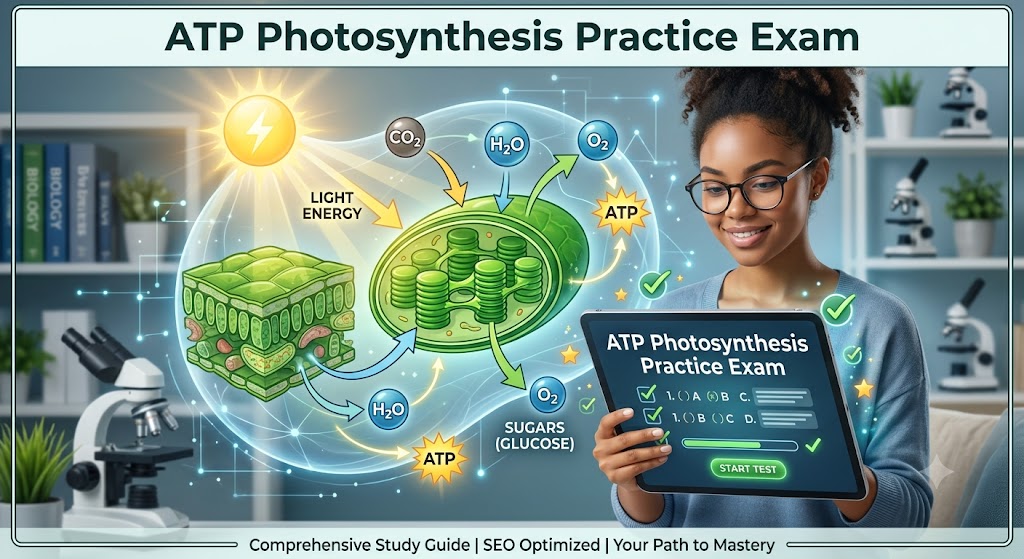
Additional Information
What the Course Entails and Exam Details
While not a complete course, a robust ATP Photosynthesis
Practice Test covers the standard curriculum found in most fundamental biology
courses. The test evaluates your comprehension across several key areas:
- ATP
(Adenosine Triphosphate): Its structure, function as the primary
cellular energy currency, the ATP-ADP cycle, and the role of ATP synthase.
- Cellular
Respiration Overview: A general understanding of how cells generate
ATP, even if the primary focus of the test is photosynthesis. The
connection is vital.
- Photosynthesis:
The full process of converting light energy into chemical energy. Key
topics include:
- Chloroplast
Structure and Function: Understanding the roles of thylakoids, grana,
stroma, and the relevant membranes and pigments.
- Light-Dependent
Reactions: How light energy is absorbed, the electron transport
chain, the production of ATP and NADPH, and the hydrolysis of water.
- Light-Independent
Reactions (Calvin Cycle): The stages of carbon fixation, reduction,
and regeneration to produce high-energy sugars, driven by the ATP and
NADPH from the light reactions.
- The
Interdependence of both stages.
- Reactants
and Products: Clearly defining and connecting CO2, H2O, light energy,
O2, and C6H12O6 (glucose).
- Factors
Affecting Photosynthesis: The impact of light intensity, temperature,
CO2 concentration, and water availability.
- The
overall chemical equation.
What to Expect in the Final Exam
Since this is a practice test, the "final exam"
experience refers to the practice test itself. Typically, this assessment is
taken online, providing immediate and detailed feedback on your performance.
Expect:
- Format:
The test is most commonly composed of multiple-choice questions,
true/false statements, and diagram labeling exercises. Some advanced
practice tests may include short-answer questions to assess your ability
to explain complex processes.
- Time
Limit: To simulate a real exam, many online practice tests include an
optional timer. While not mandatory, utilizing this feature can help you
practice managing your time effectively and build endurance for a longer
final assessment.
- Passing
Score: As a learning tool, there is often no official "passing
score." However, you should aim to understand every answer choice and
achieve a score in the 80-90% range to feel confident for a high-stakes
exam. Use detailed explanations for both correct and incorrect answers as
a valuable learning resource.
- Accessibility:
This practice test is usually accessible from any device with an internet
connection, allowing you to study whenever and wherever you choose.
How to Study and
Exam Centers
Effective study methods for the ATP Photosynthesis Practice
Test are similar to general biology preparation, but with a focused approach:
- Master
the Basics: Start with your biology textbook, lectures, and reputable
educational videos to build a solid foundational knowledge before diving
into practice questions.
- Use
Active Study: Create detailed flashcards for key terms, molecules, and
steps. Draw out diagrams of the ATP cycle, chloroplasts, and both stages
of photosynthesis and label them entirely from memory.
- Take
Multiple Practice Runs: Don't just take the test once. Revisit it
multiple times, focusing specifically on questions you missed. Many
platforms offer randomization, so you won't always face the exact same
sequence.
- Focus
on Rationales: When reviewing your results, always read the detailed
explanations provided for both correct and incorrect answers.
Understanding why an answer is correct or incorrect is crucial for
true mastery.
- Collaborate
and Explain: Explain the processes to a study partner or a tutor.
Teaching a concept is one of the most effective ways to solidify your own
understanding.
- Access
the Test Online: For this particular practice resource, the how and
where to take the test is almost always through a dedicated online
learning portal, website, or educational application. You can typically
find these resources directly through search engines or through
recommendation from instructors. This is a self-administered,
online practice test.
Job Opportunities
from the Course
Strong knowledge in fundamental biological processes like
ATP and photosynthesis is foundational for a wide range of careers in biology,
biochemistry, agriculture, and related fields. Career paths and job titles
where this knowledge is highly valuable include:
- Biologist
- Biochemist
- Plant
Scientist
- Agronomist
- Biotechnologist
- Laboratory
Technician
- Bioenergy
Researcher
- Environmental
Scientist
- Science
Educator (High School & College Levels)
Disclaimer: This is a practice test designed as a study
resource to help you prepare for broader, official biological science exams and
certifications. Completion of this practice test is for knowledge
self-assessment and does not provide an official professional certification or
qualification.
Frequently Asked Questions
Reviews
5.0
Based on 0 reviews
Leave a Review
No reviews yet. Be the first to review!