
ATP Oral Checkride Practice Test
$69.00
- Buy to unlock unlimited access to all Quiz questions.
- After purchase you can print a PDF of the whole quiz at any point. The PDF will contain the questions and the correct answers.
About this Exam
The Airline Transport Pilot (ATP) Oral Checkride is the pinnacle of pilot certification in the United States, representing the comprehensive, practical application of aeronautical knowledge. This verbal examination, conducted by a Federal Aviation Administration (FAA) Designated Pilot Examiner (DPE), is the first and arguably most critical component of the final practical test. This specific guide and practice exam are designed for experienced commercial pilots who are ready to elevate their careers and achieve the ATP certificate, commonly known as "the ultimate goal." The oral checkride focuses intensely on operational knowledge, safety culture, and advanced decision-making, simulating the demands placed on captains of transport category aircraft. Our practice materials are crafted to build the confidence and deep comprehension required to satisfy the strict standards of the DPE.
Ready to test your knowledge?
Buy Now to Access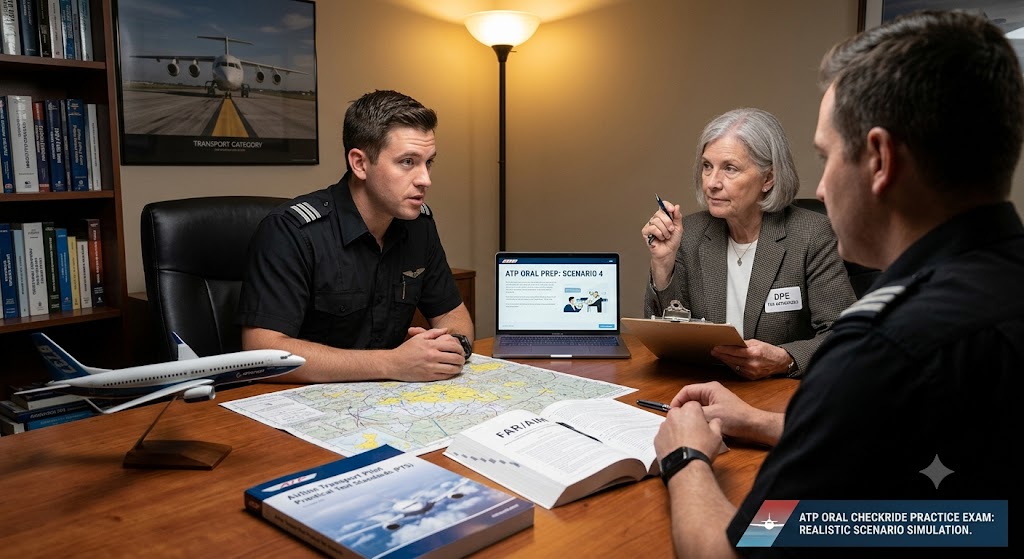
Additional Information
What the Course
Entails and Exam Details
This practice guide simulates the scenario-based nature of
the actual examination. It covers the full spectrum of high-level aviation
knowledge required for ATP certification. While the exact structure can vary by
examiner, the core areas are defined by the FAA Practical Test Standards (PTS)
and the more recent Airman Certification Standards (ACS) for Airline Transport
Pilots. Key modules focus on: High-Altitude Aerodynamics (including Mach
effects, coffin corner, and swept-wing dynamics), Transport Category Aircraft
Systems (electrical, hydraulic, pneumatic, fuel, flight control, and
environmental systems for specific aircraft types), Federal Aviation
Regulations (FARs) with particular emphasis on Part 121, Part 135, and Part 91
subparts, Crew Resource Management (CRM) and Aeronautical Decision Making (ADM)
within multi-crew environments, Advanced Meteorology (interpreting complex
forecasts, high-altitude weather, wind shear, and icing analysis), Advanced
Performance (multi-engine performance calculations, takeoff, en route, and
landing limitations), and Flight Planning, including dispatch requirements,
weight and balance, and fuel planning. The course does not issue the ATP
certificate itself; it is an optimized study resource to prepare you for the
official FAA practical test oral portion.
What to Expect in the Final Exam
It is essential to understand that the ATP Oral Checkride is
not a multiple-choice written exam. It is a one-on-one, interactive, and
verbal scenario-based assessment conducted by a DPE. The entire process will
test your ability to synthesize vast amounts of knowledge and apply it to
real-world operational challenges. The DPE will not ask simple
"recitation" questions. Instead, they will present a detailed flight
scenario, such as: "You are the Captain of a flight from Chicago to Los
Angeles. Here is your dispatch release, the weather forecast, a minimum
equipment list (MEL) item, and a fuel state. Describe your decision-making
process for departure, flight, and potential abnormal events." You must
demonstrate an understanding of the PTS standards. There is no official time
limit, but typically, this rigorous oral examination lasts between two to four
hours. You cannot rely solely on memory; you must arrive organized with all
your required reference materials, including the FAR/AIM, PTS, specific
aircraft operating manuals (POH/AFM/AOM), and aeronautical charts, and be ready
to explain why and how your decisions align with regulations and
safe operating practices. Passing requires demonstrating competence,
professionalism, and safe judgment to the satisfaction of the examiner.
How to Study and
Exam Centers
Effective preparation for the ATP Oral requires transition
from a passive student mindset to an active, commanding pilot perspective. Your
primary reference must be the FAA ATP Practical Test Standards (PTS) (or
ACS, as applicable). We recommend a multi-pronged strategy. First, engage in Deep
study and tabbing of your foundational documents (FARs, AIM, aircraft
manuals). The examiner will evaluate how efficiently you find information.
Second, conduct multiple Mock Orals with other experienced pilots,
mentors, or Certified Flight Instructors (CFIs) who are familiar with the ATP
standards. Third, utilize our specialized ATP Oral Checkride Practice Exam
scenarios and question banks to practice mental modeling, asking
yourself, "What would I do if..." for every possible system failure,
weather event, or regulation change. For exam centers: You cannot take the
final oral checkride at a generic testing facility. The practical test (oral
and flight) must be scheduled directly with a Designated Pilot Examiner (DPE).
Your flight school, flight training academy, or aviation employer will
typically help coordinate finding a qualified and available DPE who is authorized
to conduct the ATP checkride.
Job Opportunities
from the Course
Earning your ATP certificate is the mandatory requirement
for a wide array of high-paying, professional aviation roles. This guide is
your stepping stone to unlock positions such as:
- Airline
Captain (Part 121 Carriers)
- First
Officer (Airline/Regional Carriers)
- Corporate
Pilot / Chief Pilot (Large Part 135 Operators)
- International
Air Cargo Pilot
- Air
Ambulance / Medical Transport Pilot
- Federal
Aviation Administration (FAA) Inspector
- Advanced
Flight Instructor (requiring an ATP)
- Director
of Operations / Safety Manager within an airline organization
Frequently Asked Questions
Reviews
5.0
Based on 0 reviews
Leave a Review
No reviews yet. Be the first to review!