
ATP Field Sanitation Practice Test
$69.00
- Buy to unlock unlimited access to all Quiz questions.
- After purchase you can print a PDF of the whole quiz at any point. The PDF will contain the questions and the correct answers.
About this Exam
The ATP Field Sanitation Practice Exam is an essential tool designed for professionals and students aiming to master the principles of rapid hygiene monitoring and environmental sanitation in non-traditional or "field" settings.
ATP, which stands for Adenosine Triphosphate, is the universal energy molecule found in all living cells, including bacteria, yeast, and mold, as well as organic residue. In industry, measuring the amount of ATP on a surface is the standard method for immediately verifying the effectiveness of cleaning and sanitation. A certification or comprehensive understanding in this field is critical for individuals working in sectors where maintaining a pristine environment is paramount, especially when permanent facilities are unavailable or compromised. This includes roles in emergency response, military operations, outdoor hospitality, remote food service, and disaster relief.
This practice exam serves as a robust preparation resource, enabling candidates to gauge their readiness for official certification tests by simulating the format and content they will encounter.
Ready to test your knowledge?
Buy Now to Access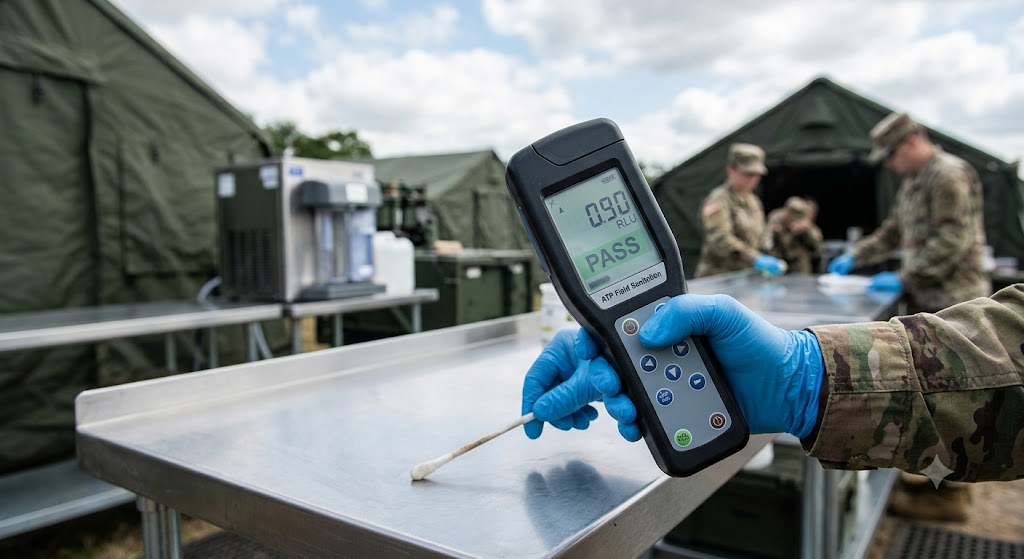
Additional Information
the Course Entails
and Exam Details
A comprehensive course in ATP Field Sanitation provides the
technical knowledge and practical skills required to implement a successful
hygiene monitoring program in challenging environments. The ATP Field
Sanitation Practice Exam evaluates understanding across several key domains:
- The
Science of ATP: Understanding what ATP is, why it is an effective
indicator of organic contamination, and the biochemical principle of
bioluminescence used in testing.
- ATP
Monitoring Technology: Mastery of the testing process, including
proper surface swabbing techniques, the use of handheld luminometers (ATP
readers), and proper storage and handling of test swabs.
- Data
Interpretation and Threshold Setting: Knowing how to read Relative
Light Unit (RLU) results and, crucially, how to establish customized
"pass," "caution," and "fail" thresholds for
different surfaces and risk zones.
- Corrective
Actions and Trending: Understanding the immediate steps to take upon a
failed test (re-cleaning and re-testing) and how to use ATP data to
identify hygiene trends and improve sanitation Standard Operating
Procedures (SOPs).
- Integrated
Field Sanitation Principles: Often, ATP monitoring is bundled with
broader field sanitation concepts such as water source protection, basic
water purification methods, waste disposal, vector control (managing
pests), and personal hygiene protocols to prevent disease non-battle
injuries (DNBI).
The underlying knowledge base is dynamic, focusing on
evidence-based practices for maintaining public health.
What to Expect in
the Final Exam
While specific official exams may vary by certifying body
(such as commercial vendors or military organizations), students preparing with
this practice exam can generally expect the final certification to possess the
following characteristics:
- Format:
The final exam is typically composed of multiple-choice questions. This
format is designed to test both factual recall and the application of
principles to real-world sanitation scenarios.
- Number
of Questions: Official exams often feature between 50 and 100
questions.
- Time
Limit: Candidates are usually given a strict time limit, ranging from
60 to 120 minutes, which requires efficient time management.
- Passing
Score: A passing score is generally set around 70% to 80%, indicating
a high level of competency.
- Proctoring
and Rules: Final exams are usually proctored, either in person at an
authorized center or online via remote proctoring services. The use of
outside resources is prohibited.
Utilizing the ATP Field Sanitation Practice Exam helps to
demystify this process and builds the confidence necessary to succeed under
exam conditions.
How to Study and Exam Centers
Effective preparation for the ATP Field Sanitation exam
requires a combination of academic study and practical understanding.
Actionable Study Strategies:
Use the Practice Test
Strategically: Do not just take the ATP Field Sanitation Practice Exam
once. Use it iteratively. After each attempt, carefully review not only the
questions you got wrong but also those you guessed on. Understand why
the correct answer is right.
Consult Official Manuals and
User Guides: If you are seeking a commercial certification, master the user
manuals for the specific ATP luminometer and swab brand you will use. For
military personnel, studying official publications like ATP 4-25.12 (Field
Hygiene and Sanitation) is non-negotiable.
Simulate Real-World Scenarios:
Create hypothetical field scenarios (e.g., "Verifying an outdoor food prep
surface after a dust storm") and determine the appropriate ATP sampling
plan, threshold setting, and corrective action.
Focus on Critical Zones:
Understand the concept of "Hygienic Zoning" (Zones 1-4) and
prioritize study on direct food contact and high-touch surfaces.
Locating Exam Centers:
The location of your official exam depends on the type of
certification you are pursuing:
- Commercial
ATP Vendor Certifications: If the certification is provided by a
manufacturer of ATP monitoring equipment (e.g., Hygiena, Neogen), exams
are often administered through their proprietary online learning
management systems or via major computer-based testing networks such as
Pearson VUE.
- Military
Certification: For service members, ATP Field Sanitation training and
testing (often leading to a Field Sanitation Team member designation) are
conducted within the military education system at specified installations.
- Institutional
or Collegiate Courses: Some environmental health degrees or
specialized hospitality programs include ATP Field Sanitation. In these
cases, the exam is taken on campus as part of the coursework.
Job Opportunities
from the Course
Earning a certification in ATP Field Sanitation validates a
specialized skill set that is highly valued in numerous industries. This
qualification can unlock various career paths, including:
- Environmental
Health Officer / Specialist
- Food
Safety and Quality Assurance (QA) Inspector
- Sanitation
Supervisor
- Quality
Control Technician (Food/Beverage Production)
- Hospitality
Hygiene Manager
- Facility
Manager (Institutions, Remote Camps)
- Disaster
Relief Sanitation Coordinator
- Pest
Control Specialist with Sanitation Focus
- Public
Health Educator
- Industrial
Hygienist
This certification demonstrates a proactive commitment to
public safety and objective cleanliness verification, making it a powerful
asset in the job market.
Frequently Asked Questions
Reviews
5.0
Based on 0 reviews
Leave a Review
No reviews yet. Be the first to review!