
ATI Reduction of Risk Potential Practice Test
$69.00
- Buy to unlock unlimited access to all Quiz questions.
- After purchase you can print a PDF of the whole quiz at any point. The PDF will contain the questions and the correct answers.
About this Exam
The ATI Reduction of Risk Potential Practice Test is a critical component of ATI’s Content Mastery Series®, designed specifically for nursing students preparing for their licensure exams (NCLEX-RN or NCLEX-PN). This test focuses on the student’s ability to minimize risks and prevent potential complications associated with a client’s conditions, treatments, and procedures. It is a vital assessment tool for determining a nursing student’s readiness to manage patient safety effectively in a real-world clinical setting.
For students, this practice test serves as a crucial benchmark, highlighting both strengths and areas requiring further study. By using this test, nursing programs can gauge their students' proficiency in applying theoretical knowledge to clinical judgment, a cornerstone of modern nursing education and safe practice.
Ready to test your knowledge?
Buy Now to Access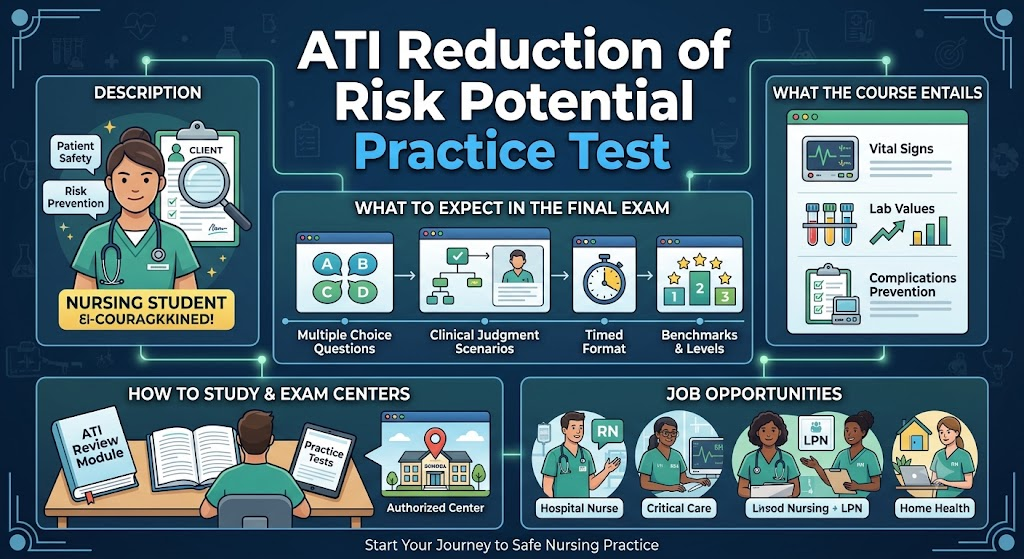
Additional Information
What the Course Entails and Exam Details
While not a standalone course itself, the "Reduction of Risk Potential" content is a primary domain within the broader nursing curriculum and the NCLEX test plan. It integrates knowledge from various subject areas, requiring students to synthesize information to protect their patients. The content outline covered in this section typically includes:
Changes/Abnormalities in Vital Signs: Recognizing and interpreting trends and significant changes in a client’s vital signs that indicate a risk or complication.
Diagnostic Tests and Lab Values: Understanding normal and abnormal values (e.g., electrolytes, complete blood count, coagulation studies) and interpreting what these results mean for the patient’s status and risk profile.
Potential for Complications of Diagnostic Tests/Treatments/Procedures: Identifying and planning to prevent complications related to common interventions.
System Specific Assessments: Conducting targeted physical assessments to monitor for signs of potential problems.
Potential for Alterations in Body Systems: Identifying risks related to pre-existing conditions or acute illness.
Therapeutic Procedures: Safe implementation and monitoring of specific procedures.
The practice test consists of multiple-choice, alternative-format, and clinical judgment questions, simulating the types of items students will encounter on their final proctored exams and the NCLEX.
What to Expect in the Final Exam
It is important to differentiate between the ATI Reduction of Risk Potential Practice Test and the final ATI proctored Content Mastery Series® exam. The practice test is a non-proctored, formative assessment intended for learning and remediation.
The final proctored exam is what students must prepare for using the practice test. You can typically expect the following format for that final, high-stakes ATI exam:
Format: The final exam will be a proctored, computer-based test, primarily consisting of multiple-choice questions, but increasingly including a significant portion of "Next Generation NCLEX" style questions. These new items include case studies, drop-down, drag-and-drop, and multiple-response formats designed to measure clinical judgment.
Number of Questions: The final ATI Content Mastery exams generally have between 60 to 70 scored items, with additional unscored pretest questions.
Time Limit: Students are usually allowed approximately one to two minutes per question, leading to a typical total testing time of 70 to 90 minutes.
Passing Score/Benchmarks: ATI does not provide a simple "passing score." Instead, students are assigned a Proficiency Level (Level 1, 2, or 3). Nursing programs typically establish a minimum proficiency level (often Level 2) that students must achieve to demonstrate mastery and avoid remediation. Achieving Level 2 or 3 is a strong predictor of NCLEX success.
How to Study and Exam Centers
Preparation for the final proctored exam requires a strategic, multi-faceted approach. Your most powerful tool is the practice test itself.
Actionable Study Strategies:
Use the ATI Practice Tests Wisely: Do not just take the practice test once. Take it, and then meticulously review the rationales for both correct and incorrect answers. This is where the true learning occurs. Pay close attention to why the correct answer is the best action to reduce client risk.
Remediate Every Weakness: ATI generates a detailed remediation report based on your practice test performance. This report directs you to the exact chapters and sections in your ATI Review Modules that you need to re-study. Do not skip this step; target your weak areas.
Master Lab Value Interpretation: You cannot reduce risk if you do not understand diagnostic results. Make flashcards for normal ranges of all critical lab values and, crucially, memorize the signs, symptoms, and nursing interventions for when those values are abnormal (e.g., hyperkalemia vs. hypokalemia).
Practice Clinical Judgment: Use the ATI Learning Systems (if available through your school) to take additional practice quizzes focusing on client needs categories. The "Next Generation NCLEX" questions in these systems are vital for developing the decision-making skills you will need on the final exam.
Where to Take the Exam:
Practice Tests: You will take the non-proctored practice tests online via your student ATI portal, typically accessible from any computer with internet access.
Final Proctored Exam: This must be taken in a secure environment. Your nursing school will schedule and administer this exam, usually in a computer lab on campus, under the supervision of a faculty member or approved proctor. In some specific cases (like distance learning programs), your school may utilize an approved virtual proctoring service.
Job Opportunities from the Course
Mastering the concepts tested in "Reduction of Risk Potential" is not just for passing a test; it is the foundation of becoming a safe and effective licensed nurse. While you do not gain a certificate directly from the practice test, the knowledge it validates is essential for passing the NCLEX and launching your career. Once you achieve licensure as a Registered Nurse (RN) or Licensed Practical/Vocational Nurse (LPN/LVN), a vast number of job opportunities become available:
Registered Nurse (RN) - Med-Surg Unit
Critical Care Nurse (ICU/ER)
Licensed Practical Nurse (LPN) in Long-Term Care
Pediatric Nurse
Home Health Nurse
Surgical Nurse
Occupational Health Nurse
Public Health Nurse
Case Manager
Nursing Educator
The knowledge you prove by excelling in "Reduction of Risk Potential" directly translates to better patient outcomes and makes you a highly desirable candidate for any of these roles.
Frequently Asked Questions
Reviews
5.0
Based on 0 reviews
Leave a Review
No reviews yet. Be the first to review!