
ATI Gas Exchange and Oxygenation Practice Exam
$69.00
- Buy to unlock unlimited access to all Quiz questions.
- After purchase you can print a PDF of the whole quiz at any point. The PDF will contain the questions and the correct answers.
About this Exam
The ATI Gas Exchange and Oxygenation Practice Exam is an invaluable resource for nursing students mastering critical respiratory care.
This diagnostic tool is specifically designed to assess readiness for the proctored ATI exam within medical-surgical or critical care nursing curriculum.
For aspiring Registered Nurses and LPNs/LVNs, mastering these concepts is vital for ensuring safe and effective patient outcomes in complex clinical environments.
Ready to test your knowledge?
Buy Now to Access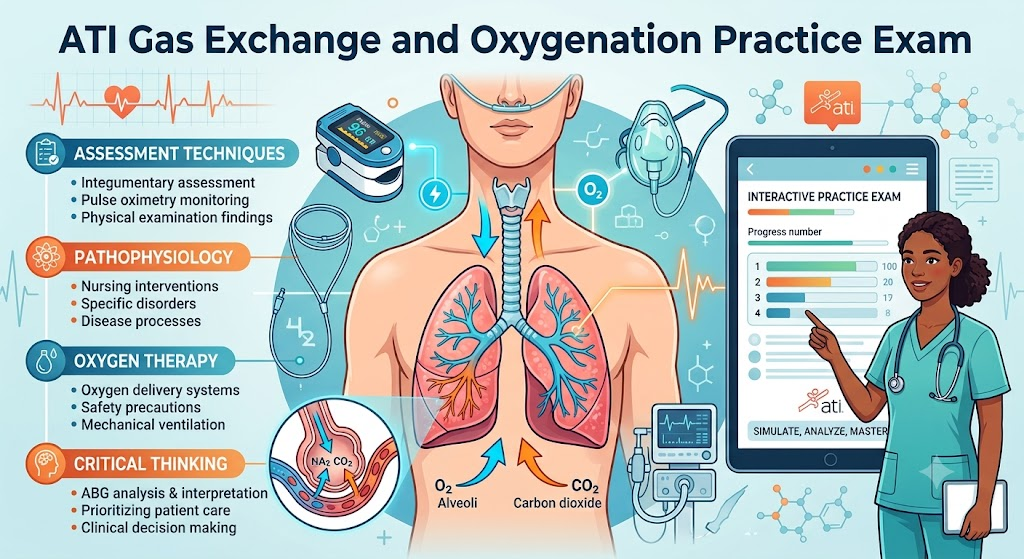
Additional Information
What the Course Entails and Exam Details
The curriculum covering gas exchange and oxygenation dives deep into essential concepts of respiratory physiology and pathophysiology.
Core topics typically include acid-base balance and analysis of Arterial Blood Gases (ABGs).
Students also learn detailed respiratory assessment techniques, advanced airway management, and diagnostic procedures.
A significant portion of the course covers common disorders such as COPD, pneumonia, asthma, pulmonary embolism, and acute respiratory distress syndrome (ARDS).
Expect in-depth analysis of oxygen therapy, non-invasive ventilation, and mechanical ventilation strategies.
The exam details involve complex scenarios requiring prioritization and critical thinking.
What to Expect in the Final Exam
The proctored ATI assessment, for which this practice exam prepares you, typically follows a structured multiple-choice format.
It may also include alternative item types, such as ‘select all that apply,’ ordered response, and ‘hot spot’ identification related to chest X-rays or anatomy.
You should expect around 60 to 70 scored questions.
A specific time limit, often approximately one hour, will apply, creating a true-to-test testing experience.
Your specific nursing program will set the required passing score and proficiency benchmark, and these results often contribute significantly to a student's course grade or graduation readiness.
How to Study and Exam Centers
Developing an effective study plan is crucial.
Start by consistently using this ATI Gas Exchange and Oxygenation Practice Exam to simulate the actual test environment.
Analyze both correct and incorrect answers, focusing on the provided rationales to bridge knowledge gaps.
Supplement your practice with the comprehensive ATI Review Module books, online tutorials, and video series.
Use the ATI dynamic custom test tools to target specific areas of difficulty.
When you are ready for the official proctored assessment, it is typically administered directly through your school's secure computer testing center.
Proctored exams are not available on open online portals like other certifications, as they are part of an accredited nursing program's assessment.
Job Opportunities from the Course
Success in this critical nursing area—demonstrated by passing related courses and assessments—directly prepares students for various high-demand healthcare careers.
While not a standalone certification, this knowledge is fundamental for all aspiring Registered Nurses (RNs) and Licensed Practical Nurses (LPNs/LVNs).
Graduate nurses with strong respiratory competencies find opportunities as:
Medical-Surgical Registered Nurses
Critical Care (ICU) Registered Nurses
Telemetry Unit Nurses Post-Anesthesia Care Unit (PACU) Nurses
Respiratory Resource or Coordination Nurse
Nursing Educator focusing on respiratory care
Case Manager specializing in chronic respiratory disease management
Frequently Asked Questions
Reviews
5.0
Based on 0 reviews
Leave a Review
No reviews yet. Be the first to review!