
ATI Critical Thinking Practice Test
$69.00
- Buy to unlock unlimited access to all Quiz questions.
- After purchase you can print a PDF of the whole quiz at any point. The PDF will contain the questions and the correct answers.
About this Exam
The ATI Critical Thinking assessment, often taken as a practice or proficiency exam, is a standardized test used primarily in nursing and healthcare education. This exam is designed to measure and evaluate a candidate's critical thinking ability—their capacity to analyze information, solve problems, make inferences, and draw sound conclusions under pressure. While frequently used as part of the admission process for nursing schools or as a milestone within a program, this test is beneficial for anyone aspiring to enter a field where logical reasoning, prioritization, and clinical judgment are paramount. It offers crucial feedback on a student’s readiness and highlights areas for improvement.
Ready to test your knowledge?
Buy Now to Access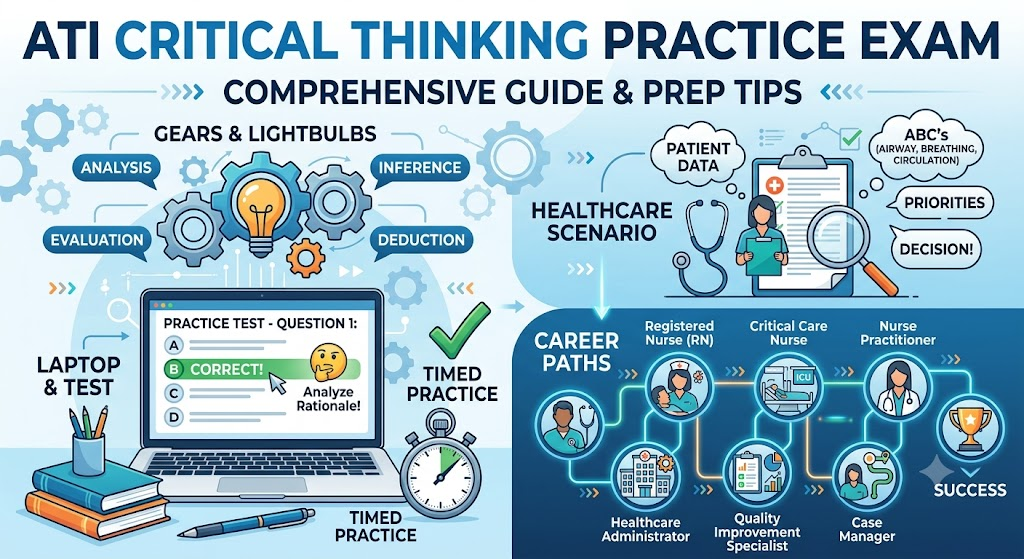
Additional Information
What the Course Entails and Exam Details
This is not typically a single "course" with a fixed syllabus, but rather a targeted assessment. However, preparation for this exam, and the general academic path that leads to it, entails understanding key critical thinking principles and their application in clinical or complex scenarios. While ATI provides various prep materials and guides, the test itself focuses on several core skills:
Analysis: Breaking down complex scenarios, identifying key elements, and recognizing patterns and relationships within data.
Inference: Drawing logical conclusions based on the information provided, recognizing what can and cannot be safely deduced.
Evaluation: Assessing the strength of arguments, the credibility of sources, and the potential outcomes of different actions.
Deductive and Inductive Reasoning: Applying general rules to specific situations and using specific observations to make broader predictions.
Interpretation: Explaining the meaning of information, identifying underlying assumptions, and recognizing biases.
Prioritization: In a healthcare context, determining the most critical client needs and ordering interventions effectively.
The exam itself typically consists of multiple-choice questions. It is generally a timed test, challenging your ability to think quickly and accurately. The specific number of questions, exact time limits, and proficiency cut-off scores can vary depending on the institution administering the test and the version used. However, the score is often predictive of success in demanding academic programs and later, in clinical practice. The questions often present hypothetical scenarios, logical problems, or medical case studies (where medical knowledge might be embedded, but the core focus remains on the thinking process).
What to Expect in the Final Exam
While you are preparing for the "practice" test, it is crucial to understand that it closely mirrors the structure and challenges of the final, often proctored, ATI Critical Thinking assessment.
You can expect:
Question Format: Primarily standard multiple-choice questions, requiring you to select the single best answer. Some questions may involve analyzing charts, priority-setting, or multiple-select formats.
Scenario-Based Questions: Questions frequently immerse you in realistic clinical or professional scenarios, asking you to identify priorities, potential complications, appropriate actions, or logical flaws.
Time Constraints: The exam is timed, requiring efficient reading, analysis, and decision-making for each question.
Scoring: You will receive a proficiency level score or percentile rank rather than a simple pass/fail mark. This score indicates how your critical thinking skills compare to others and helps predict your likelihood of academic and NCLEX success. Your institution determines the relevant scoring benchmarks.
Test Environment: When taken as part of a proctored setting (either in-person at your school or remotely via online proctoring), expect strict adherence to rules regarding prohibited items, external communication, and the use of materials.
How to Study and Exam Centers
Successfully preparing for the ATI Critical Thinking test involves both general critical thinking development and specific practice.
Study Strategies:
Practice, Practice, Practice: Utilize ATI-provided practice tests, question banks, and review modules. Look for other reputable critical thinking resources online and in textbooks. Analyze why each correct answer is correct and, crucially, why the incorrect answers are wrong.
Develop Logical Reasoning: Engage in puzzles, riddles, logic games, and read opinion pieces critically, identifying arguments and potential fallacies.
Review Priority-Setting Frameworks: Familiarize yourself with frameworks crucial to nursing decision-making, such as Maslow’s Hierarchy of Needs, the Nursing Process (ADPIE), ABCs (Airway, Breathing, Circulation), and Safety/Risk Reduction.
Timed Practice: Take practice tests under timed conditions to improve your speed and learn to manage test anxiety.
Form Study Groups: Discussing different analytical approaches to practice questions with peers can provide new insights and reinforce your reasoning skills.
Read Carefully: Pay attention to keywords, negators, qualifiers, and the context of the question stem. Avoid making assumptions not supported by the text.
Focus on Rationales: ATI practice tests provide detailed rationales for each answer choice. Study these extensively to understand the correct logic.
Exam Centers and Administration:
The administration of the ATI Critical Thinking assessment is typically managed through educational institutions. This means:
At Your School: Many nursing schools and other healthcare programs administer the test to their students as an admissions test, diagnostic tool, or final assessment within their facilities.
Online Portals & Remote Proctoring: ATI assessments, including the Critical Thinking test, are often available through an online student portal. This may involve remote proctoring services (like Proctorio) allowing you to take the exam from a quiet, secure location at home while being monitored via a webcam. Physical centers can be used by schools, but the Critical Thinking Assessment is predominantly taken through school channels or approved online platforms. Check with your academic advisor or program coordinator for specific scheduling and testing locations.
Job Opportunities from the Course
Strong critical thinking skills are not just necessary to pass this test or graduate—they are a prerequisite for success and advancement in countless professional fields. Demonstrating proficiency in this area, both in academia and in practice, opens doors to various rewarding career paths. These polished skills directly translate to success in roles such as:
Registered Nurse (RN): Critical thinking is essential for patient assessment, diagnosing conditions, prioritizing care, and making life-saving decisions every shift.
Practical Nurse (LPN/LVN): Vital for providing safe patient care, monitoring conditions, and communicating vital information to the healthcare team.
Nursing Case Manager: Requires analyzing patient data, organizing complex care plans, and making informed decisions about resource allocation and treatment.
Healthcare Administrator: Necessary for strategic planning, resource management, problem-solving facility challenges, and interpreting operational data.
Clinical Research Coordinator: Involves interpreting study protocols, analyzing data, and ensuring patient safety and regulatory compliance.
Quality Improvement Specialist: Uses data analysis and analytical reasoning to identify areas for system-wide improvement in healthcare settings.
Critical Care Nurse: Demands instantaneous decision-making and precise, analytical thinking in high-stakes, life-threatening scenarios.
Physician Assistant/Nurse Practitioner: Requires strong reasoning for diagnosing and treating diverse medical conditions and managing patient care.
Embrace the challenge of the ATI Critical Thinking practice test. It is a fantastic opportunity to sharpen the mental tools you will use throughout your professional life, paving the way for a successful career in the dynamic and rewarding world of healthcare. Good luck, and think critically!
Frequently Asked Questions
Reviews
5.0
Based on 0 reviews
Leave a Review
No reviews yet. Be the first to review!