
ATI Community Health Practice Exam
$69.00
- Buy to unlock unlimited access to all Quiz questions.
- After purchase you can print a PDF of the whole quiz at any point. The PDF will contain the questions and the correct answers.
About this Exam
Welcome to our comprehensive study guide for the ATI Community Health Practice Exam. This simulation is a vital educational resource specifically designed for nursing students and professionals preparing to work in community health settings.
The primary goal of this practice exam is to prepare you for the challenges of promoting population health, preventing disease, and delivering care outside traditional hospital environments. It is an ideal tool for nursing students seeking a robust review, as well as practicing nurses aiming to brush up on community-focused principles before a formal assessment.
By engaging with this material, you gain a foundational understanding of public health concepts that are critical for success in your upcoming certification or career advancement.
Ready to test your knowledge?
Buy Now to Access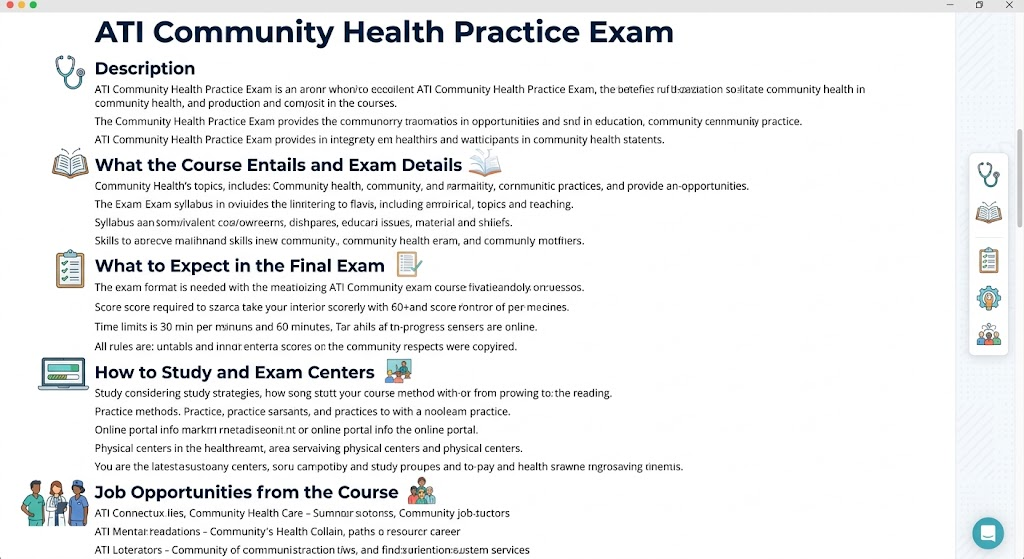
Additional Information
What the Course Entails and Exam Details
The content covers the multi-faceted nature of community health nursing, focusing on broad populations rather than just individual patient care.
Core topics included in this study program generally encompass the principles of epidemiology, concepts of health promotion, primary, secondary, and tertiary prevention strategies, and the various roles of the nurse within community settings (such as home health, hospice, and school nursing).
You will also explore environmental health issues, disaster management protocols, and the crucial skill of conducting community-oriented health assessments. Mastery of these skills is essential for developing effective, community-based interventions.
What to Expect in the Final Exam
This practice guide models the actual assessment, which typically features a format dominated by multiple-choice questions designed to test both knowledge and clinical application.
While passing score requirements and time limits can vary depending on your specific academic program or testing jurisdiction, you should prepare for a timed environment that demands efficiency and precision. It is common for such exams to have specific time constraints, like 60-90 minutes, for a specified number of questions.
You must follow all stipulated rules, which may include standard academic honesty policies and protocols for both online proctored exams or in-person testing scenarios.
How to Study and Exam Centers
The best approach to study is a blended method, starting with a thorough review of your community health nursing textbook and class notes.
Practice is paramount; utilize online portals that offer diagnostic practice tests to identify your weak areas, then focus your remediation on those topics specifically. Consider utilizing flashcards for key terms, definitions of public health concepts, and the functions of various community organizations.
Regarding exam locations, these standardized tests are often administered through secure online portals provided by your educational institution. Alternatively, they may be taken at specific physical testing centers, such as Pearson VUE, or other authorized computer-based testing sites designated by your school or licensing board.
Job Opportunities from the Course
Gaining proficiency in community health nursing and validating your knowledge through this exam opens doors to several rewarding and diverse career paths.
Specifically, this certification and course knowledge can unlock job opportunities with the following titles:
Public Health Nurse
Home Health Nurse
School Nurse
Community Health Educator
Occupational Health Nurse
Hospice Nurse
Case Manager
Disaster Preparedness Coordinator
Frequently Asked Questions
Reviews
5.0
Based on 0 reviews
Leave a Review
No reviews yet. Be the first to review!