
ATC Tower Cab Block 5 Practice Test
$69.00
- Buy to unlock unlimited access to all Quiz questions.
- After purchase you can print a PDF of the whole quiz at any point. The PDF will contain the questions and the correct answers.
About this Exam
The ATC Tower Cab Block 5 Practice Exam is a critical milestone for individuals training to become certified Air Traffic Controllers. This specific block of training is a deep dive into advanced tower operations, typically following foundational phases. It's designed for students currently enrolled in approved FAA Air Traffic-Collegiate Training Initiative (AT-CTI) programs, candidates preparing for the FAA Academy, or trainees who want to ensure their knowledge and procedural skills are sharp for complex tower environments. This certification stage and its practice test assess your ability to manage ground and local control positions within intricate, high-volume air traffic scenarios.
Ready to test your knowledge?
Buy Now to Access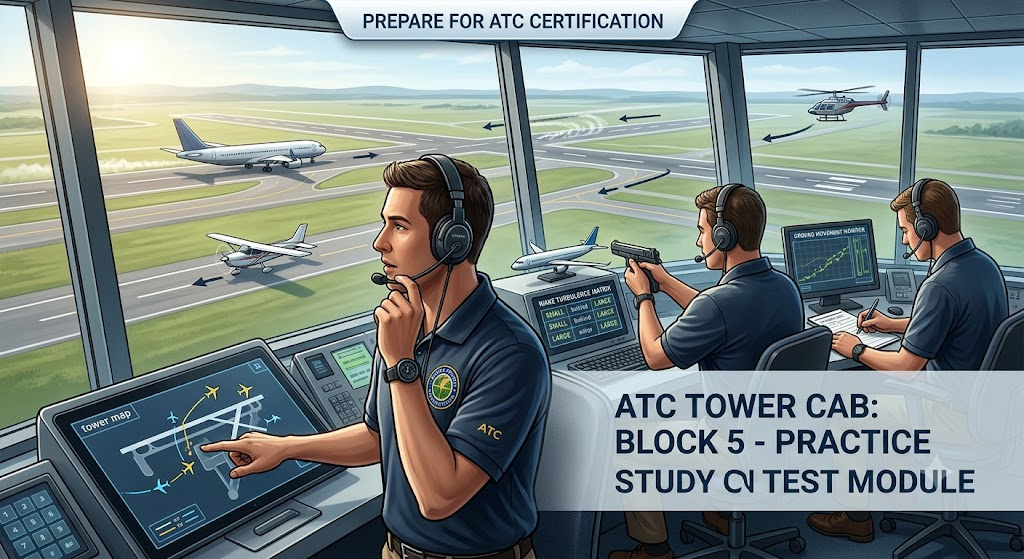
Additional Information
What the Course Entails and Exam Details
The course of study for the ATC Tower Cab Block 5 module and its associated tests covers a range of complex operational and procedural topics. This phase emphasizes the practical application of standard operating procedures, diverse separation standards, and clear, decisive communication in a dynamic, multiple-runway environment. Key areas of focus typically include:
Intricate Ground Control Procedures: Managing multiple aircraft and vehicles simultaneously on complex taxiway systems.
Diverse Local Control Tasks: Coordinating arrivals and departures across multiple active runways and intersecting/parallel configurations.
Complex Separation Standards: Applying and maintaining various initial, radar, non-radar, and wake turbulence separation minimums for different aircraft types and sequences.
Aeronautical Phraseology: Demonstrating exact and efficient pilot-controller communications in diverse, high-pressure situations.
Tower Equipment & Systems: Proficiency in operating standard and advanced tower display and communication technologies.
Emergency & Unusual Situations: Procedures for handling engine failures, bird strikes, low fuel, hijacking, communication issues, and weather-related emergencies.
Weather Dissemination & Impact: Understanding how weather affects diverse tower operations and communicating relevant information clearly.
The actual exams in this block are robust evaluations, with knowledge components often administered in a computer-based or written format. Candidates are typically expected to achieve a passing score, often 70% or higher, on the knowledge portion to progress. The practice test you are preparing for should closely mirror the format, difficulty, and complexity of these evaluations.
What to Expect in the Final Exam
While the final evaluation leading to full certification involves on-the-job and intensive practical simulation, the written/computer-based knowledge and block tests are crucial filters. The specific knowledge-based final exam you are practicing for is generally administered in a controlled environment and often consists of:
Computer-Based Knowledge Questions: Expect multiple-choice and scenario-based questions that test your understanding of FAA orders, procedures, and real-time decision-making. You will likely answer questions with detailed operational scenarios involving specific separation requirements and clearances.
Simulation-Inspired Scenarios: Some knowledge tests incorporate elements of simulated traffic, requiring you to make calls or choose correct responses for presented situations on a screen. The practice test should provide significant exposure to these scenario types.
Pass Score & Constraints: Passing requirements are typically strict, with a typical minimum requirement around 70%. Be prepared for time limits on the test as well, reflecting the real-time nature of the job.
The full, official Control Tower Operator (CTO) Certificate, and the facility rating within that certification, also requires a rigorous, "over-the-shoulder" practical examination with an FAA examiner after successful completion of all training phases and on-the-job training.
How to Study and Exam Centers
Preparation for the ATC Tower Cab Block 5 and its practice test must be thorough and multifaceted. Combine deep theoretical study with practical application. Effective strategies include:
Active and Comprehensive Practice Tests: Use online practice portals and simulation software that explicitly reference and test the Block 5 curriculum. Repeat these tests to identify weak areas. This practice exam is your primary tool.
Intensive Simulation Practice: Engage heavily in high-fidelity ATC simulations, either through your collegiate program or professional software. Focus on complex, multiple-runway scenarios.
Procedures Review (FAA Orders): Continually study and internalize key documents, especially FAA Order JO 7110.65 (Air Traffic Control). Pay close attention to the specific chapters on tower, separation, and communications.
Flashcards & Mnemonics: Create flashcards for complex phraseology, aircraft characteristics, and specific separation standards. Use mnemonics to recall crucial sequences.
Scenario Discussion Groups: Join or form study groups to discuss and review intricate scenario examples and best procedural responses. Peer learning is highly effective in this field.
Instructor & Peer Feedback: Seek specific feedback on your simulation performance and knowledge application from experienced instructors and peers.
Knowledge exams and practice test access are usually managed through the training institution's online portal, the FAA's official training management systems (e.g., eLMS for academy trainees), or authorized professional development platforms for ATC. Official final knowledge exams are often administered under proctored conditions at approved academic centers, FAA academies, or possibly authorized Pearson VUE/similar physical testing centers, while practice tests are typically online. The practical "over-the-shoulder" evaluations and final CTO exams must be conducted on-site at the training or operational FAA facility.
Job Opportunities from the Course
Successfully completing the ATC Tower Cab Block 5 module, its evaluations, and the subsequent Control Tower Operator certificate requirements opens the door to a challenging and rewarding career. This process unlocks multiple potential job titles and career paths, primarily centered on critical control roles. The specific jobs this path can lead to include:
Air Traffic Controller (ATC)
Tower Controller
Ground Controller
Local Controller
Developmental Air Traffic Controller
Air Traffic Specialist (specific roles, may require further specialization)
Completion of this block and full certification is required before you can work in an operational tower and manage real traffic. The journey begins with training, of which this practice test is a crucial preparation component. Be dedicated and utilize all resources, and you will be well-prepared to succeed and launch an exciting career in the dynamic world of Air Traffic Control.
Best of luck with your studies and your upcoming test!
Frequently Asked Questions
Reviews
5.0
Based on 0 reviews
Leave a Review
No reviews yet. Be the first to review!