
ATC Tower Cab Block 3 Practice Test
$69.00
- Buy to unlock unlimited access to all Quiz questions.
- After purchase you can print a PDF of the whole quiz at any point. The PDF will contain the questions and the correct answers.
About this Exam
Welcome to your comprehensive study guide for the ATC Tower Cab Block 3 Practice Exam. This is a crucial step in the journey of any aspiring air traffic controller trainee (developmental controller) within the FAA training pipeline. The Block 3 training is a transition from basic theory and controlled simulations into complex, dynamic tower operations, demanding a higher level of situational awareness, faster decision-making, and mastery of a busy airport environment. This practice test is specifically designed to assess and reinforce the knowledge and operational skills necessary to manage multiple aircraft, conflicting traffic, and varied surface operations simultaneously. If you are a developmental controller preparing for your final evaluation in this critical training block, this study guide is your essential companion.
Ready to test your knowledge?
Buy Now to Access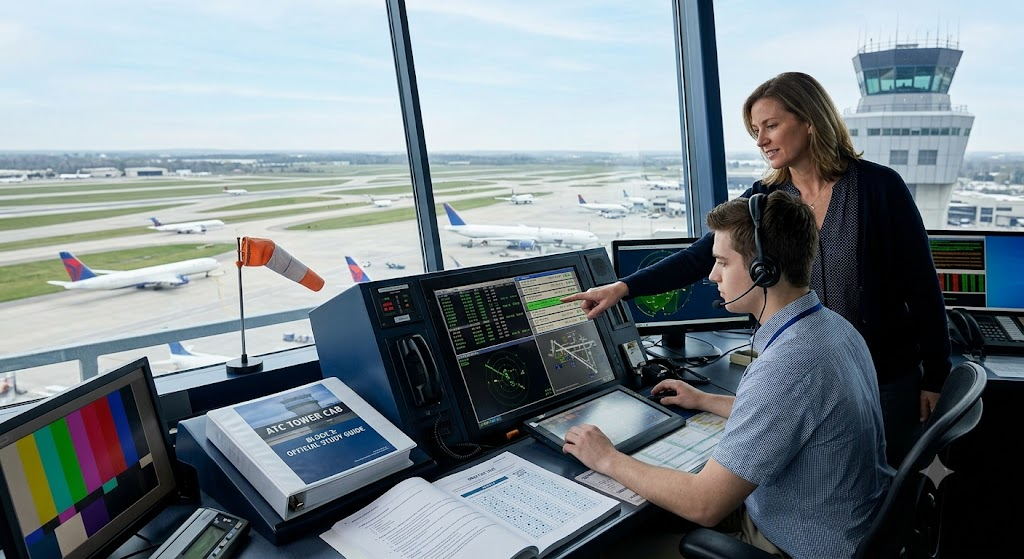
Additional Information
What the Course Entails and Exam Details
The comprehensive ATC Tower Cab Block 3 curriculum builds upon the foundational skills learned in earlier phases. It focuses on the advanced application of procedures within the airport's designated airspace and movement areas. The core topics covered in this training block, and therefore assessed in the practice and final exams, include:
Advanced Airport Operations: Mastery of departure, arrival, and ground movement procedures for multiple aircraft configurations (single, parallel, and intersecting runways).
Complex Traffic Sequencing: Learning how to sequence numerous aircraft, adjusting spacing for different aircraft classes, and managing complex wake turbulence categories in real-time.
Conflict Resolution and Management: Practicing the immediate identification and safe, efficient resolution of potential surface and airborne conflicts in a high-density environment.
Advanced Clearance Procedures: Issuing complex, multi-faceted taxi, departure, and arrival clearances under varied operational and weather conditions.
Emergency and Abnormal Operations: In-depth training on handling diverse emergencies (e.g., communication failures, aircraft emergencies, severe weather events) and implementing appropriate, time-critical procedures.
Surface Movement Coordination: Seamless interaction with ground control to ensure safe and efficient aircraft transitions between the movement area and non-movement areas.
This practice test is structured to simulate the written component of the final Block 3 evaluation. It is typically a rigorous, closed-book multiple-choice exam that covers both regulatory knowledge and procedural application scenarios. Passing this test is a vital indicator of readiness for the critical practical application phase.
What to Expect in the Final Exam
The actual final evaluation for ATC Tower Cab Block 3 is not a single test but a demanding two-part process. You must successfully navigate both:
Knowledge-Based Written Exam: This is a comprehensive, timed multiple-choice exam. The format focuses on testing your deep understanding of FAA Order 7110.65 (Air Traffic Control), specific local tower procedures (LTP), and advanced operational concepts. While specific passing scores can vary slightly, you should aim for a score of 80% or higher to demonstrate true proficiency. You can expect questions relating to precise regulations, minimum separation standards, and procedural applications in diverse scenarios.
Operational Practical Evaluation: This is the most demanding component, often requiring multiple sessions. You will be placed in a high-fidelity tower simulator and assessed on your ability to safely and efficiently control live, simulated traffic. Performance is evaluated based on critical criteria such as safety of flight, efficient traffic flow, correct standard phraseology, proper coordination, and conflict resolution. This is a pass/fail assessment based on specific error counts, critical error penalties, and an overall assessment by certified FAA evaluators. This evaluation tests your ability to apply all learned concepts under pressure, just as you would in a real-world tower environment. Time limits are not based on a clock, but on your ability to maintain a safe, efficient, and orderly flow of traffic during various traffic periods and complex scenarios.
How to Study and Exam Centers
Your success on the ATC Tower Cab Block 3 Practice Exam, and ultimately the final evaluation, hinges on dedicated study, practical repetition, and leveraging all available training resources. Here are the specific, actionable strategies for effective preparation:
Master the Core Material: Dedicate extensive study time to FAA Order 7110.65 (the Controller's Bible). Use the practice test questions to identify sections you need to revisit and fully master. Memorize key regulations and procedures.
Utilize Official Training Resources: Study all provided FAA manuals, training guides, and local tower procedure documents (LTP). Pay close attention to scenario-based training exercises.
Practice, Practice, Practice in Simulation: If available, utilize any allocated simulator time to practice complex scenarios repeatedly. Focus on the core skills evaluated in Block 3: sequencing, conflict resolution, and handling unexpected events. If personal simulation software is permitted and reliable, it can provide additional practice, but it should not replace official training.
Engage with Instructors and Peers: Seek regular feedback from your instructors. Discuss difficult scenarios with your colleagues. Ask questions whenever you have the slightest uncertainty. Collaboration and peer learning are incredibly beneficial in air traffic control training.
Take Multiple Practice Tests: The ATC Tower Cab Block 3 Practice Exam is your best tool for identifying knowledge gaps and understanding the test format. Take it multiple times, treating each attempt as a real exam to build stamina and identify consistently challenging topics.
As a developmental controller in official FAA training, you will not use external testing providers like Pearson VUE. Both the practice and final examinations are administered directly at official FAA training facilities. These include:
The Mike Monroney Aeronautical Center (FAA Academy) in Oklahoma City, OK, for initial training phases and certain assessments.
Your assigned Air Traffic Control (ATC) facility (e.g., your permanent duty station), where most practical evaluations and localized knowledge tests are conducted.
Authorized FAA-certified contract air traffic control schools or designated collegiate programs for specific types of initial or specialized training, if applicable to your training track. Your designated FAA training manager or supervisor will coordinate all official testing.
Job Opportunities from the Course
Successfully passing the ATC Tower Cab Block 3 evaluation is a major milestone in your career. It demonstrates your operational readiness and directly unlocks the next phase of your development, which will eventually lead to certification as a fully qualified controller. Achieving success in this block unlocks the following opportunities:
Certified Professional Controller (CPC - Tower): Upon successful completion of all remaining training blocks (including practical on-the-job training in a live environment) and passing all final certifications, you will earn your CPC certification. This is the ultimate goal, allowing you to control live traffic independently in your assigned tower facility.
Specialized Controller Positions: Controllers with demonstrated expertise in complex tower operations can progress into specialized roles, such as facility trainers, quality assurance specialists, or operational supervisors.
Career Advancement within the FAA: The FAA offers extensive career paths within air traffic management, leading to regional or headquarters-level leadership positions.
Contract Air Traffic Control: Your valuable expertise and certification are highly sought after by private companies that operate contract air traffic control towers for smaller airports and during special events.
Opportunities in Related Fields: The decision-making, pressure management, and operational expertise required of controllers can open doors in related industries, such as aviation safety management, airport operations, and operational coordination for major airlines.
Frequently Asked Questions
Reviews
5.0
Based on 0 reviews
Leave a Review
No reviews yet. Be the first to review!