
ATC Jeopardy Block 5 Practice Test
$69.00
- Buy to unlock unlimited access to all Quiz questions.
- After purchase you can print a PDF of the whole quiz at any point. The PDF will contain the questions and the correct answers.
About this Exam
The ATC Jeopardy Block 5 Practice Test is a dynamic, interactive training assessment designed for aspiring Air Traffic Controllers (ATCs), typically those in the "Basics" or "Tower Cab" phase of their FAA Academy or facility-specific training.
This is not a standalone external certification but a vital internal milestone. It transforms a standard written exam into a competitive, high-stakes, Jeopardy-style simulation to test synthesization of critical knowledge. It is engineered to build quick recall, pressure handling, and comprehensive understanding of intricate procedural rules.
Ready to test your knowledge?
Buy Now to Access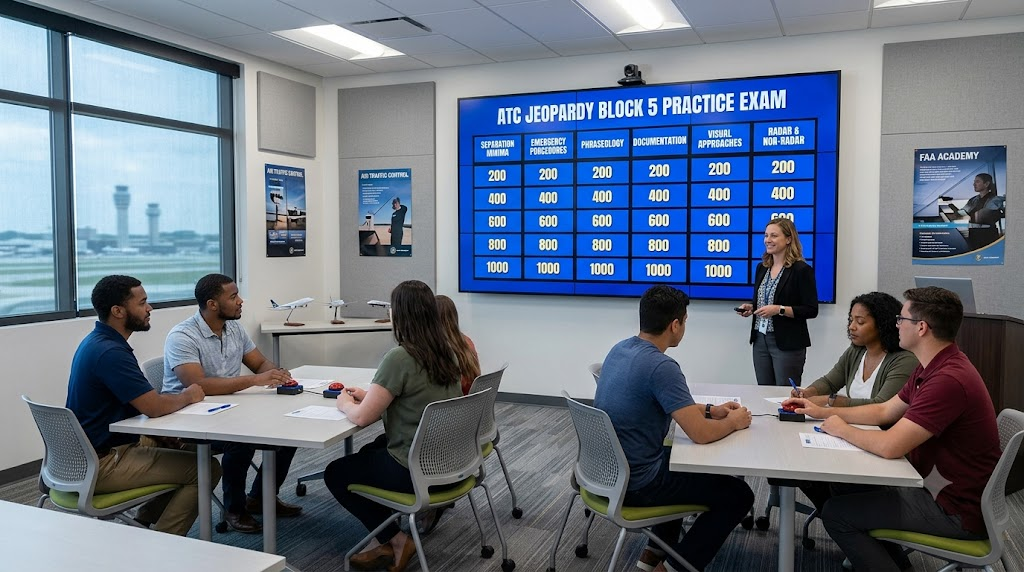
Additional Information
What the Course Entails and Exam Details
The "Block 5" designation generally indicates a specific, advanced cluster of topics in the broader ATC curriculum. This practice test focuses heavily on the application of knowledge from the current and preceding blocks. The core syllabus and skills you must master include:
Separation Minima (Radar & Non-Radar): Deep understanding and application of rules to maintain safe distance between aircraft, including standard, diverging courses, and visual separation.
Weather and Visual Rules: Mastery of VFR (Visual Flight Rules) and IFR (Instrument Flight Rules) minima, special VFR operations, and conditions for applying visual separation.
Emergency and Distress Procedures: Immediate and correct actions for handling scenarios like radio failure (Squawk 7600), hijacking (Squawk 7500), bomb threats, and "MAYDAY" conditions.
Search and Rescue (SAR): Knowledge of SAR procedures, interagency agreements, and an ATC’s role in initiating and assisting in SAR missions.
Phraseology and Communication: Flawless application of standard ATC phraseology and radio procedures.
Documentation and Forms: Proper use of flight progress strips, logs, and facility documentation (e.g., AF Form 3616).
Duty Priorities and Operations: Clear understanding of which tasks take precedence in an operational environment.
What to Expect in the Final Exam
The unique "Jeopardy" format is both the appeal and the challenge of this practice test.
Format: The activity is conducted with multiple "teams" or individual participants. A classic Jeopardy board is presented (often digitally) with five to six categories, each containing five questions with increasing point values (e.g., 200, 400, 600, 800, 1000).
Game Mechanics:
Buzzer System: Participants must "buzz in" to get the first chance to answer.
Phrasing Requirement: Every response must be phrased in the form of a question. Failing this results in a point deduction.
Timed Responses: After buzzing in, you have a very short time (often 5–15 seconds) to formulate and deliver your answer.
Scoring: Correct answers add points; incorrect answers or a failure to answer after buzzing deduct points. Other teams may get a "rebound" chance.
This pressure-filled simulation is designed to mimic the rapid decision-making required in an actual air traffic control tower or radar room. A "passing" score in this context often means having a high net positive point total and demonstrating a low error rate.
How to Study and Exam Centers
Preparation for the ATC Jeopardy Block 5 Practice Test must be both comprehensive and strategic.
Study Strategies:
Utilize Flashcards: Create or use digital flashcard sets for separation minima, phraseology, squawk codes, and emergency actions. This is key for rapid recall.
Master the Manuals: Ensure an in-depth understanding of the FAA Order JO 7110.65, "Air Traffic Control," as it is the primary source material.
Conduct Group Practice: Gather study partners and run Jeopardy-style drills. Simulate the pressure, time limits, and "buzz-in" scenario.
Rehearse Phraseology: Practice speaking ATC instructions and responses aloud until they are second nature.
Simulate High-Stress: Practice recalling information under pressure (e.g., with background noise or during physical exertion) to build mental resilience.
Exam Centers: As this is a prerequisite test within the ATC training pipeline, you do not take it at a third-party location like Pearson VUE. It is administered exclusively at authorized FAA training facilities or within a specified program, most notably at the FAA Academy in Oklahoma City, Oklahoma, or at your assigned Air Traffic Control facility during on-the-job training.
Job Opportunities from the Course
Successfully navigating and excelling in Block 5 and the Jeopardy Practice Test is a crucial step towards full certification. Completing the entire ATC training program and becoming a Certified Professional Controller (CPC) unlocks a highly specialized career path with the FAA or equivalent entities.
Certified Professional Controller (CPC)
Air Traffic Control Specialist (Terminal, En-Route, or Flight Service)
FAA Academy Instructor
ATC Traffic Management Coordinator
Airport Operations Manager
Aviation Safety Inspector
ATC System Analyst or Researcher
Use this study guide as your comprehensive resource to prepare for the unique and challenging ATC Jeopardy Block 5 Practice Test.
Frequently Asked Questions
Reviews
5.0
Based on 0 reviews
Leave a Review
No reviews yet. Be the first to review!