
ATC Jeopardy Block 1 Practice Test
$69.00
- Buy to unlock unlimited access to all Quiz questions.
- After purchase you can print a PDF of the whole quiz at any point. The PDF will contain the questions and the correct answers.
About this Exam
The ATC Jeopardy Block 1 Practice Test is an essential resource for students navigating the initial, foundational phase of air traffic control training. Created to mirror the high-stakes environment of Block 1 coursework, this practice exam uses an interactive, competitive format, similar to the popular TV game show, to reinforce core concepts. It is designed specifically for trainees within the Air Traffic Control (ATC) pipeline, providing a low-pressure yet comprehensive way to assess their readiness for official certification exams. The Block 1 phase typically covers the fundamental knowledge required to progress to advanced simulation and on-the-job training. Mastering this content is crucial for a successful career in aviation safety.
Ready to test your knowledge?
Buy Now to Access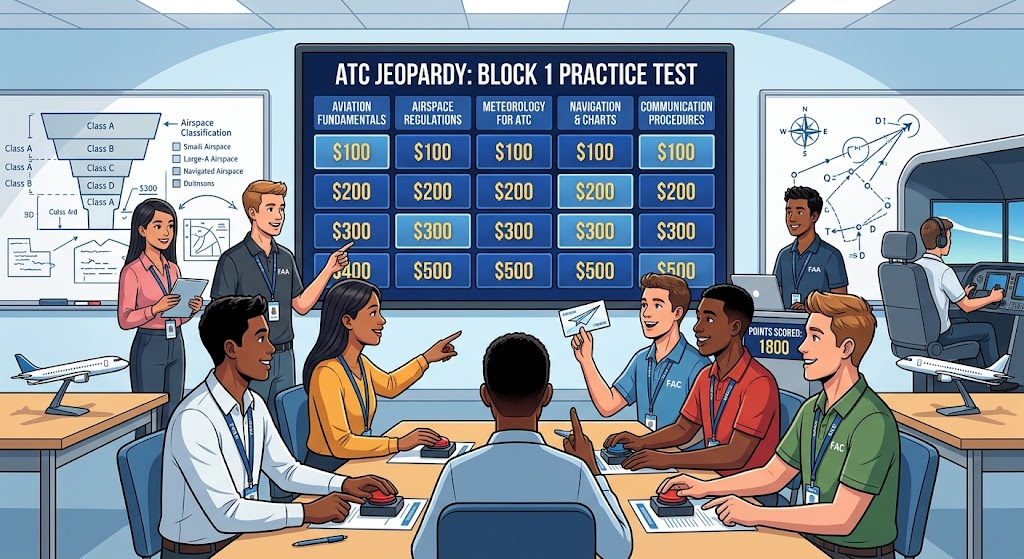
Additional Information
What the Course Entails and Exam Details
The core curriculum covered in Block 1 training, which this practice test reviews, is intensive and multi-faceted. It establishes the building blocks necessary for controlling aircraft safely. The ATC Jeopardy format typically focuses on key knowledge areas such as:
Aviation Fundamentals: Understanding basic aerodynamics, aircraft types, engine performance, and critical flight instruments.
ATC Regulations and Procedures: In-depth knowledge of standard operational procedures (SOPs), clearance structures, separation minima, and federal aviation regulations.
Meteorology for Controllers: Interpreting weather reports (METARs, TAFs), understanding the impact of weather phenomena like turbulence and wind shear, and applying this knowledge to controller decisions.
Navigation: Principles of both VOR and satellite-based (GPS) navigation, reading aeronautical charts, and understanding airways structures.
Communication and Phraseology: Mastering standard ATC terminology, the phonetic alphabet, and correct transmission protocols to prevent misunderstandings in a high-consequence environment. The practice test structure often simulates the fast-paced nature of these topics, testing both recall and application.
What to Expect in the Final Exam
Understanding the difference between this practice tool and the real thing is critical. While the "Jeopardy" practice test is an interactive game for review, the actual official final Block 1 certification exam is a formal, standardized assessment. Students can expect a rigorous multiple-choice test. The exam will contain many questions covering all the topics listed above (Meteorology, Navigation, Regulations, etc.). Passing score requirements are strict; typically, a minimum of 70% to 80% is required to advance to subsequent training blocks, though specific percentages can vary by the specific academy or region. Time limits are also strictly enforced, challenging candidates to demonstrate both accuracy and efficiency in recalling complex information. The final exam is designed to validate that trainees have truly internalized the foundational principles of Air Traffic Control and are ready to apply that knowledge in practical simulation environments. No outside aids or notes are permitted.
How to Study and Exam Centers
To prepare effectively for both the ATC Jeopardy Block 1 Practice Test and the official final exam, actionable study strategies are key. Utilize visual aids for complex concepts like airspace classification and navigation charts. Form study groups to leverage collaborative learning and test each other in "lightning rounds," mimicking the high-speed recall required for the ATC Jeopardy game. Use flashcards for phraseology and regulations. Access online practice portals provided by your training institution to repeatedly take the simulated tests, identifying weak areas.
Regarding exam centers: The ATC Jeopardy Block 1 Practice Test is typically accessed online through a trainee’s educational portal or learning management system. However, the final, high-stakes Block 1 certification exam is conducted under secure conditions. This final exam usually takes place at major Air Traffic Control training centers, such as the FAA Academy in Oklahoma City, or at designated, secure contractor facilities approved by the regulating authority, requiring in-person attendance. Specific authorized schools and designated testing centers handle different stages of the overarching career pipeline, but for the fundamental Block 1 final, location information is usually disseminated directly within the training structure.
Job Opportunities from the Course
Successfully completing the entire Air Traffic Control training pipeline, of which mastering Block 1 content is the foundational step, opens the door to several high-responsibility, prestigious, and essential careers in aviation safety. While finishing this first major phase is not a complete certification on its own, it is a critical milestone that allows candidates to progress towards these eventual roles:
Air Traffic Controller (ATC) - The most common path, working in Control Towers, Terminal Radar Approach Control (TRACON) facilities, or En Route Centers (ARTCCs), responsible for the safe and orderly flow of aircraft in the air and on the ground.
Flight Service Specialist - A critical role providing pre-flight and in-flight services to pilots, including weather briefings, airport advisories, flight plan filing, and search-and-rescue support.
Remote Pilot Operator (RPO) - A growing field supporting ATC operations through simulated scenarios or directly managing unmanned aircraft in integrated airspace, dependent on further specialization.
Navigational Aid Specialist - Expertise gained in navigation and regulations can lead to technical support roles ensuring the functionality of critical aviation infrastructure, such as VOR stations and lighting systems, though this requires separate technical certification.
Frequently Asked Questions
Reviews
5.0
Based on 0 reviews
Leave a Review
No reviews yet. Be the first to review!