
ATC Initial Tower Block 5 Practice Test
$69.00
- Buy to unlock unlimited access to all Quiz questions.
- After purchase you can print a PDF of the whole quiz at any point. The PDF will contain the questions and the correct answers.
About this Exam
The ATC Initial Tower Block 5 Practice Test is a crucial preparation tool for Air Traffic Control (ATC) trainees specializing in terminal operations. This phase of training, often administered within specialized programs like the FAA Academy, focuses specifically on the complex duties of control tower operations. The test is designed for ATC developmentals who have completed foundational training and are now mastering the advanced procedures required to manage visual and instrument traffic safely and efficiently in the immediate vicinity of an airport. Success in this block is a mandatory stepping stone toward eventual facility rating and certification.
Ready to test your knowledge?
Buy Now to Access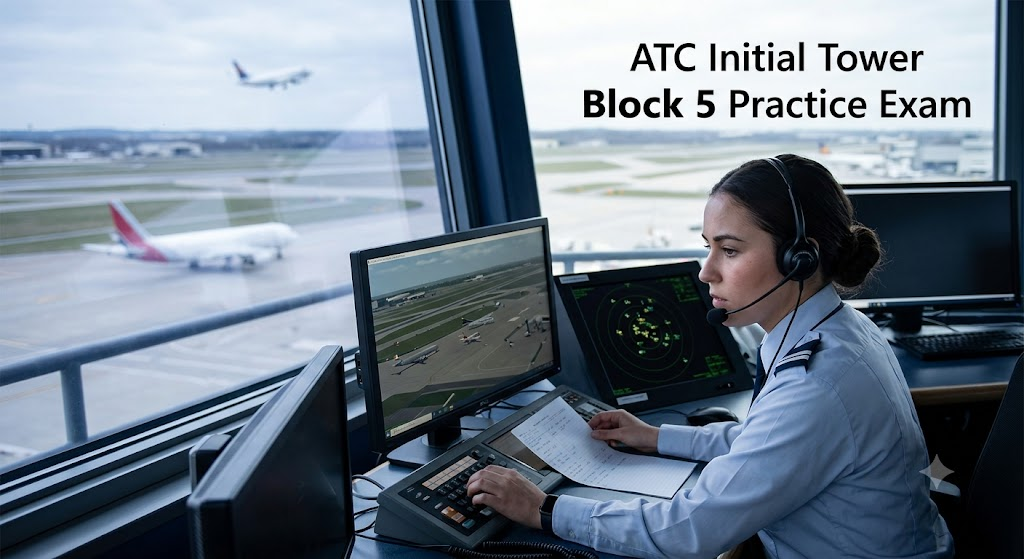
Additional Information
What the Course Entails and Exam Details
This block of instruction delves into the practical application of air traffic control procedures within a control tower environment. Trainees learn to synthesize numerous factors simultaneously. Key topics covered include advanced sequencing and separation for departing and arriving aircraft; application of wake turbulence separation minima; managing complex runway operations (including intersecting runways); coordinating seamlessly between ground, local control, and flight data positions; interpreting complex weather data affecting airport operations; and executing precise phraseology in high-density traffic scenarios. The curriculum emphasizes critical decision-making under pressure and situational awareness within the tower cab.
What to Expect in the Final Exam
While this is a practice test, it is designed to simulate the rigorous knowledge requirements of the actual ATC Block 5 qualification exam. The practice test typically consists of multiple-choice questions, scenario-based problems, and questions requiring the interpretation of charts and procedures. Trainees must demonstrate a deep understanding of FAA Order 7110.65 (Air Traffic Control) and specific terminal procedures. The actual qualification exam is high-stakes; trainees are usually required to achieve a score of 80% or higher. It is often a timed assessment, mirroring the fast-paced nature of real-world air traffic control operations. Consistent performance on practice assessments is indicative of readiness for the official evaluation.
How to Study and Exam Centers
Effective preparation for the ATC Initial Tower Block 5 requires a dedicated study strategy. Trainees should meticulously review FAA Order 7110.65, focusing heavily on the sections relevant to terminal and tower operations. Utilizing practice tests repeatedly is essential for identifying knowledge gaps and becoming familiar with the types of scenario-based questions asked. Creating flashcards for separation minima and specific phraseology can also enhance recall. Study groups with other ATC developmentals are highly effective for discussing complex scenarios and reinforcing procedural knowledge.
It is important to note that these official qualification exams are not administered at public testing centers like Pearson VUE. The actual ATC Block 5 exam is conducted internally at the authorized training facility where the trainee is enrolled, such as the FAA Academy in Oklahoma City or specialized training departments within air traffic control facilities where on-the-job training (OJT) occurs. Access to these internal exams and authorized practice materials is strictly controlled and provided directly to registered trainees.
Job Opportunities from the Course
Successfully progressing through Initial Tower training blocks, including achieving qualification in Block 5, is mandatory for trainees seeking to become Certified Professional Controllers (CPCs). This training does not lead directly to public job placement but unlocks critical advancement within the specific agency or organization conducting the training (e.g., the FAA). Key career paths and steps enabled by mastering this phase include:
Air Traffic Control Specialist (Terminal/Tower)
FAA ATC Developmental (progression to advanced phases)
Certified Professional Controller (CPC) - Terminal (upon full facility certification)
Facility Training Specialist (future path)
Support Specialist (Terminal Operations)
The foundation built in this course is essential for a successful career ensuring the safety and efficiency of the National Airspace System.
Frequently Asked Questions
Reviews
5.0
Based on 0 reviews
Leave a Review
No reviews yet. Be the first to review!