
ATC Engineering Technology 2 Sustainability Practice Test
$69.00
- Buy to unlock unlimited access to all Quiz questions.
- After purchase you can print a PDF of the whole quiz at any point. The PDF will contain the questions and the correct answers.
About this Exam
The ATC Engineering Technology 2 Sustainability Practice Test is a comprehensive tool designed to help engineering and technology students, as well as professionals, prepare for their certification in sustainable engineering practices. This certification validates essential knowledge and skills for integrating sustainability into engineering projects across various disciplines. The course and practice test are ideal for those pursuing roles in environmental management, green building, renewable energy, and corporate sustainability within the engineering and technology sectors. Whether you are a current student looking to bolster your credentials or a working professional aiming to stay current with green technologies and standards, this practice exam serves as a crucial step towards achieving recognized certification.
Ready to test your knowledge?
Buy Now to Access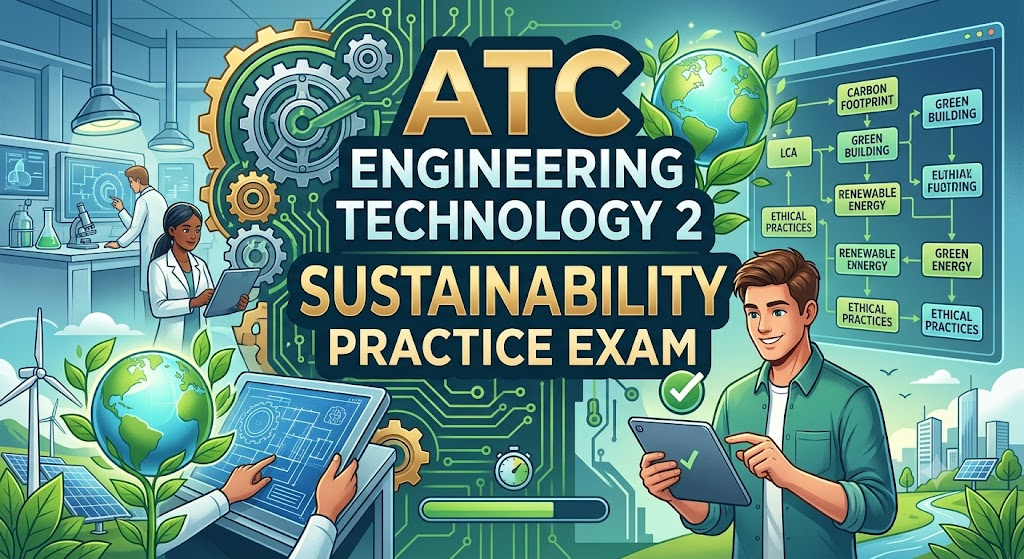
Additional Information
What the Course Entails and Exam Details
This course provides a thorough foundation in the principles and practices of engineering technology with a strong emphasis on sustainability. Key topic areas covered include:
Fundamental Sustainability Concepts: Understanding core principles of sustainability and their historical and global context.
Green Building & Sustainable Design: Principles of designing environmentally responsible and resource-efficient buildings and infrastructure, including common certification standards.
Renewable Energy Systems: In-depth knowledge of technologies like solar, wind, and hydropower, and their integration into the grid and individual projects.
Environmental Impact Assessment & Carbon Footprinting: Learning methods for assessing the environmental effects of a project, including scope 1 and scope 2 emissions, and techniques for carbon analysis.
Life Cycle Assessment (LCA) & Eco-Audits: Techniques for evaluating the entire life cycle environmental impact of products and systems, from raw material extraction to disposal.
Regulatory Compliance & Ethical Considerations: Understanding relevant environmental regulations and ethical guidelines in engineering decision-making for sustainable outcomes.
Sustainable Materials & Circular Economy: Exploring the selection of sustainable materials and the application of circular materials management.
Exam Details (Typical for the Certification Exam):
Format: The actual certification exam typically consists of multiple-choice questions (MCQ), which may include scenario-based questions and data interpretation exercises.
Passing Score: To pass the formal certification exam, a specific passing percentage (often in the range of 70% to 75%) is usually required.
Time Limit: A defined time limit (commonly between 90 minutes and 2 hours) is standard for completing the official exam.
Language: The exam and study materials are predominantly provided in English.
Please note that this Practice Test is designed to simulate the style, depth, and time constraints of the official exam to aid in your study process and identify areas needing focus. It does not replace the official exam but offers a valuable learning and review experience.
What to Expect in the Final Exam
While formats can vary, the official certification exam generally mirrors the structure and question types found within this practice exam. You can expect:
Comprehensive Coverage: Questions will span all the key topic areas outlined in Section 2, ensuring a rigorous testing of your foundational and applied knowledge.
Application-Oriented Questions: Many questions will require you to apply sustainable principles to solve engineering problems or interpret data within realistic scenarios.
Varied Difficulty: The exam will contain a mix of straightforward conceptual questions and more complex analysis or calculation-based problems.
Secure Environment: For the official exam, whether online or at a testing center, you can expect proctoring, a no-notes policy, and other standard security measures to ensure exam integrity.
Utilizing this Practice Exam will familiarize you with the type of questions, the pressure of time, and the clarity required to answer effectively. We recommend taking the practice exam multiple times, tracking your progress, and thoroughly reviewing both correct and incorrect answers.
How to Study and Exam Centers
Preparation is key to succeeding on the ATC Engineering Technology 2 Sustainability certification exam. Here are actionable study strategies and details on how to take the exam:
Actionable Study Strategies:
Utilize This Practice Test: Take the practice exam early to identify your strengths and weaknesses. Repeat it after focused study sessions to gauge improvement. Set conditions like the actual exam (quiet space, timer) for maximum realism.
Review Course Materials: Re-read and take detailed notes from your original course lectures, textbooks, online modules, or any supplied study guides.
Form a Study Group: Collaborative learning can expose you to different perspectives, allow you to explain concepts (which reinforces learning), and keep you motivated.
Seek Hands-On Experience: Where possible, apply sustainable concepts to projects. Understand LCA tools, perform carbon footprint calculations, or research green building certifications (like LEED or BREEAM) and wind/solar technology applications.
Understand Key Terms & Abbreviations: Familiarize yourself with a comprehensive list of all technical terms and industry abbreviations used in the course and sustainability field.
Seek Clarification: If you encounter confusing topics, don't hesitate to ask your instructor, fellow students, or use online forums dedicated to sustainable engineering.
Exam Centers and Formats:
The official ATC Engineering Technology 2 Sustainability certification can often be taken through several avenues:
Online Proctored Exams: Many certifications offer a secure online testing option. You will take the exam via your own computer with live proctoring through a webcam and screen-monitoring software.
Authorized Testing Centers: The exam may be available at designated physical locations. This includes authorized community colleges, technical schools, and corporate training facilities.
In-School/College Testing: If you completed the course as part of a formal educational program, your institution likely has its own proctored testing facilities and schedules.
Always refer to the official ATC Engineering Technology 2 Sustainability certification body or your educational institution for the most up-to-date and specific study resources, registration processes, and confirmed exam center options.
Job Opportunities from the Course
Earning the ATC Engineering Technology 2 Sustainability certification opens doors to a wide range of rewarding career paths. This certification can enhance your resume for job titles such as:
Sustainability Engineer
Environmental Technologist
Green Building Consultant
Renewable Energy Analyst
Sustainable Design Coordinator
Environmental Compliance Officer
Corporate Sustainability Specialist
Facilities Manager with a Green Focus
Energy Efficiency Auditor
Waste Management Coordinator
Industries such as construction, manufacturing, energy, and transportation are increasingly seeking professionals who can demonstrate proficiency in sustainable engineering practices. This certification signals to employers that you have validated knowledge and are prepared to contribute to their green initiatives.
Frequently Asked Questions
Reviews
5.0
Based on 0 reviews
Leave a Review
No reviews yet. Be the first to review!