
ATAP Certified Threat Manager (CTM) Practice Test
$69.00
- Buy to unlock unlimited access to all Quiz questions.
- After purchase you can print a PDF of the whole quiz at any point. The PDF will contain the questions and the correct answers.
About this Exam
The ATAP Certified Threat Manager (CTM) credential is a professional certification offered by the Association of Threat Assessment Professionals (ATAP). This certification is designed to validate the knowledge, skills, and experience of individuals working in behavioral threat assessment and management (BTAM).
It is not an introductory program; rather, it targets experienced professionals across various sectors (corporate security, law enforcement, education, human resources, and mental health) who are actively engaged in identifying, evaluating, and managing potential threats of violence.
Successfully challenging the CTM process and passing the practice test and final exam signals a high level of competence, dedication to ethical standards, and a comprehensive understanding of threat assessment principles and evidence-based practices.
Earning this designation demonstrates a commitment to public safety, workplace security, and the ongoing development of the field.
Ready to test your knowledge?
Buy Now to Access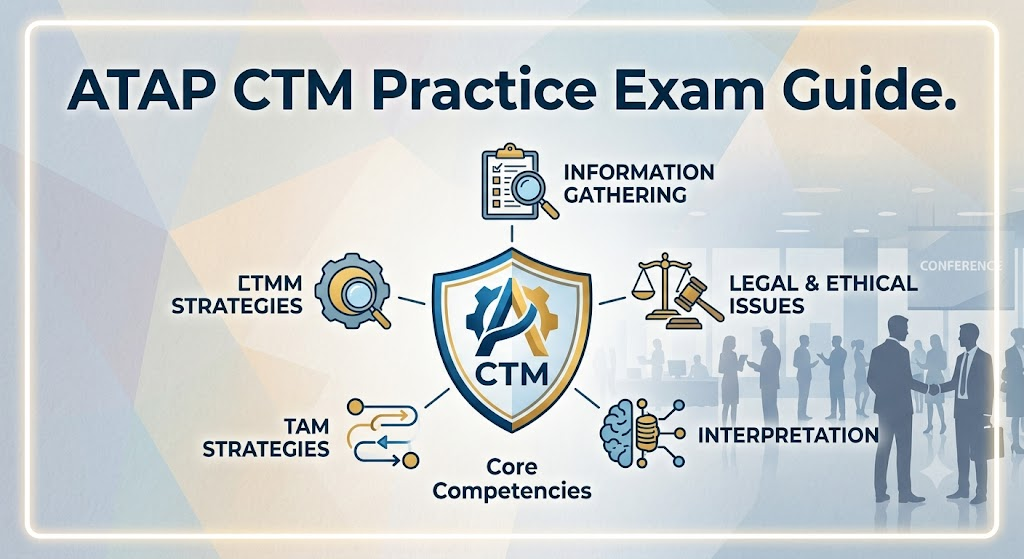
Additional Information
What the Course Ent entails and Exam Details
While there is no single mandated course for the ATAP CTM, candidates are expected to demonstrate proficiency across a broad spectrum of core competencies and a defined Body of Knowledge (BOK).
A key resource recommended by ATAP is a curated body of knowledge bundle composed of seminal texts in the field.
The curriculum and exam span topics including:
Threat Assessment Principles: Distinguishing between affective/impulsive violence and predatory/targeted violence; understanding the concept of path to violence; legal/ethical considerations.
Behavioral Indicators: Recognizing and interpreting fixations, grievances, approaches, attack-related behaviors, and other warning signs.
Information Gathering & Interpretation: Effectively collecting relevant data (historical, behavioral, environmental), assessing credibility, and analyzing the totality of the circumstances.
Violence Risk Assessment: Applying structured professional judgment to evaluate the likelihood and potential severity of targeted violence.
Threat Management Strategies: Developing and implementing interventions (monitoring, mental health support, legal action, administrative measures, protective details) and mitigation plans.
Ethics and Professionalism: Adhering to professional standards, maintaining confidentiality, and operating within legal and ethical boundaries.
Insider Threat and Specific Case Types: Understanding unique dynamics and approaches for different threat types and environments.
What to Expect in the Final Exam
The ATAP Certified Threat Manager (CTM) final examination is a rigorous assessment that challenges a candidate’s theoretical knowledge and practical application skills. It is not just about recall; it requires the ability to analyze complex scenarios and apply threat assessment principles in real-world contexts.
Specific details on the exam format are generally provided once an application is approved. However, candidates can typically expect:
Format: A combination of question styles which may include multiple-choice, scenario-based problems, and questions testing legal and ethical understanding. The emphasis is on testing practical scenario-based thinking and professional application.
Passing Score: Candidates must achieve a required passing score to earn the CTM credential. This score is set to ensure certified individuals meet a high standard of competence.
Time Limit: The exam will have a specific time limit, demanding both accuracy and efficient time management.
Rules & Procedures: Strict rules and procedures govern the testing environment to ensure security and integrity. Information regarding application fees, approval requirements (which often include years of experience and sometimes specific education/training), and a mandatory waiting period between attempts is detailed in the ATAP CTM program overview. Fees vary and are typically non-refundable or partially so, depending on the status of the application.
How to Study and Exam Centers
Preparation for the ATAP CTM exam is an intensive process, often requiring months of dedicated study and practical application of the knowledge base. This is where your Practice Test becomes invaluable.
Study Strategies:
Leverage the Practice Test: Use a high-quality practice test as a primary diagnostic tool. It will help you identify knowledge gaps, familiarize yourself with the question styles, practice time management, and build confidence in your scenario analysis skills. Re-taking the practice test and reviewing detailed explanations for both correct and incorrect answers is crucial.
Master the Body of Knowledge (BOK): Obtain and deeply study the recommended BOK materials, which typically include leading textbooks and guidelines in behavioral threat assessment.
Review ATAP Resources: Thoroughly read all official program materials, guidelines, and ethics documents provided by ATAP.
Join a Study Group: Collaborative learning with other professionals is highly encouraged and beneficial for discussing complex cases, sharing insights, and staying motivated.
Independent Reading & Flashcards: Complement structured study with relevant research papers, articles, and use flashcards for memorizing key terms, theories, and legal precedents.
Practice Scenario Analysis: Continually apply threat assessment concepts to hypothetical or real-world (and anonymized) cases, sharpening your critical thinking and assessment abilities.
Exam Centers & Delivery:
Once you have completed the prerequisite experience and have a current, approved application, you must typically contact ATAP directly to schedule your examination.
The actual delivery method and location can vary. Official ATAP exams have been known to be administered at ATAP’s annual conferences, providing a convenient opportunity for members. Other delivery options might exist, such as through established online testing portals or authorized testing centers like Pearson VUE. However, the exact availability and scheduling process are managed directly by ATAP for its certified programs. Always refer to the most current official information from ATAP regarding exam scheduling and delivery.
Job Opportunities from the Course
Earning the ATAP CTM credential unlocks a variety of specialized career paths and career advancement opportunities. This certification is a powerful validator of expertise in threat management, opening doors in sectors concerned with safety and security.
Corporate Security Director or Manager
Threat Assessment Team Leader/Manager (within corporate, educational, or government settings)
Specialized Law Enforcement Professional (e.g., Intelligence Unit, Threat Management Unit)
Human Resources Professional (with enhanced security and conflict management focus)
Threat Assessment Consultant for private firms or public entities
Director of Safety and Security in Educational Institutions (K-12 or higher education)
Executive Protection Specialist (with enhanced threat assessment capabilities)
Legal Professional with expertise in liability and threat mitigation
Emergency Management Coordinator with focus on violence prevention
Congratulations on taking the initiative to prepare for the ATAP CTM practice test and certification journey. Your commitment to safety, professionalism, and continuous improvement in this challenging field is commendable and vital. Good luck with your study!
Frequently Asked Questions
Reviews
5.0
Based on 0 reviews
Leave a Review
No reviews yet. Be the first to review!