
ASVAB General Science Practice Test 2026 (FREE CAT and PP)
$69.00
- Buy to unlock unlimited access to all Quiz questions.
- After purchase you can print a PDF of the whole quiz at any point. The PDF will contain the questions and the correct answers.
About this Exam
The Armed Services Vocational Aptitude Battery (ASVAB) is a standardized test used to determine qualification for enlistment in the United States Armed Forces. The General Science (GS) subtest is a critical component of the ASVAB, designed to assess your understanding of a broad range of scientific principles typically taught in high school. This subtest is crucial because your score directly affects your eligibility for various military occupational specialties (jobs) that require technical and scientific knowledge.
The ASVAB is intended for individuals seeking to join any branch of the US military, including the Army, Navy, Air Force, Marine Corps, and Coast Guard. The 2026 version of the practice test ensures that applicants are preparing with the most current material and testing formats.
Ready to test your knowledge?
Buy Now to Access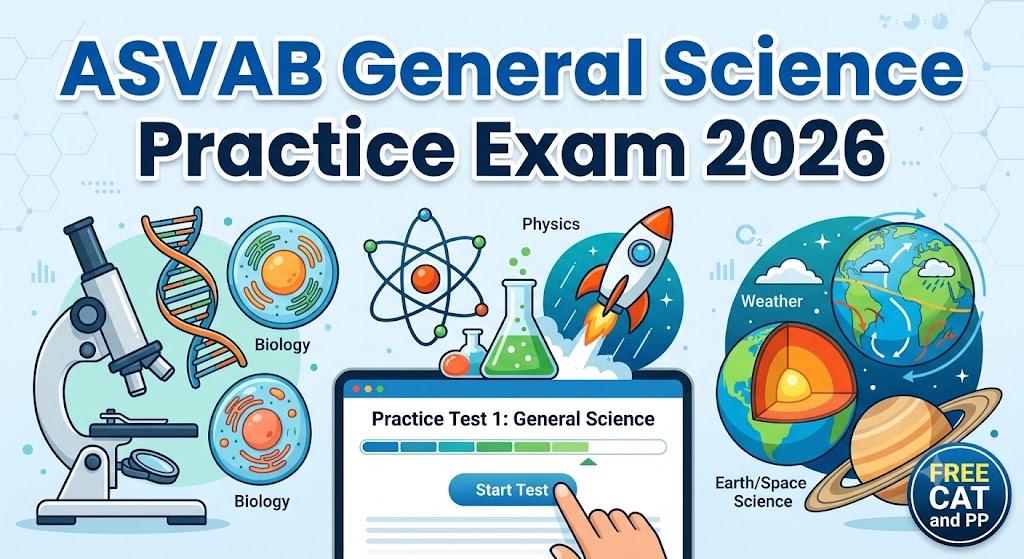
Additional Information
What the Course Entails and Exam Details
The General Science subtest covers foundational knowledge across three main scientific disciplines: Life Science, Physical Science, and Earth and Space Science. The questions focus on recognizing facts, understanding concepts, and applying scientific principles rather than complex mathematical calculations.
Core topics included in the exam are:
Life Science: Basic biology, human anatomy and physiology, genetics, ecology, and cell theory.
Physical Science: Fundamental chemistry (elements, compounds, chemical reactions) and basic physics (motion, forces, energy, electricity, and magnetism).
Earth and Space Science: Geology (rocks, plate tectonics), meteorology (weather patterns, atmosphere), and astronomy (solar system, stars).
What to Expect in the Final Exam
The ASVAB is administered in two main formats: the computerized Adaptive Test (CAT-ASVAB) and the traditional paper-and-pencil (P&P) test. You should be prepared for either format, although the CAT-ASVAB is the most common.
Exam Format: The General Science subtest is a timed, multiple-choice exam.
For the CAT-ASVAB: You will typically have approximately 15 minutes to answer about 20 questions. The CAT format is adaptive, meaning the difficulty of the questions adjusts based on whether you answered the previous question correctly.
For the Paper-and-Pencil ASVAB: You will typically have 11 minutes to answer 25 questions.
Scoring: ASVAB subtest scores are reported as standard scores. Your General Science score is combined with other subtest scores to determine your overall Armed Forces Qualification Test (AFQT) score, which dictates military eligibility, as well as specific service composite scores (or "line scores") used to qualify you for specific military jobs.
How to Study and Exam Centers
Preparation is key to scoring well on the General Science subtest. Here are some actionable study strategies:
Review High School Science Material: Dust off your high school textbooks or use online resources focusing on biology, chemistry, and physics basics. Pay attention to key terminology, definitions, and major scientific laws.
Use Practice Tests: Taking timed ASVAB General Science practice tests is essential. This helps you get used to the types of questions asked and the time constraints of the actual exam. Focus on understanding why a particular answer is correct, not just memorizing answers.
Create Flashcards: Flashcards are excellent for memorizing scientific terms, definitions, chemical elements, and basic formulas.
Focus on Concepts: The GS subtest measures understanding, not just recall. Make sure you understand the underlying concepts (e.g., how photosynthesis works, the difference between potential and kinetic energy).
Exam Centers: The official ASVAB is not taken online from home. It is administered at specific locations:
Military Entrance Processing Stations (MEPS): These are the main locations where applicants undergo processing for the military, including taking the ASVAB.
Military Entrance Test (MET) Sites: These are mobile or satellite testing locations, often in local National Guard armories or reserve centers, provided for applicants who do not live near a MEPS.
Your military recruiter will schedule your ASVAB testing at one of these authorized centers.
Job Opportunities from the Course
A strong score on the ASVAB General Science subtest is vital for qualifying for technically demanding and rewarding careers within the military. A high GS score is often required for composite scores that unlock specialized fields.
Below is a list of potential military job titles (across various branches) that heavily rely on a good General Science score:
Medical Laboratory Specialist
Hospital Corpsman (Navy Medic)
Dental Specialist
Pharmacy Technician
Nuclear Power Program Candidate (Navy)
Avionics Systems Technician
Weather Observer/Forecaster
Biological Science Research Assistant
Chemical, Biological, Radiological, and Nuclear (CBRN) Specialist
Intelligence Analyst (depending on specialization)
Environmental Science Officer
Frequently Asked Questions
Reviews
5.0
Based on 0 reviews
Leave a Review
No reviews yet. Be the first to review!