
ASU ASB353 Death and Dying Practice Exam
$69.00
- Buy to unlock unlimited access to all Quiz questions.
- After purchase you can print a PDF of the whole quiz at any point. The PDF will contain the questions and the correct answers.
About this Exam
Elevate your
preparation for the ASU ASB353 exam with our comprehensive practice assessment.
Designed specifically for students enrolled in Arizona State University's
"Death and Dying in Cross-Cultural Perspective" course, this practice
exam is an indispensable tool for mastering complex anthropological concepts.
It provides a realistic simulation of the final exam, helping learners identify
knowledge gaps, reduce test anxiety, and solidify their understanding of how
different societies perceive, ritualize, and cope with mortality. Whether you
are aiming for an 'A' or simply want to ensure you pass, this practice exam is
your strategic partner for academic success.
Sample Questions
Explanation:
Explanation:
Explanation:
Explanation:
Explanation:
Ready to test your knowledge?
Buy Now to Access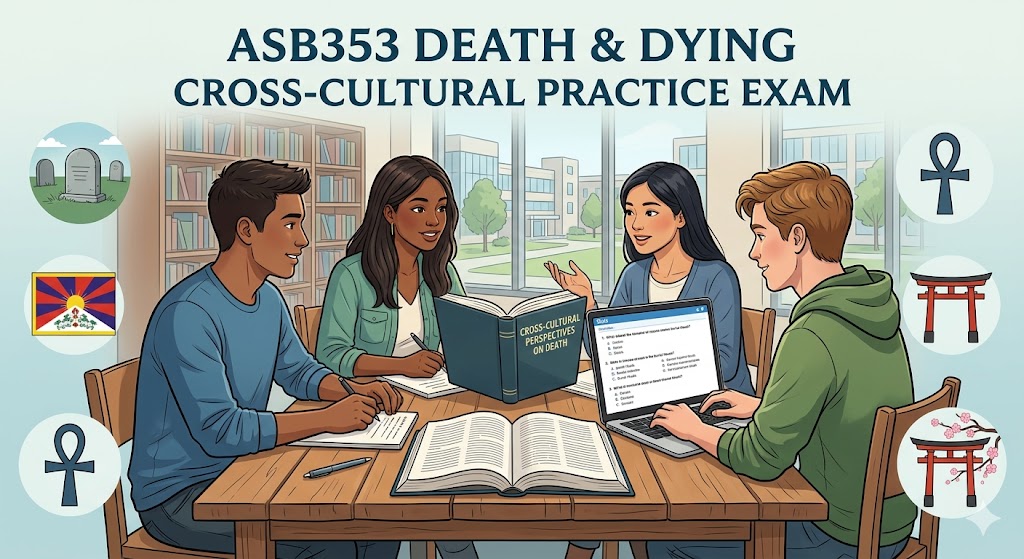
Additional Information
What the Course Entails and Exam Details
ASB353 Death and
Dying in Cross-Cultural Perspective delves deeply into the ultimate human
experience through a comparative anthropological lens. Students explore an
array of cultural, religious, and social responses to death, grief, and the
afterlife.
The course
curriculum typically covers:
- The development of anthropological
theories surrounding death and ritual.
- Diverse cross-cultural perspectives on
the definition of death and the soul.
- Detailed studies of funeral rites, body disposition
methods (e.g., burial, cremation, sky burial), and mourning practices
worldwide.
- Concepts of the afterlife, ancestor
veneration, and the relationship between the living and the dead.
- The political, economic, and social
dimensions of mortality, including issues of inequality.
- Modern challenges such as the
medicalization of death, ethical dilemmas in end-of-life care, and the
impact of globalization on traditional practices.
The practice exam
itself is carefully structured to reflect the actual assessment. It features
multiple-choice and true/false questions derived directly from core course
materials, textbooks, and lecture notes, providing a targeted and relevant
review experience.
What to Expect in the Final Exam
The actual ASU
ASB353 final exam is a comprehensive assessment that evaluates understanding of
all key concepts presented throughout the semester. While specific details may
vary slightly by instructor, students can generally expect the following:
- Format: A mix of multiple-choice, true/false,
and potentially short-answer or essay questions. The examination is
designed to test not only rote memorization but also critical thinking and
the ability to compare and contrast diverse cultural practices.
- Time
Limit: Usually a standard 1-2
hour time slot is allotted, requiring efficient time management.
- Proctoring: The exam may be proctored in a physical
classroom setting or administered online through services like Honorlock
or Respondus Monitor, which require a webcam and a secure testing
environment.
- Grading: Standard university grading policies
apply, contributing significantly to your final grade for the course.
How to Study and Exam Centers
Preparation is the
absolute key to success in ASB353. We recommend a proactive and diversified
study strategy:
- Engage
with Our Practice Exam: Take
the practice exam under simulated conditions without your notes. Use the
results to pinpoint specific topics where you need more study, then retake
it to measure your improvement.
- Review
Syllabus and Course Materials:
Systematically review class notes, lecture recordings, and especially the
required readings. Pay close attention to case studies and specific
cultural examples.
- Use
Active Recall: Create
flashcards for key terms (e.g., "liminality," "secondary
burial," "bereavement") and summarize complex cultural
rituals from memory.
- Form
Study Groups: Discussing
concepts with classmates is an exceptional way to deepen understanding and
gain new perspectives on the material.
- Exam
Location: The official ASB353
final exam is conducted through Arizona State University. Students taking
the course in-person will sit for the exam at designated locations on
their respective ASU campuses (such as Tempe, Downtown Phoenix, or West).
Online (ASU Online) students will typically take the exam remotely through
the university's learning management system, Canvas, utilizing authorized
proctoring software.
Job Opportunities from the Course
While ASB353 is an
academic course rather than a direct vocational certification, the unique
insights and critical thinking skills it cultivates are highly valuable in
several empathetic and culturally sensitive career paths. Professionals in
these fields benefit immensely from understanding diverse perspectives on mortality
and grief. Possible career opportunities include:
- Hospice
and Palliative Care Specialist
- Bereavement
Counselor or Grief Therapist
- Funeral
Director or Mortician
- Medical
Anthropologist
- Social
Worker (specializing in geriatric or end-of-life care)
Frequently Asked Questions
Reviews
5.0
Based on 0 reviews
Leave a Review
No reviews yet. Be the first to review!