
ASTB Mechanical Comprehension Practice Exam
$69.00
- Buy to unlock unlimited access to all Quiz questions.
- After purchase you can print a PDF of the whole quiz at any point. The PDF will contain the questions and the correct answers.
About this Exam
The Aviation Selection Test Battery (ASTB) is a critical component of the application process for individuals seeking a career as a commissioned officer in the United States Navy, Marine Corps, or Coast Guard. The ASTB Mechanical Comprehension section, specifically, is a vital component of this exam designed to assess a candidate's intuitive understanding of basic mechanical principles and their application in real-world scenarios.
This test is tailored for aspiring military leaders, particularly those with ambitions in the dynamic fields of aviation, engineering, and technical operations within the armed forces. It evaluates the critical thinking and practical understanding essential for success in rigorous training programs and future roles as officers and technical specialists. Whether you are aiming to pilot state-of-the-art aircraft or command mission-critical systems, your score on this section will reflect your mechanical aptitude.
Ready to test your knowledge?
Buy Now to Access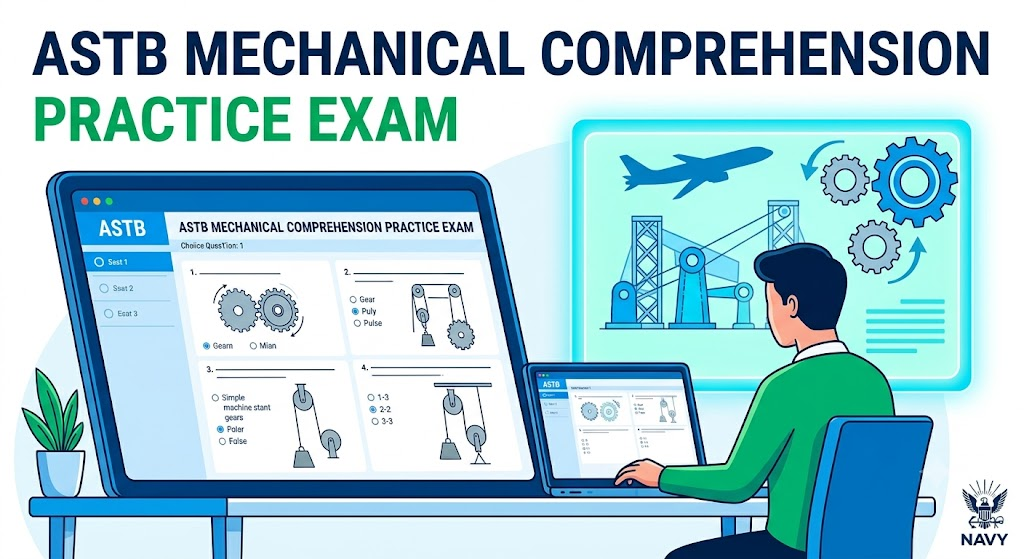
Additional Information
What the Course Entails and Exam Details
While not a single structured "course" in the traditional sense, preparing for the ASTB Mechanical Comprehension section requires a deep dive into fundamental physical laws and the practical application of everyday mechanical devices. The core topics covered within this section and the broader exam include:
Basic Physical Principles: A strong grasp of core physics concepts is essential. Be prepared to apply knowledge of force, motion (including velocity, acceleration, and Newton's laws), work, energy (potential and kinetic), and friction.
Simple Machines: Candidates must demonstrate a comprehensive understanding of how basic mechanical devices function and provide mechanical advantage. This includes an in-depth look at levers, pulleys, gears, wheels and axles, inclined planes, wedges, and screws.
Mechanical Systems & Mechanisms: The exam tests your ability to visualize and predict the behavior of complex systems. You’ll be asked to analyze interacting gears, connecting rods, and fundamental fluid power and thermodynamic principles (in introductory terms).
Tools and Their Applications: Recognizing common manual and dynamic tools and understanding their correct usage in mechanical tasks is also evaluated.
The overarching ASTB exam includes multiple subtests beyond Mechanical Comprehension, covering areas such as math skills, reading comprehension, and aviation/nautical information. The Mechanical Comprehension subtest itself usually consists of a series of multiple-choice questions (the specific number can vary between computerized and paper-based versions, typically around 15-25) with a dedicated time limit.
What to Expect in the Final Exam
The actual ASTB exam, including the Mechanical Comprehension section, is often administered on a computer and may be computer-adaptive (meaning the difficulty of subsequent questions can change based on your previous answers). This interactive format makes it dynamic and responsive to your skill level.
Format: The ASTB and its Mechanical Comprehension component consist almost entirely of multiple-choice questions. You can expect to encounter diagrams, scenarios, and theoretical questions that require you to identify mechanical principles at play, predict outcomes, or calculate basic results.
Passing Score: There isn't a single universal "passing score" for the ASTB or this specific subtest. Instead, your performance will contribute to several composite scores (such as the Officer Aptitude Rating or Stanine scores) which are then evaluated competitively by selection boards. Competitive thresholds vary by service, program, and year, so aiming for the highest possible score is always advisable.
Time Limits: This section will have a strict time limit within which you must answer all questions. Pacing is key, as you need to read, analyze the scenario or diagram, and select the best answer quickly and accurately. The overall ASTB exam will also have comprehensive time limits for each main section and subtest.
Rules: The exam is strictly proctored, and specific rules regarding forbidden items, test-taking behavior, and confidentiality will be strictly enforced at the authorized testing centers.
How to Study and Exam Centers
Preparation is paramount for achieving a competitive score. Follow these actionable strategies and access authorized testing resources to succeed:
Study Strategies:
Conceptual Understanding: Do not simply memorize answers. Focus on truly understanding the why and how behind physical laws and simple machines. Relate these concepts to everyday objects.
Use Practice Tests: Leverage a variety of reputable ASTB practice exams and sample questions. This will not only test your knowledge but also familiarize you with the question format, common pitfalls, and the time constraints of the exam. Seek out specific Mechanical Comprehension practice questions.
Review Core Science: Revisit fundamental high school and college-level material in physics, particularly regarding mechanics.
Practice with Diagrams: The test frequently uses visual aids. Practice analyzing diagrams of gear systems, pulleys, and structural challenges.
Time Management Drills: Mimic exam conditions by timing yourself during practice sessions. Work on your ability to quickly eliminate incorrect options and make informed decisions efficiently.
Seek Comprehensive Guides: Use dedicated ASTB study guides (both official military materials and reputable third-party options) that provide structured reviews of all tested topics.
Exam Centers:
The ASTB is typically not available for online testing from home. It must be taken at authorized military and educational sites. Common testing locations include:
NROTC Units: Naval Reserve Officers Training Corps units located at numerous universities across the United States.
Military Bases & Testing Facilities: Many Navy, Marine Corps, and potentially other military installations have dedicated testing centers (such as Navy Recruiting Districts or specialized testing hubs like NAMI – the Naval Aerospace Medical Institute).
Recruiting Offices: Contact a military officer recruiter for information on specific local testing options. They will be able to guide you to the appropriate, authorized testing location and schedule an exam.
Always verify the current, official procedure and locations for scheduling and taking the ASTB through a military recruiting representative.
Job Opportunities from the Course
A strong performance on the ASTB, fueled by high aptitude in Mechanical Comprehension, unlocks numerous pathways to becoming a commissioned officer with technical responsibilities, especially within the context of military aviation and operations. This exam is a critical filter for coveted roles in the armed forces. Key job titles and career paths this achievement unlocks include:
Naval Aviator (Pilot)
Naval Flight Officer (NFO)
Marine Corps Officer (Aviation/Ground Technical)
Coast Guard Officer (Aviation/Operational)
Various Military Engineering Roles
Technical Operations & System Specialists
Maintenance & Logistics Officer Roles
Frequently Asked Questions
Reviews
5.0
Based on 0 reviews
Leave a Review
No reviews yet. Be the first to review!