
ASTB Aviation/Nautical Information Test (ANIT) Practice
$69.00
- Buy to unlock unlimited access to all Quiz questions.
- After purchase you can print a PDF of the whole quiz at any point. The PDF will contain the questions and the correct answers.
About this Exam
The Aviation/Nautical Information Test (ANIT) is a specialized section of the Aviation Selection Test Battery (ASTB), the primary test used by the U.S. Navy, Marine Corps, and Coast Guard to select candidates for pilot and naval flight officer (NFO) training programs. This subtest is designed to measure an applicant’s knowledge of aviation and nautical terminology, history, principles, and regulations. It is essential for aspiring military aviators to demonstrate a strong foundational understanding in these areas to be competitive for selection.
Ready to test your knowledge?
Buy Now to Access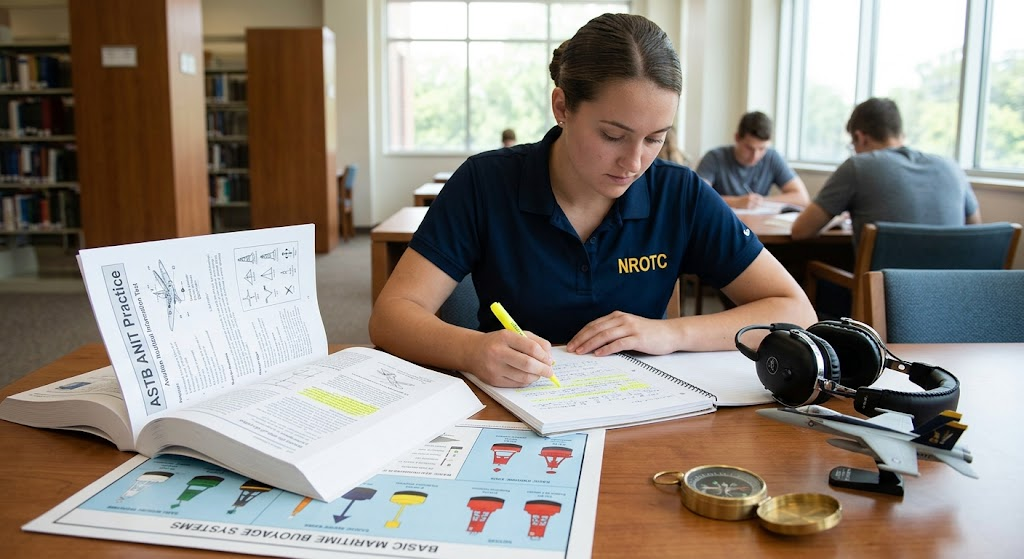
Additional Information
What the Course Entails and Exam Details
The ANIT covers a broad range of topics that are fundamental to both aviation and maritime environments. Candidates are expected to have a comprehensive grasp of:
Aviation Fundamentals: Principles of flight, basic aerodynamics, aircraft components, flight control surfaces, and aviation history.
Nautical Knowledge: Ship and boat terminology, nautical rules of the road (e.g., right-of-way rules at sea), basic seamanship, and nautical history.
Navigation: Basic principles of both air and sea navigation, including understanding charts, buoys, and compass headings.
Regulations and Terminology: Specific vocabulary used in both military aviation and naval operations, as well as relevant safety regulations.
What to Expect in the Final Exam
The ANIT is a multiple-choice subtest that is part of the larger ASTB-E (the current electronic version). The specific parameters can vary, but generally, the test is time-limited and designed to be challenging.
Format: Multiple-choice questions with several options.
Time Limit: Approximately 15 to 20 minutes are allocated for the ANIT section.
Adaptive Testing: The ASTB-E is computer-adaptive, meaning the difficulty of the questions adjusts based on the test-taker's performance. Correct answers lead to harder questions, which are weighted more heavily, while incorrect answers lead to easier questions.
How to Study and Exam Centers
To prepare effectively, candidates should focus on building a robust foundational knowledge and practicing under timed conditions.
Study Guides and Resources: Use dedicated ASTB study guides (e.g., from Baron's, Trivium, or Peterson's), official FAA manuals (like the Pilot’s Handbook of Aeronautical Knowledge), and USCG resources for nautical rules and terminology.
Flashcards: Essential for memorizing the extensive vocabulary required for both aviation and nautical components.
Practice Tests: Take timed practice ANIT sections to improve speed and accuracy. This will help you manage the strict time limits during the actual exam.
Testing Centers: The ASTB is not offered at commercial centers like Pearson VUE. Instead, it is administered at:
Military Entrance Processing Stations (MEPS).
Navy Officer Recruiting Stations.
Marine Corps Officer Selection Offices.
Select NROTC units at universities.
You must coordinate with a military recruiter to schedule the test.
Job Opportunities from the Course
Scoring well on the ASTB, particularly on the ANIT section, is essential for qualifying for the following military career paths:
U.S. Navy Pilot
U.S. Navy Naval Flight Officer (NFO)
U.S. Marine Corps Pilot
U.S. Marine Corps Naval Flight Officer (NFO)
U.S. Coast Guard Aviator
Achieving a high score significantly improves an applicant’s competitiveness for these prestigious and demanding roles.
Frequently Asked Questions
Reviews
5.0
Based on 0 reviews
Leave a Review
No reviews yet. Be the first to review!