
ASQ Certified Six Sigma Black Belt (CSSBB) Practice Test
$69.00
- Buy to unlock unlimited access to all Quiz questions.
- After purchase you can print a PDF of the whole quiz at any point. The PDF will contain the questions and the correct answers.
About this Exam
The ASQ Certified Six Sigma Black Belt is a leading professional certification for individuals seeking to become quality experts and champions of continuous improvement. This designation recognizes professionals who possess a deep understanding of Six Sigma philosophies, methodologies, including the vital DMAIC model (Define, Measure, Analyze, Improve, Control), and advanced team leadership skills. Black Belts are prepared to lead complex, organization-wide improvement projects that drive significant cost savings, enhance efficiency, and dramatically improve product and service quality. This certification is ideal for experienced professionals in manufacturing, healthcare, service industries, engineering, project management, and quality management roles who are ready to elevate their careers and make a measurable impact on organizational performance. (Candidates typically require years of experience and completed projects to be eligible for certification, so this guide aims to prepare you for the final hurdle: the exam).
Ready to test your knowledge?
Buy Now to Access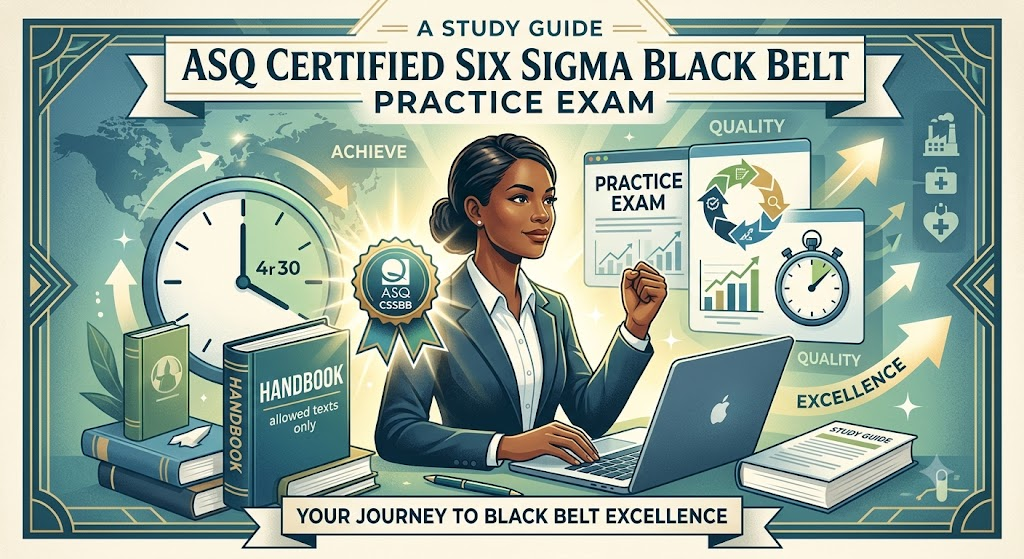
Additional Information
What the Course Entails and Exam Details
Preparing for the ASQ CSSBB requires dedication to a rigorous body of knowledge. The exam tests your competence across nine primary domains, reflecting the varied skillset required for a successful Black Belt. The core topics covered in standard study materials and tested on the exam include:
Organizational Roadmaps & Deployment: Understanding Six Sigma's fit within the entire business, strategic planning, and implementation.
Process Management: Designing, managing, and improving organizational processes, including lean principles.
Team Management: Leading diverse teams, understanding dynamics, managing conflict, and driving change.
DMAIC Methodology:
Define: Project charter development, voice of the customer, process mapping.
Measure: Data collection, basic statistics, measurement system analysis (MSA), process capability.
Analyze: Root cause analysis, hypothesis testing, exploratory data analysis, failure modes and effects analysis (FMEA).
Improve: Designing experiments (DOE), implementing solutions, Kaizen, and piloing changes.
Control: Statistical process control (SPC), visual management, and sustaining improvement.
Tools & Statistics: In-depth application of various qualitative and quantitative tools, from advanced charts to complex statistical analysis.
Lean Principles & Design for Six Sigma (DFSS): Comprehensive understanding of Lean concepts and designing quality into new products or processes.
While this page focuses on the practice test and the final exam, remember that the real journey involves understanding the full course and body of knowledge. The exam will require you to not only know the theories but also demonstrate your ability to apply them to practical scenarios. The computer-based delivery (CBT) ensures standard testing and often immediate results.
What to Expect in the Final Exam
The actual ASQ CSSBB examination is a challenging, standard test designed to thoroughly evaluate your comprehension of the body of knowledge. Here is what you must be prepared for:
Format: The exam consists entirely of multiple-choice questions. It is a computer-delivered exam (CBT). A limited number of translated paper-based exams may be available, but the standard and widely accessible format is computer-based.
Question Count: A total of 165 multiple-choice questions. Out of these, 150 questions are scored, and 15 are unscored "pre-test" questions, used by ASQ for validation and not affecting your score. You will not know which questions are pre-test, so treat all questions with the same focus.
Time Limit: You are allowed 4 hours and 30 minutes (270 minutes) to complete the entire examination. This includes time for a tutorial and administrative tasks, but the pure testing time is 4 hours and 18 minutes. Manage your time wisely, as you have just under 1.5 minutes per scored question, plus the pre-test questions.
Passing Score: ASQ uses a scaled score system. The range of possible scores typically goes from 200 to 750, with a passing score generally established at 550 or higher. This is not a simple raw percentage but rather a weighted, scaled score based on the difficulty of the specific questions you answer and overall standard setting.
Rules & Materials: The CSSBB exam is a special kind of open book exam. However, there are very strict rules about what materials are allowed. You are generally permitted to use specified official ASQ materials like the The Certified Six Sigma Black Belt Handbook or other authorized books. Critical Rule: No handwritten notes, tabs, or annotations of any kind are allowed within your materials. You cannot bring any additional loose notes, notebooks, or unauthorized electronic devices. Only official texts are permitted and must be presented for inspection at the testing center.
Results: For computer-based tests, you will receive a general "Pass" or "Fail" notification on your screen immediately after completing and submitting your exam. A more detailed official score report, particularly with failure, will follow by email within a few business days.
How to Study and Exam Centers
Passing the ASQ CSSBB exam is a significant achievement and requires structured and intensive preparation. Here are effective strategies and how to proceed:
Actionable Study Strategies:
Utilize Official ASQ Resources: The most reliable materials are from ASQ itself. These include The Certified Six Sigma Black Belt Handbook, study guides, and the official CSSBB Question Bank. The Question Bank is especially valuable as it contains hundreds of practice questions similar in style to the real exam, allowing you to test your knowledge in timed simulation modes. Remember to prepare the specific authorized materials you plan to use in the open-book format, ensuring they meet all annotation rules.
Master the DMAIC Phases: Deeply understand every step and tool in the DMAIC methodology. Focus not just on what they are, but how and when to apply them and what they mean in a real-world project context.
Take Practice Exams Under Conditions: Practice is key. Use reliable CSSBB practice tests (like the official question bank and reputable third-party sources) and take entire exams under strict time limits, simulated exam conditions (quiet space, no distractions), and, crucially, using only your allowed open-book materials. Review your results in detail, understand the logic behind correct answers, and focus additional study time on areas where you are weak.
Consider a Prep Course: Many organizations (ASQ sections, universities, private training providers) offer virtual or in-person CSSBB prep courses. These provide structured learning, expert guidance, and often additional study materials.
Form a Study Group: Collaborating with other candidates can be highly motivating and allow you to learn from different perspectives and discuss challenging concepts.
Focus on Application and Statistics: While general concepts are important, the CSSBB exam heavily emphasizes the practical application of statistical tools. Ensure you can solve complex problems and interpret the results effectively. Practice using your allowed calculator (ASQ has a list of approved calculators - typically non-programmable statistical calculators, check the current policy).
Manage Time and Stress: During study and the exam, break down long study sessions, take regular breaks, and practice relaxation techniques. On exam day, manage your time carefully, mark difficult questions to return to, and trust your training.
Regularly Review the Body of Knowledge (BoK): The official CSSBB BoK is the definitive guide to what will be on the exam. Periodically review it to ensure you have covered all topic areas and have a strong grasp of the material.
Register Early and Plan for Testing Windows: ASQ has specific testing windows throughout the year. Be aware of the dates and registration deadlines to plan your study schedule effectively.
How and Where to Take the Exam:
ASQ Registration: Your journey begins by submitting an application and fees through the official ASQ website (asq.org). ASQ will review your application and, once approved, send you an eligibility email.
Exam Delivery: All computer-based CSSBB exams are administered by a leading test delivery partner, which is typically Prometric.
Testing Options: You generally have two options for taking the CBT exam:
Prometric Test Centers: You can select from hundreds of professional Prometric testing centers located globally. You will need to schedule your appointment at your chosen center through the Prometric online scheduling tool once you have your eligibility details.
Remote Proctoring (Online): Prometric also offers an online remote proctoring option for the CSSBB exam (often through their "ProProctor" system). This allows you to take the exam from the comfort of your home or office on your own computer, with a remote proctor monitoring you via webcam and other security measures. You must have a strong and stable internet connection and meet all other hardware and software requirements. Note: Remote proctoring may not be available in all regions or locations, particularly where local in-person testing is mandated (e.g., China).
Paper-Based Testing (Limited): Very limited translated paper-based exams may be available in specific locations and languages. This is not the typical format and has very strict rules and schedules.
Find Your Center/Schedule: After you receive your eligibility information from ASQ, you will go to the Prometric website, locate a test center (if choosing in-person), and select an available date and time within your approved testing window. Follow all of Prometric's identification, scheduling, and reschedule policies.
Day of Exam: Be sure to bring valid, government-issued photo identification. At a test center, you will be given a secure environment and access to your allowed materials (subject to rigorous check). If testing remotely, you will be guided through a check-in process and environmental scan before beginning the exam under live proctoring.
Job Opportunities from the Course
Earning the ASQ Certified Six Sigma Black Belt certification unlocks a wide range of rewarding career paths and significant professional advancement. Black Belts are highly valued across numerous industries for their ability to lead impactful change. Here are some key job titles and roles commonly associated with this designation:
Continuous Improvement Manager: Develop and lead strategic continuous improvement programs across multiple departments.
Quality Director / Quality Manager: Oversee all quality assurance and quality control functions, ensuring compliance with standards and driving excellence throughout the organization.
Operational Excellence Consultant: Work externally with multiple clients or internally within a large corporation to design and implement efficient operations and lean strategies.
Process Improvement Engineer: Apply technical engineering skills and Six Sigma methodology to optimize processes in manufacturing or other technical environments.
Lean Six Sigma Manager: Specifically focus on the integrated application of lean principles and Six Sigma tools to drive efficiency and quality simultaneously.
Project Manager (Continuous Improvement focus): Manage large-scale, cross-functional improvement projects, applying project management methodologies and quality tools for successful delivery.
Data Analyst / Statistician (with Black Belt focus): Use advanced data analysis and statistical techniques (developed during your certification) to derive deep process insights and guide data-driven decision-making.
Business Analyst (Process Optimization): Analyze current processes and workflows to identify and recommend improvements using Six Sigma and Lean concepts.
VP of Operations / Director of Continuous Improvement (career progression): Experienced Black Belts often advance to high-level executive positions responsible for overall operational performance and strategic improvement.
Internal Auditor / Quality Systems Manager: Use Black Belt skills to perform rigorous audits and manage quality management systems (like ISO 9001) effectively.
Supply Chain Quality Engineer: Focus on improving quality, efficiency, and reliability throughout the end-to-end supply chain and vendor relationships.
This list is just a snapshot, as the core principles of the ASQ CSSBB (problem-solving, leadership, data analysis) are applicable in nearly every industry and function. The certification demonstrates a dedication to quality and a set of powerful skills that are in high demand by organizations worldwide.
Good luck with your preparation for the ASQ CSSBB practice test and final examination! You can achieve this distinction with structured study, focused practice, and determination. We are here to support your success. Remember to use the proper spacing and formatting for your final guide, making it easy for students to read and review.
Frequently Asked Questions
Reviews
5.0
Based on 0 reviews
Leave a Review
No reviews yet. Be the first to review!