
ASQ Calibration Technician Certification Practice Test
$69.00
- Buy to unlock unlimited access to all Quiz questions.
- After purchase you can print a PDF of the whole quiz at any point. The PDF will contain the questions and the correct answers.
About this Exam
The ASQ Calibration Technician Certification (CCT) is a highly respected credential for professionals specializing in the accuracy and reliability of measurement equipment. This certification validates your proficiency in calibrating, maintaining, and repairing various measuring and test instruments. It is designed for individuals working in quality control, manufacturing, testing laboratories, and engineering fields who are responsible for ensuring that all measuring equipment is functioning according to established standards. Earning this certification demonstrates to employers your dedication to precision, metrology principles, and adherence to international quality guidelines, significantly enhancing your career prospects in the precision manufacturing and quality sectors.
Ready to test your knowledge?
Buy Now to Access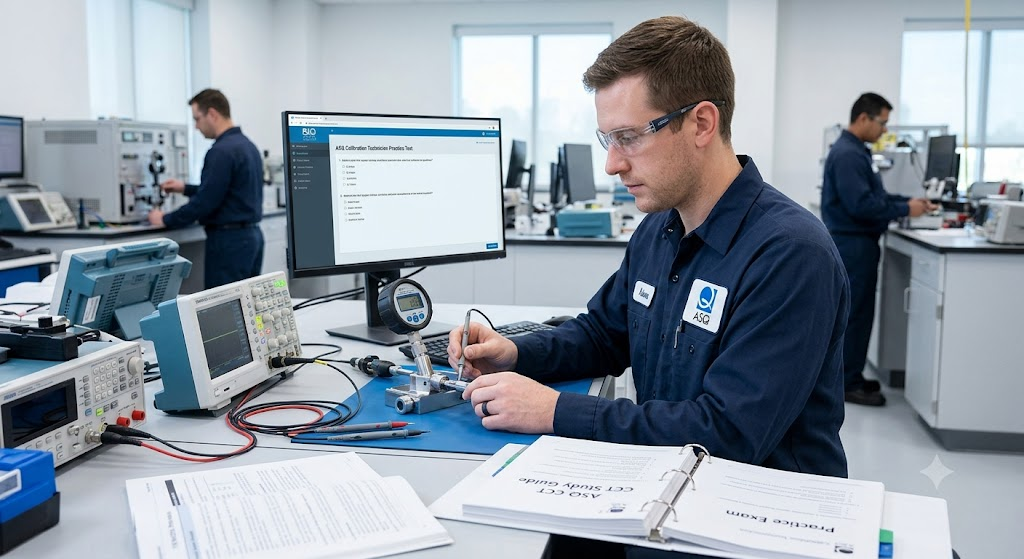
Additional Information
What the Course Entails and Exam Details
To become a Certified Calibration Technician, you must demonstrate comprehensive knowledge across several key areas outlined in the ASQ Body of Knowledge. The exam content typically covers a wide array of metrology and calibration principles, including measurement systems, uncertainty analysis, equipment verification and validation, traceability to international standards (like NIST), quality management systems, and standard calibration practices for various types of instruments (mechanical, electrical, thermodynamic, etc.). Key skills assessed include interpreting technical documentation, implementing safety protocols, and accurately recording and analyzing measurement data. The CCT exam ensures that you possess both the theoretical understanding and practical knowledge required for success in a professional calibration role.
What to Expect in the Final Exam
The official ASQ Certified Calibration Technician examination is typically a computer-based test consisting of approximately 100 to 110 multiple-choice questions. You will have a total of four hours (240 minutes) to complete the entire exam. ASQ exams are generally conducted with an "open-book" policy for specific reference materials; however, you are usually restricted to a small number of bound books and certain calculator models, so it's critical to verify the current rules on the official ASQ website well before your testing date. The passing score for the CCT exam is determined by a cut score set by a panel of subject matter experts, and it is reported as a scaled score rather than a percentage.
How to Study and Exam Centers
A robust study strategy involves leveraging official ASQ resources, including the CCT Body of Knowledge, priming materials, self-study guides, and practice tests that mirror the exam format. We highly recommend forming study groups with colleagues or taking preparatory courses if available. Creating digital or physical flashcards for complex concepts and formulas is also beneficial. Practicing with sample questions will help you manage your time effectively during the actual exam and identify weak areas for focused review. ASQ manages its computer-based testing through Prometric test centers globally. You will need to register for your exam appointment via the official ASQ website, selecting a convenient location and date at a registered testing facility or through an online proctoring option where applicable.
Job Opportunities from the Course
Achieving the ASQ Calibration Technician Certification opens doors to a diverse range of opportunities across many high-demand sectors. This credential proves your advanced skill set and dedication to quality standards, making you a competitive candidate for various roles, including:
Calibration Technician
Metrologist
Lead Calibration Specialist
Quality Control Technician (specializing in equipment)
Instrumentation Technician
Test and Measurement Technician
Laboratory Technician
Quality Assurance Inspector (focus on tool accuracy)
Equipment Maintenance Technician
Field Service Technician (Calibration)
Frequently Asked Questions
Reviews
5.0
Based on 0 reviews
Leave a Review
No reviews yet. Be the first to review!