
ASNT Industrial Radiography Radiation Safety Practice Test
$69.00
- Buy to unlock unlimited access to all Quiz questions.
- After purchase you can print a PDF of the whole quiz at any point. The PDF will contain the questions and the correct answers.
About this Exam
The ASNT Industrial Radiography Radiation Safety Personnel (IRRSP) certification program is a vital credential designed to ensure the highest standards of safety and professional integrity for individuals who work with ionizing radiation in industrial settings.
This program, administered by the American Society for Nondestructive Testing (ASNT), focuses exclusively on radiation safety practices and regulatory compliance.
It is specifically tailored for nondestructive testing (NDT) technicians, radiographers, quality control inspectors, and radiation safety officers (RSOs) who utilize X-ray and gamma-ray sources in sectors like aerospace, manufacturing, construction, and oil and gas.
By achieving this certification, professionals demonstrate their commitment to workplace safety and public health, while significantly enhancing their career opportunities in a high-demand field.
Ready to test your knowledge?
Buy Now to Access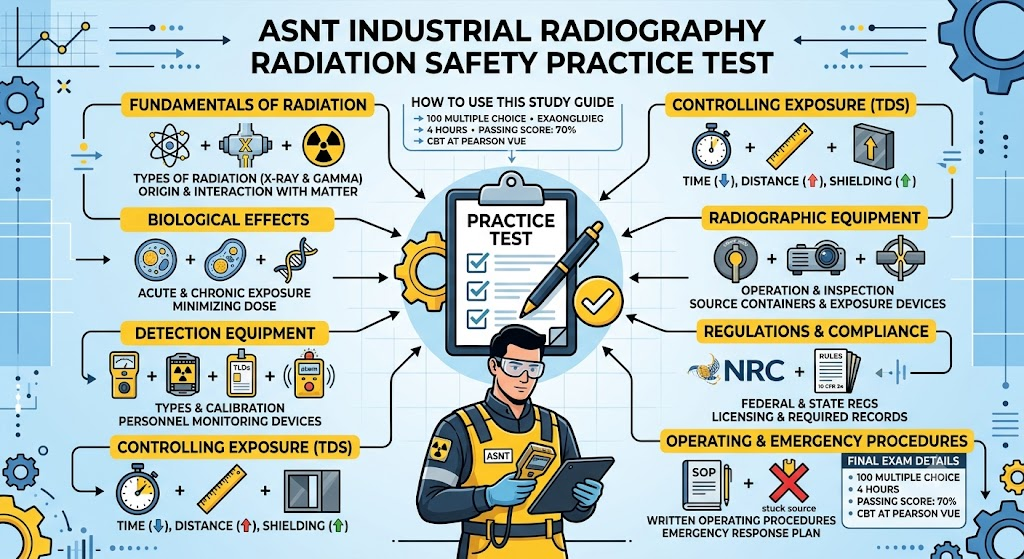
Additional Information
What the Course Entails and Exam Details
Preparing for the ASNT IRRSP certification often begins with a specific radiation safety training course from an authorized provider. While ASNT itself provides educational resources, many employers and technical schools offer the required 40-hour curriculum.
The core syllabus covers a comprehensive spectrum of safety-critical knowledge:
Radiation Physics: Understanding the nature of X-rays and gamma rays, their production, interactions with matter, and unit measurements.
Biological Effects: Learning how ionizing radiation affects human tissue, the risks of exposure, and the concept of "As Low As Reasonably Achievable" (ALARA).
Radiation Detection Instruments: Training on the correct use, calibration, and interpretation of survey meters, dosimeters, and other essential monitoring devices.
Regulatory Requirements: Mastering the strict federal (e.g., U.S. NRC 10 CFR Part 34) and state-specific regulations governing industrial radiography.
Emergency Procedures: Developing clear, decisive action plans for responding to equipment malfunctions, source disconnects, or potential overexposures.
Operational Safety & Control: Implementing practical measures, including time, distance, shielding, and the establishment of restricted areas (barriers and posting).
Transport and Storage: Ensuring compliance with laws for the secure handling, transportation, and storage of radioactive sources and equipment.
Radiography Equipment: Understanding the operation, maintenance, and potential hazards of specific X-ray machines and gamma-ray exposure devices.
Beyond the initial training, candidates must document a minimum amount of hands-on experience—hours vary depending on whether the application is for Radioactive Materials (RAM), X-ray, or a combination. The IRRSP program uniquely requires both an ASNT central written examination and an employer-administered practical examination to become fully certified.
What to Expect in the Final Exam
The ASNT Central Written Examination for Industrial Radiography Radiation Safety is a computer-based test composed of approximately 100 multiple-choice questions.
You will typically have between 2 and 3 hours to complete the examination.
The content will thoroughly assess your theoretical knowledge and understanding of all topics detailed in Section 2, with a strong emphasis on regulatory compliance and standard operating procedures.
To pass, you must achieve a score of at least 70%.
It is important to understand that you cannot be fully certified until you have also passed the hands-on, employer-administered practical exam, which must be completed within six months of passing the written portion. The practical exam confirms your ability to safely apply your knowledge in a real-world setting. If you fail the written exam, you must submit a new application before you are eligible to retest, with specific limitations on consecutive attempts.
How to Study and Exam Centers
Successfully passing the ASNT Industrial Radiography Radiation Safety exam requires a dedicated and multifaceted study strategy:
Effective Study Methods:
Deep Dive into Recommended Resources: Study the ASNT-recommended references line-by-line. This includes the relevant volumes of the ASNT NDT Handbook (Volume 4 on Radiographic Testing), ASNT Study Guides, and the specific supplementary Question and Answer (Q&A) books.
Master the Regulations: Create a detailed summary of the key federal and state regulations. Use flashcards for numeric values, specific rules on posting, and required documentation. This is often a critical factor in passing.
Take Practice Tests: Regularly complete full-length ASNT Industrial Radiography Radiation Safety practice tests. Use these to identify your knowledge gaps, practice time management, and become familiar with the multiple-choice format. This is one of the most effective ways to build confidence and refine your preparation.
Join a Study Group: Collaborate with fellow technicians and RSOs. Discussing complex scenarios, emergency procedures, and regulatory updates with peers can provide invaluable new perspectives.
Utilize Online Courses and Workshops: Consider enrolling in an online preparatory or refresher course specifically designed for the ASNT IRRSP exam. Many online NDT studies platforms offer comprehensive video lectures, interactive quizzes, and additional mock exams.
Exam Centers and Scheduling:
The ASNT central written examination is administered through the computerized network of Pearson VUE. This provides excellent flexibility, allowing you to schedule your exam at any authorized Pearson VUE testing center in the United States and globally. Candidates manage their own scheduling through the ASNT online portal (MyCert), which is integrated with Pearson VUE.
Job Opportunities from the Course
Earning your ASNT Industrial Radiography Radiation Safety Certification validates your technical skill and commitment to safety, opening doors to diverse and rewarding career paths:
Radiographer
Industrial Radiographer (X-Ray & Gamma Ray)
Nondestructive Testing (NDT) Technician
NDT Level II Technician
Quality Control Inspector (NDT)
Radiation Safety Officer (RSO) Assistant
NDT Supervisor
Asset Integrity Inspector
Radiation Protection Officer (RPO)
With this critical certification, you become an indispensable part of teams dedicated to quality, reliability, and safety across multiple industries.
Frequently Asked Questions
Reviews
5.0
Based on 0 reviews
Leave a Review
No reviews yet. Be the first to review!