
ASNT 40 hour Radiation Safety Practice Exam
$69.00
- Buy to unlock unlimited access to all Quiz questions.
- After purchase you can print a PDF of the whole quiz at any point. The PDF will contain the questions and the correct answers.
About this Exam
The ASNT 40-hour Radiation Safety course is a critical foundational program for anyone looking to enter the world of non-destructive testing (NDT), particularly in industrial radiography. This comprehensive training equips personnel with the essential knowledge and practical skills required to safely manage and work with ionizing radiation sources. It is designed for prospective and current radiographers, NDT technicians, Radiation Safety Officers (RSOs), quality control personnel, and individuals closely associated with operations involving radioactive materials and X-ray devices. Successful completion of this course and its associated exam is often the first major step towards earning more formal and widely recognized certifications, such as the ASNT Industrial Radiography and Radiation Safety Personnel (IRRSP) certification, or meeting regulatory requirements. This guide serves as your path to understanding and mastering the preparation, including the essential use of ASNT 40-hour Radiation Safety practice exams, for your final, formal certification test.
Ready to test your knowledge?
Buy Now to Access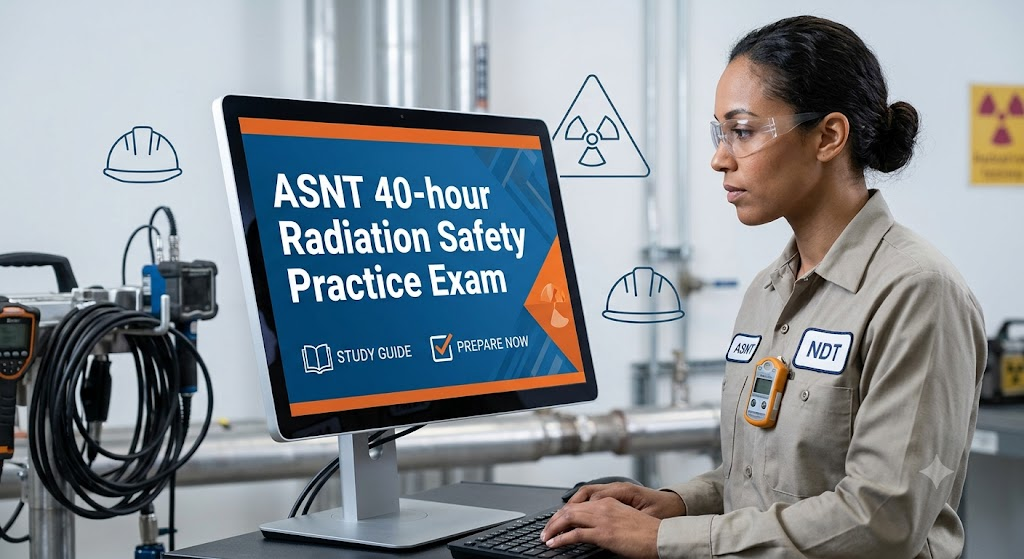
Additional Information
What the Course Entails and Exam Details
This intensive 40-hour course delves into a broad spectrum of critical topics that form the backbone of safe radiation practices in industrial settings. While specific course providers may vary slightly in their exact syllabus, the core knowledge areas typically include:
Radiation Physics and Basic Principles: Understanding the structure of the atom, radioactive decay, different types of ionizing radiation (e.g., gamma, X-ray), and how radiation interacts with matter.
Biological Effects of Radiation: Learning about the potential health risks associated with radiation exposure, both acute and chronic, and the importance of adhering to safety limits.
Radiation Detection and Measurement: Mastering the principles and correct usage of essential radiation survey instruments, dosimeters, and monitoring devices to quantify radiation levels.
Principles of Radiation Safety: Focusing on the three key elements of radiation protection: Time, Distance, and Shielding (TDS), as well as practical applications.
Regulatory Requirements (US focus and state variations): Gaining detailed knowledge of relevant federal (e.g., NRC, OSHA, Department of Transportation) and applicable state regulations governing the possession, use, transportation, and disposal of radiation sources.
Operating and Emergency Procedures: Learning specific, documented protocols for routine equipment operation, maintenance, leak testing, source exchanges, and, critically, how to respond safely to unexpected incidents and emergencies.
Radiographic Equipment: Understanding the types, components, and safe operation of common industrial radiography equipment, including gamma projectors (using isotopes like Iridium-192, Cobalt-60) and X-ray machines.
What to Expect in the Final Exam
While the exact structure of the final exam taken immediately after a specific 40-hour course might depend on the training provider and the requirements they meet (e.g., employer qualification vs. preparation for formal certification), a standard, comprehensive exam based on this body of knowledge often follows this format and meets these expectations, especially if it prepares you for formal certification like IRRSP:
Format: Typically, the written exam is comprised of multiple-choice questions, which evaluate your theoretical understanding and practical application of radiation safety principles and regulations. It is usually a closed-book exam.
Time Limit: Expect to have a specific, limited amount of time to complete the exam. For a formal 100-question certification exam, this might be around 3 hours. Individual course completion exams may have different, sometimes shorter, time limits reflecting a smaller number of questions. Plan for at least half a day if including registration, breaks, and multiple potential test sections.
Passing Score: Requirements for a passing score will vary. Course completion may require a score of 70% or 80%. Formal certification bodies like ASNT for IRRSP generally have a set passing percentage (often in the range of 70-80%). Always verify the exact passing score needed for your specific exam.
Specific Rules: You may be required to bring current government-issued photo identification (often two forms) and potentially basic writing materials. The use of programmable calculators is typically prohibited. A simple or online/built-in calculator might be permitted or provided. Cheating of any form, including the use of unauthorized materials, will result in immediate disqualification. All testing is generally conducted in English.
Content Emphasis: Be prepared for a heavy emphasis on understanding and applying regulations, TDS principles, operating and emergency procedures, and correctly interpreting survey measurements. Calculations related to shielding and dose limits are often part of the exam.
How to Study and Exam Centers
Preparation for both the final exam and the ASNT 40-hour Radiation Safety practice exam is key to success. Here’s a detailed approach:
Review Course Materials Thoroughly: Your original course notes, textbooks, PowerPoint presentations, and any practical session materials are your primary resources. Go over these repeatedly.
Focus on Weak Areas: Use quizzes within the course, or earlier ASNT 40-hour Radiation Safety practice exams, to identify areas where you feel less confident. Dedicate extra study time to these specific topics.
Utilize Flashcards: Create flashcards for key definitions, regulatory parts, safety principles (TDS), instrument types, typical radiation energies, half-life values, and dose limits. This is excellent for quick recall.
Practice, Practice, Practice: Seek out reputable ASNT 40-hour Radiation Safety practice exams and quizzes. Many training providers include practice exams. Look for resources that simulate the format, timing, and question types of the real exam. Treat these practice sessions as real tests to build your familiarity and time management skills. Ensure any practice exams are from trustworthy, professional sources.
Understand the "Why": Don't just memorize answers. Understand the underlying physical principles, biological effects, and the safety reasoning behind each rule and procedure.
Official ASNT Resources: Explore the ASNT website (asnt.org) for official study guides, reference books, and recommended reading lists relevant to radiation safety, industrial radiography, and formal certifications like IRRSP. ASNT often sells specific study materials and practice question books.
Exam Centers and How to Take the Exam:
Course Completion Exams: The exam for completing your specific 40-hour course will be administered by the training provider. This can be in-person at their training facility or sometimes online through proctored platforms, as specified by the course rules.
Formal Certification Exams (like ASNT IRRSP): To take a formal certification exam like ASNT IRRSP, you typically need to:
Apply and Be Approved: Submit an application to ASNT for the relevant certification. Provide proof of your training (your 40-hour course completion certificate) and experience as required.
Register & Pay: Pay the necessary exam fees to ASNT.
Schedule with Pearson VUE: Once approved by ASNT, you can schedule your computer-based testing (CBT) through Pearson VUE, which has numerous authorized testing centers worldwide, and online proctoring options where available. Some exams may still be offered at specific ASNT direct testing sites or during ASNT events.
Physical Testing Centers: Pearson VUE provides a vast network of professional, secure physical testing centers. Authorized schools and NDT training facilities may also serve as exam locations for certain types of exams or when authorized. Always check with ASNT and Pearson VUE for the most up-to-date center listings and availability.
Job Opportunities from the Course
Successfully completing an ASNT 40-hour Radiation Safety course, and potentially subsequent certification, opens doors to a variety of rewarding career paths in industries where non-destructive testing and radiation sources are integral to safety and quality control. Here is a clear list of some specific job titles:
Industrial Radiographer: The most direct career path, involving the actual performace of radiographic inspections on pipelines, welds, aircraft components, pressure vessels, and more, in accordance with strict safety procedures. (Often requires subsequent practical/experience validation and formal certification).
Radiation Safety Officer (RSO) Assistant: Supporting the primary RSO in managing an organization's entire radiation safety program, ensuring compliance with all regulations, overseeing dosimeter programs, maintaining equipment, and conducting training.
NDT Technician (Level I or II in RT or related methods): Working within teams in fields like aerospace, energy, manufacturing, and transportation, using radiographic testing and often other NDT methods, with a crucial focus on maintaining safety as defined in the training.
Quality Control (QC) Inspector: Utilizing knowledge of radiation safety and NDT principles to inspect incoming materials, in-process production, or finished goods, ensuring they meet specified standards and quality requirements, which might involve verifying results from radiographic inspections.
Field Inspector/Pipeline Inspector: Specialized roles involving the inspection of critical infrastructure, such as pipelines, bridges, and storage tanks, frequently using industrial radiography on-site, requiring a high degree of safety and procedure adherence.
Industrial Gauge Operator/Technician: Working in manufacturing or processing plants with industrial devices that contain radioactive sources for level, density, or thickness measurements, requiring strict adherence to radiation safety protocols.
Entry-Level Radiation Protection/Health Physics Technician: Assisting in various aspects of radiation safety, environmental monitoring, and safety programs in settings like industrial facilities, medical labs (though ASNT is more industrial focused), or with regulatory agencies.
Transportation of Radioactive Materials Specialist: Working with companies involved in the critical logistics of moving radioactive materials and sources safely, ensuring all transport regulations are strictly followed.
Frequently Asked Questions
Reviews
5.0
Based on 0 reviews
Leave a Review
No reviews yet. Be the first to review!