
ASE School Bus Technician Brakes Certification (S4) Practice
$69.00
- Buy to unlock unlimited access to all Quiz questions.
- After purchase you can print a PDF of the whole quiz at any point. The PDF will contain the questions and the correct answers.
About this Exam
The Automotive Service Excellence (ASE) School Bus Technician Brakes Certification (S4) is a specialized credential designed for professionals who are committed to the safety and reliability of school transportation. This certification validates a technician's expertise in the diagnosis, service, and repair of the complex brake systems found on modern school buses, ensuring that these vital vehicles operate with maximum safety.
It is ideal for current diesel or school bus technicians looking to advance their careers, prove their proficiency to employers, and specialize in a high-consequence system. Beyond passing the exam, candidates must also possess two years of relevant work experience (which can be a combination of education and hands-on experience) to become fully certified.
Ready to test your knowledge?
Buy Now to Access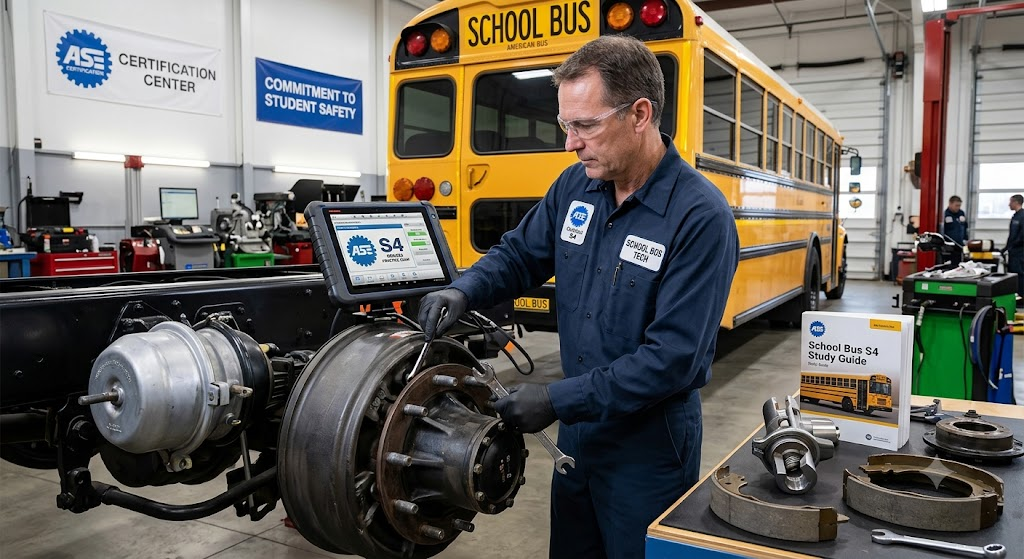
Additional Information
What the Course Entails and Exam Details
This comprehensive practice study guide focuses on the critical areas that dominate the S4 exam content. The exam itself is built around three core domains:
Air Brakes Diagnosis & Repair (Approximately 68%): This is the heart of the exam and covers the full spectrum of air brake systems, including air supply systems (compressor, governor, dryers), service systems, spring/parking brakes, and specific components like S-cam, air-disc, and foundational brakes, along with related Federal Motor Vehicle Safety Standards (FMVSS 121).
Hydraulic Brakes Diagnosis & Repair (Approximately 24%): While air brakes are predominant, many school buses utilize hydraulic systems. This section covers master cylinders, power boost units, caliper and wheel cylinder operation, and related diagnostic procedures.
Wheel Bearings Diagnosis & Repair (Approximately 8%): Focuses on the assessment and proper maintenance of wheel bearings and hub assemblies, ensuring smooth and safe operations.
What to Expect in the Final Exam
The final S4 exam is a computer-based, multiple-choice assessment that challenges your technical logic and problem-solving abilities. It is not designed to trick you but to measure your practical, safe, and efficient diagnostic and repair knowledge.
Key exam details are:
Format: The test contains a total of 60 questions. Of these, 50 are scored, and 10 are unscored research items used for future test development.
Time Limit: You will have 75 minutes to complete the entire exam.
Passing Score: ASE uses a criterion-referenced passing standard, which means the score required to pass is based on the knowledge required for competent performance. The score isn't a simple percentage.
Question Style: Be prepared for "Technician A and Technician B" questions, where you must evaluate the statements of two techs independently to determine if one, both, or neither is correct.
How to Study and Exam Centers
Preparation is paramount for success in an ASE exam. Here are actionable strategies and study resources:
Download the Official ASE Task List: Start with the definitive S4 task list from ASE. This outlines exactly what is covered and allows you to rate your current proficiency in each sub-topic. Use it as your study roadmap.
Use Diverse Study Materials: Combine official and third-party study guides, eBooks, and practice tests. These resources often break down complex systems and provide visual aids that are invaluable for understanding component interaction.
Practice Diagnostic Logic: ASE questions don't just ask about parts; they ask about finding the correct first step in a diagnostic sequence. Practice asking, "What is the most likely cause?" rather than "What part should I replace first?"
Focus on the Tech A/B Questions: These can be tricky. Practice evaluating each statement independently. For example, determine if Technician A is 100% correct, and then separately determine if Technician B is 100% correct before choosing your answer option.
Take Multiple Practice Exams: Repetition with timed practice tests will not only solidify your knowledge but also help you manage your time effectively and get comfortable with the exam’s pacing.
Schedule at an Authorized Testing Center: Once you feel prepared, you must register and schedule your exam through the official ASE portal. The test is administered at authorized professional testing centers, such as Prometric, which are located throughout the United States.
Job Opportunities from the Course
Earning the S4 certification signals a high level of competency and specialization, which is highly sought after in the student transportation industry. It can unlock numerous professional opportunities, including:
School Bus Fleet Technician
Diesel Shop Lead Technician
Transit Authority Maintenance Technician
School District Shop Foreman
Medium-Duty Truck Brake Specialist
Fleet Maintenance Manager
Fleet Safety Inspector
Heavy-Duty Brake System Technical Trainer
Frequently Asked Questions
Reviews
5.0
Based on 0 reviews
Leave a Review
No reviews yet. Be the first to review!