
ASE Electrical and Electronic Systems (A6) Practice Test
$69.00
- Buy to unlock unlimited access to all Quiz questions.
- After purchase you can print a PDF of the whole quiz at any point. The PDF will contain the questions and the correct answers.
About this Exam
The ASE Electrical and Electronic Systems (A6) certification is a vital credential designed for automotive professionals who diagnose, service, and repair the complex electrical and electronic networks within today’s cars, SUVs, and light-duty trucks (up to Class 3). This certification, administered by the National Institute for Automotive Service Excellence (ASE), formally recognizes your technical expertise and problem-solving abilities. It is engineered for experienced technicians seeking to prove their proficiency, advance their careers, and command higher wages. Earning your A6 is also a required step toward achieving the prestigious status of ASE Master Automobile Technician.
Ready to test your knowledge?
Buy Now to Access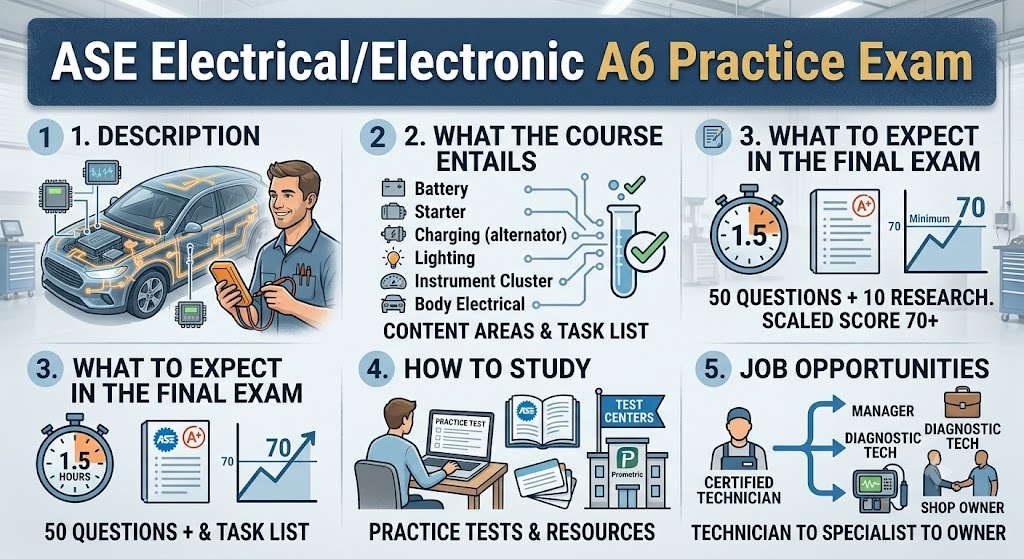
Additional Information
What the Course Entails and Exam Details
The ASE A6 exam assesses a broad spectrum of knowledge related to the electrical backbone of modern vehicles. It requires a deep understanding of circuit theory, diagnostic equipment usage, and systematic troubleshooting. The official Test Specifications and Task List outline the precise areas of focus and the approximate percentage of questions dedicated to each:
A. General Electrical/Electronic System Diagnosis (26%): This section is the foundation, covering skills like interpreting electrical schematics, utilizing digital multimeters to measure voltage, current, and resistance, testing for shorts, opens, and grounds, performing voltage drop tests, using scan tool data and trouble codes (DTCs), and checking circuit waveforms.
B. Battery and Starting System Diagnosis and Repair (18%): Focuses on testing and replacing batteries, diagnosing and repairing starting circuits, and testing starter motors and related components.
C. Charging System Diagnosis and Repair (10%): Covers diagnosing charging circuit issues, testing alternators, and repairing or replacing component parts of the charging system.
D. Lighting Systems Diagnosis and Repair (10%): Examines your ability to diagnose and fix headlights, taillights, turn signals, hazard lights, and other exterior lighting systems.
E. Instrument Cluster and Driver Information Systems Diagnosis and Repair (10%): Includes troubleshooting dashboard indicators, gauges, driver information displays, and the network interfaces that support them.
F. Body Electrical Systems Diagnosis and Repair (26%): This significant area details the "comfort and convenience" systems, such as power windows, seats, mirrors, locks, anti-theft systems, infotainment, and increasingly complex driver-assistance features (like camera and park assist systems).
What to Expect in the Final Exam
The official ASE A6 exam is a rigorous, computer-based test composed of multiple-choice questions. It includes 50 scored questions designed to test your actual diagnostic reasoning. Additionally, there are 10 non-scored research questions, used only for statistical purposes, bringing the total number of questions seen to 60.
You will have a maximum of 1 hour and 30 minutes (1.5 hours) to complete the entire exam. ASE does not publish an official raw percentage needed to pass. Instead, it uses a scaled scoring system from 1 to 100, where a scaled score of 70 is the minimum requirement to pass. This system accounts for variations in the difficulty of different versions of the test. A passing score proves your ability to meet professional standards in a real-world setting.
How to Study and Exam Centers
Effective preparation for the A6 exam requires a blend of study and practical experience. Start by obtaining the official ASE Automobile & Light Truck Study Guide, which contains the full "Test Specifications and Task List." Use this list as a diagnostic tool for your own knowledge: treat each task as a checklist and focus your effort on areas where your understanding or experience is weakest.
Utilize high-quality ASE A6 practice tests that simulate the official exam environment. These are invaluable for familiarizing yourself with the wording of ASE questions (which often describe a customer concern) and learning how to apply diagnostic logic to eliminate incorrect answers. Study electrical schematics, wire routing diagrams, and component locators, as being able to visualize a circuit is a massive advantage. On test day, remember to pace yourself and never leave a question blank, as there is no penalty for guessing.
ASE exams are administered at secure, proctored Prometric Testing Centers nationwide. There are thousands of locations, including some colleges and automotive schools authorized to serve as testing sites. You must first register for your exam(s) directly on the ASE website (ase.com) to receive an eligibility ID, and then use that ID to schedule your actual testing date and time through the Prometric online scheduling portal.
Job Opportunities from the Course
Earning your ASE A6 certification signals to employers and customers that you possess specialized skills in a critical and in-demand area of automotive technology. This credential opens doors to advanced roles and career paths, including:
Automotive Electrical Specialist: The direct role for diagnostic and repair experts focused on electrical systems.
Diagnostic Technician: Specialized technicians who are expert troubleshooters, often the last line of defense in a shop for complex issues.
Fleet Maintenance Technician: Overseeing the reliability of commercial or government vehicle fleets, which heavily rely on electrical integrity.
Shop Owner or Service Manager: Certification builds trust and sets a professional standard for leading a team or business.
Advanced Engine Performance Specialist (L1): The A6 is a required stepping stone to this highly technical master-level certification.
Hybrid/Electric Vehicle Specialist (L3): This emerging and lucrative field is a natural progression for those with deep electrical proficiency.
Good luck with your preparation, and we wish you success in becoming ASE A6 certified!
Frequently Asked Questions
Reviews
5.0
Based on 0 reviews
Leave a Review
No reviews yet. Be the first to review!