
ASE Auto Body Technology – Collision Repair & Refinish (B2–B5) Practice Exam
$69.00
- Buy to unlock unlimited access to all Quiz questions.
- After purchase you can print a PDF of the whole quiz at any point. The PDF will contain the questions and the correct answers.
About this Exam
The ASE (Automotive Service Excellence) Auto Body Technology series (B2-B5) represents a pinnacle of achievement for collision repair and refinish professionals. This certification program is meticulously designed for individuals dedicated to demonstrating their expertise in non-structural analysis and damage repair, structural analysis and damage repair, painting and refinishing, and the mechanical and electrical components involved in collision repair. This comprehensive guide and the associated practice exam serve as indispensable resources, engineered to bolster the confidence and readiness of technicians aiming for these prestigious ASE credentials. Whether you are an experienced technician refining your knowledge or a dedicated student preparing for your certification, this practice material provides targeted support on your path to validated proficiency in the dynamic field of collision repair.
Proper spacing between sentences makes the guide easy to read and understand. This professional-grade resource helps bridge the gap between practical skills and successful examination performance, allowing candidates to simulate the test experience, identify key knowledge gaps, and reinforce critical repair and safety concepts. Utilizing this guide effectively will significantly enhance your preparation and position you for success in achieving ASE B2, B3, B4, and B5 certifications.
Ready to test your knowledge?
Buy Now to Access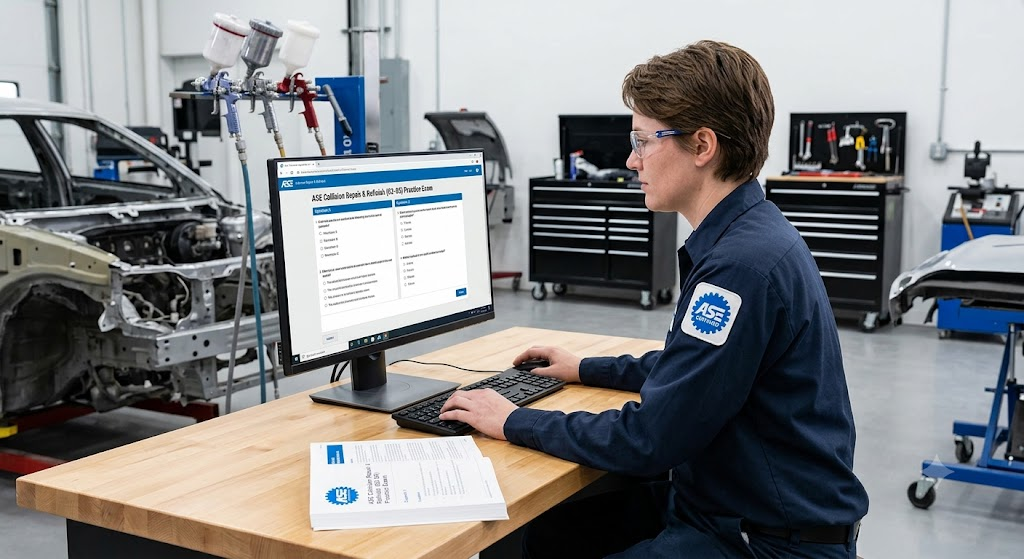
Additional Information
What the Course Entails and Exam Details
The content covered conceptually within this study guide and reflected in the practice exam aligns with the combined scope of the four distinct ASE Auto Body Technology exams:
B2 - Painting and Refinishing: Covers all aspects of automotive painting, from surface preparation, masking, and priming to finish coating, clear coat application, defect identification, and color matching. You will test your knowledge on paint materials, safety, application techniques, and understanding common finish problems.
B3 - Non-Structural Analysis and Damage Repair (Body Repair): Focuses on assessing non-structural damage, performing metal straightening and repair, using body fillers, understanding plastic repair, welding techniques, and ensuring panel alignment. This includes knowledge of tools, safety procedures, and various material types (steel, aluminum, composites).
B4 - Structural Analysis and Damage Repair: Dives deeper into analyzing the structure of the vehicle, including the unibody and frame, determining damage, understanding measuring systems and equipment, planning pulling and repair procedures, replacing structural components, and addressing specialized materials and construction methods. Crucial knowledge on welding, corrosion protection, and restoration to pre-accident specifications is assessed.
B5 - Mechanical and Electrical Components: This unique exam within the series tests your understanding of the non-collision-related systems that are frequently impacted by collision events. This includes knowledge of steering and suspension, drivetrain, HVAC (heating, ventilation, and air conditioning), restraint systems (like airbags), and automotive electrical systems, all specifically viewed from the perspective of a collision repair technician and within collision contexts.
By engaging with materials covering this collective knowledge, individuals gain a deep understanding of the standards, technologies, procedures, and safety requirements across the entire collision repair and refinish spectrum. Proper study involves integrating this technical knowledge with practical, hands-on skills, ensuring a comprehensive approach to both the practice and actual ASE certification exams.
What to Expect in the Final Exam
While this practice material prepares you for the ultimate goal, it is crucial to understand the structure of the actual ASE certification exams for each section (B2, B3, B4, and B5):
Format: The final ASE exams are computer-based and primarily consist of multiple-choice questions. These questions are designed to assess both theoretical knowledge and the application of practical concepts, often presenting scenarios or "real-world" collision repair challenges. Some question types may involve multiple-multiple choice (select all that apply) or scenario-based reasoning.
Passing Score: Each ASE exam has a proprietary passing score set by ASE, which is determined based on the specific test version's content and level of difficulty. It is generally understood that achieving a strong majority (e.g., around 70-75% or higher, varying by test) indicates proficiency. A pass/fail result is typically provided at the end of the test. Practice exam scores can provide a valuable benchmark for progress but may not perfectly mirror the scoring of the final certification exams.
Time Limits: You will encounter a specific time limit for each exam you choose to take during your testing session. These limits are typically around 60 to 90 minutes per individual B-series test, allowing focused effort on each area. If you register for multiple tests, each will have its distinct timer, but you can manage your total time spent at the testing center.
Rules and Environment: The final exams are administered under strict proctored conditions at authorized testing centers. You must present valid government-issued photo identification upon arrival. All personal belongings, including cell phones, notes, and study materials, are typically restricted and must be placed in a locker provided by the center. No outside resources are allowed during the test, and you may be provided with specific scratching materials (like digital scratch pads) depending on the center's current protocols. The environment is designed to be secure and quiet to ensure test integrity.
Using a well-structured practice exam is an essential simulation for these conditions, helping you get accustomed to multiple-choice question formats, time constraints, and building test-taking stamina and confidence. Proper preparation ensures you are ready for the unique challenges and professional environment of the actual ASE B2-B5 certification assessments.
How to Study and Exam Centers
Study Strategies:
Utilize the Practice Exam Effectively: Take the practice exam multiple times. Treat each attempt as a real simulation by adhering to time limits. Closely analyze all results, carefully reviewing questions you answered incorrectly. Understand why the correct answer was right and why other options were incorrect. Focus on your weaker areas.
Official ASE Resources: Consult the official ASE Study Guide (found on ase.com) for each specific test (B2, B3, B4, B5). These guides outline the full range of test specifications, including standard terminology, question types, and key concepts. Also, access any free ASE practice questions available on their website.
Textbooks and Training Materials: Employ current, comprehensive automotive collision repair and refinishing textbooks recommended for technicians. Reviewing course materials from vocational programs can also be highly beneficial.
On-the-Job Experience: There is no substitute for actual practical experience. Integrate your study with on-the-job learning. Reflect on how concepts you are studying apply to the repair situations you encounter daily in the shop. Pay close attention to industry standards, safety protocols, and proper tool usage.
Create Study Aids: Develop flashcards, mind maps, and summaries for key concepts, procedures, materials, and safety rules. Study groups can also offer different perspectives and help with information retention.
Time Management: Practice answering questions efficiently. Get used to reading questions carefully yet quickly and identifying key information. Simulated practice is invaluable for building this skill.
Exam Centers:
For the Practice Exam: The practice exam associated with this guide is typically accessed online through a specific learning platform or study portal. You will need a compatible computer or device with internet access to log in and complete the simulation, offering flexibility in your study location and timing.
For the Final ASE Certification Exams: The actual certification exams (B2, B3, B4, B5) are administered by specialized, highly secure computer-based testing (CBT) services. The primary partner for ASE is Prometric, with authorized centers located throughout the United States and Canada (and often internationally). When you are ready, you will need to register and pay for your exams on the ASE website and then schedule your specific testing date and location directly through the Prometric portal. The test center itself will be a secure, monitored environment. Remember to bring valid identification to your scheduled appointment. Proper planning and understanding of both your study materials and the test scheduling process are key to a smooth experience.
Job Opportunities from the Course
Successfully preparing for and subsequently achieving your ASE Collision Repair & Refinish (B2-B5) certifications demonstrates significant validated proficiency and professional commitment within the automotive industry. This prestigious recognition can unlock numerous valuable career opportunities across different segments of collision repair and automotive body technology, such as:
Certified Collision Repair Technician: Perform comprehensive non-structural body and panel repairs, ensure alignment, and execute high-quality structural restoration using specialized measuring and pulling equipment.
Certified Automotive Refinish Technician / Painter: Expertly prepare surfaces, apply priming and painting finishes, match colors, and manage all aspects of automotive painting and clear coat application, adhering to safety standards.
Structural Damage Specialist: Specialize in analyzing vehicle frames and unibodies, determining structural damage, planning, and executing critical structural repairs to restore safety and pre-accident integrity.
Non-Structural Body Repair Technician: Focus on metal straightening, plastic repair, welding techniques, panel replacement, and body filler application for non-structural damages.
Collision Shop Estimator: While requiring strong communication and administrative skills, having ASE B2-B5 certifications significantly boosts credibility when assessing damages, calculating repair costs, and communicating with insurance companies and customers.
Shop Foreman / Supervisor: Advance into leadership roles, where your technical mastery allows you to effectively guide other technicians, manage shop operations, maintain quality standards, and ensure safety compliance.
Automotive Tech Instructor: Utilize your expert knowledge and ASE credentials to teach collision repair and refinishing techniques to students at vocational schools or community colleges, shaping the next generation of technicians.
Insurance Adjuster / Appraiser (Technical Understanding): Although perhaps requiring different professional paths, the deep understanding of collision repair gained through ASE preparation can be an invaluable asset in interpreting damage reports and assessing repairs for insurance companies.
Technical Sales and Service Representative: Your validated technical expertise can lead to opportunities working with manufacturers of refinishing products, tools, or repair equipment, advising other shops on product use and best practices.
Achieving these certifications, which are recognized and respected throughout the industry, often leads to higher earning potential, enhanced job security, increased responsibilities, and greater opportunities for advancement in various automotive collision repair professional environments. Your successful completion of this study guide, practice exam, and the subsequent certification tests represents a critical step forward in a rewarding and technical automotive career.
Frequently Asked Questions
Reviews
5.0
Based on 0 reviews
Leave a Review
No reviews yet. Be the first to review!