
ASE Advanced Engine Performance Specialist Certification (L1) Practice Test
$69.00
- Buy to unlock unlimited access to all Quiz questions.
- After purchase you can print a PDF of the whole quiz at any point. The PDF will contain the questions and the correct answers.
About this Exam
The ASE Advanced Engine Performance Specialist Certification (L1) is an advanced-level credential designed for seasoned automotive technicians who specialize in complex vehicle diagnostics. This certification is not for beginners; it is specifically geared toward professionals who diagnose and repair intricate drivability and emissions control systems on modern automobiles and light trucks. By earning the L1 certification, technicians demonstrate to employers and customers that they possess a superior level of knowledge and skills in this demanding, fast-changing automotive niche. It is a true badge of expertise for those who have mastered the standard ASE Engine Performance (A8) and are ready to take their career to the highest technical tier.
Ready to test your knowledge?
Buy Now to Access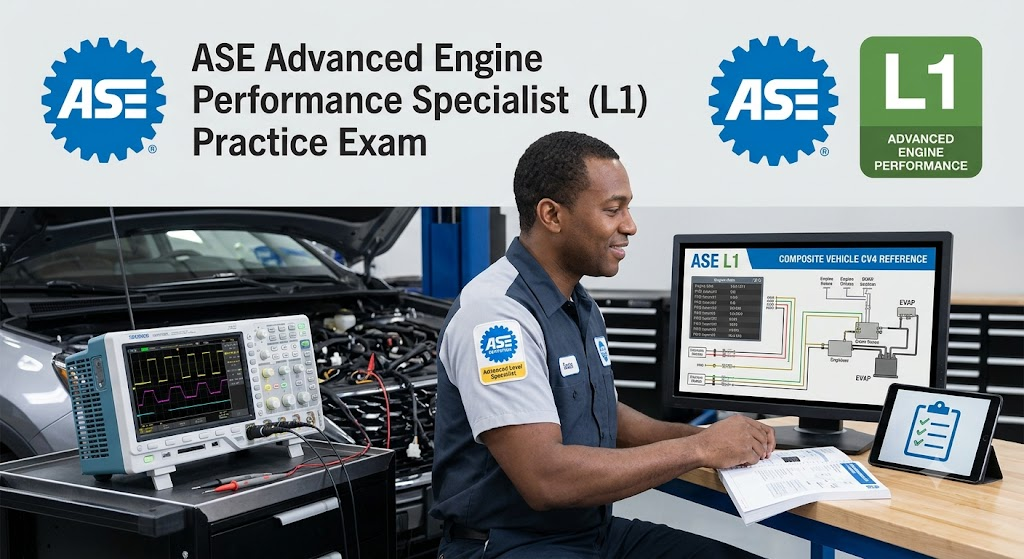
Additional Information
What the Course Entails and Exam Details
To succeed on the ASE L1 exam, a candidate must have a comprehensive understanding of how individual vehicle systems interact to affect overall engine performance. The core topics, which are detailed in the official ASE L1 Task List, include:
A. General Powertrain Diagnosis: This section covers identifying and analyzing complex performance problems using scan tools, oscilloscopes, and other advanced diagnostic equipment. It emphasizes logical troubleshooting processes rather than guesswork.
B. Computerized Powertrain Controls Diagnosis: You must understand sensor inputs, actuator outputs, communication networks (CAN bus), and the internal logic of the engine control module (ECM/PCM). It tests your ability to interpret enhanced data PIDs.
C. Ignition System Diagnosis: This includes diagnosing problems with distributorless, coil-on-plug, and waste-spark systems, including primary and secondary circuit failures.
D. Fuel Systems & Air Induction Diagnosis: Candidates must understand gasoline direct injection (GDI), multiport fuel injection, electronic throttle controls (ETC), and turbocharging/supercharging systems.
E. Emission Control Systems Diagnosis: You will be tested on the newest standards and systems, including Enhanced EVAP, exhaust gas recirculation (EGR), positive crankcase ventilation (PCV), and catalytic converter monitor strategies.
Note: A critical component of the L1 exam is the Composite Vehicle Type 4 (CV4) Reference Booklet. This booklet, which describes a fictional, representative vehicle with a typical powertrain and emission control systems, is used to answer approximately half of the exam questions. Familiarity with the diagrams and charts within it is essential.
What to Expect in the Final Exam
The official ASE Advanced Engine Performance Specialist Certification (L1) exam is a regular computer-based test, but with a few distinct rules. Here are the specific details of what to expect on your test day:
Total Questions: The exam consists of 75 multiple-choice questions.
Scored Questions: Only 50 of these questions are scored towards your final result. The remaining 25 are "unscored pretest" items used by ASE to gather statistical data for future exams. You will not know which questions are scored, so you must treat every question as if it counts.
Time Limit: You are given a generous 180 minutes (3 hours) to complete the test.
Reference Materials: You cannot bring your own materials. The CV4 Reference Booklet will be provided at the test center. It is vital to use the CV4-specific portion of the booklet to answer the corresponding questions.
Passing Score: ASE uses scaled scoring. The raw score (number of correct answers) required to pass is adjusted based on the specific difficulty of that version of the test, though it typically lands around 70%.
Results: Upon completing the exam, you will not receive your score immediately. Results will be posted to your myASE account after the statistical analysis period for that testing window is complete.
How to Study and Exam Centers
Preparing for the L1 exam requires a rigorous combination of study and hands-on experience. A mandatory prerequisite is passing the ASE A8 (Engine Performance) test. You also need to submit proof of three years of relevant, hands-on working experience to be fully certified, though you can take the L1 exam before you meet the experience requirement.
Actionable Study Strategies:
Analyze the CV4 Booklet: Download and study the Composite Vehicle Type 4 (CV4) Reference Booklet from the official ASE website months before your exam. Memorize the layout of the wiring schematics and the component location charts. You must be able to navigate it efficiently under time pressure.
Use Official Study Guides: The official ASE L1 Study Guide contains the detailed Task List. Ensure you are confident in your ability to perform every single task listed.
Take High-Quality Practice Tests: Online practice tests and diagnostic simulators are incredibly valuable. They mirror the computer-based format and help you practice time management. Focus on tests that provide detailed explanations for correct and incorrect answers to understand the "why" behind the solutions.
Refresher on A8 Material: Much of the L1 knowledge builds on the A8 base. Revisit your A8 study materials to ensure your fundamental knowledge is sharp.
Where to Take the Exam:
ASE exams are administered at nearly 500 secure, proctored testing centers across North America, primarily through Prometric. Many community and technical colleges are also authorized testing locations. To find a center near you and schedule your exam:
Step 1: Purchase your desired L1 test through your myASE account on the official ASE website (www.ase.com).
Step 2: Use the official test center locator to find a convenient location and view available times.
Step 3: Schedule your appointment. You have 90 days from the date of purchase to take the exam.
Job Opportunities from the Course
Achieving the ASE L1 Advanced Engine Performance Specialist certification is a significant milestone that can profoundly impact your career trajectory and earning potential. It unlocks opportunities in various specialized areas:
Advanced Diagnostics Technician: Lead the diagnostics team in high-end independent shops, handling the cases that other technicians cannot solve.
Shop Foreman/Service Manager: The L1 certification demonstrates leadership-level technical expertise, a crucial step toward management roles.
Emission Control Specialist: Work in specialized emissions repair and testing facilities, ensuring vehicles meet strict state compliance.
Performance Tuning Specialist: Apply your understanding of advanced engine controls to aftermarket performance tuning and customization.
Automotive Field Service Engineer: Work for manufacturers to solve widespread, complex vehicle issues that come from the field.
Fleet Manager: Manage and diagnose performance issues for large corporate or municipal fleets.
Automotive Instructor: Use your expert-level knowledge to train the next generation of automotive technicians.
Earning your L1 is more than just passing a test; it is an investment in your professional standing, making you a more valuable asset to any service facility and opening doors to highly rewarding career paths. Start your journey today!
Frequently Asked Questions
Reviews
5.0
Based on 0 reviews
Leave a Review
No reviews yet. Be the first to review!