
ASCP Technologist in Microbiology (M) Practice Exam
$69.00
- Buy to unlock unlimited access to all Quiz questions.
- After purchase you can print a PDF of the whole quiz at any point. The PDF will contain the questions and the correct answers.
About this Exam
The ASCP Technologist in Microbiology (M) certification is a prestigious credential offered by the American Society for Clinical Pathology (ASCP) Board of Certification (BOC). This certification validates the knowledge and skills of medical laboratory professionals specializing in clinical microbiology. It is designed for individuals who have already met specific education and experience requirements, typically possessing a baccalaureate degree and relevant laboratory experience. Achieving the M (ASCP) designation demonstrates a high level of competence and commitment to the field, making it a valuable asset for career advancement in diagnostic microbiology.
Ready to test your knowledge?
Buy Now to Access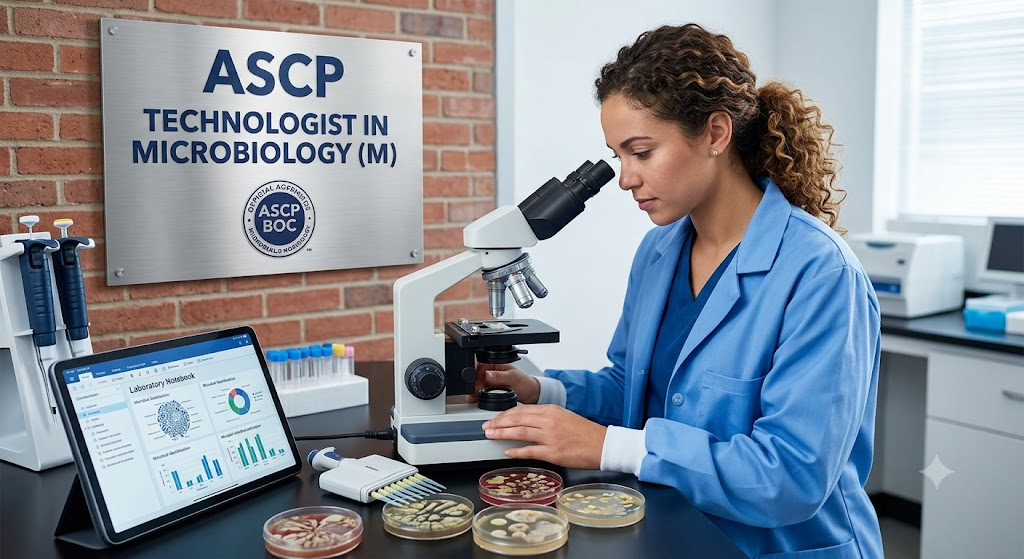
Additional Information
What the Course Entails and Exam Details
The ASCP Technologist in Microbiology exam covers a comprehensive range of topics critical to the operations of a modern clinical microbiology laboratory. The exam content is categorized into several major areas, with theoretical and practical knowledge required for each. Key areas include:
Bacteriology: Identification, susceptibility testing, and pathogenicity of aerobic and anaerobic bacteria.
Mycology: Identification of clinically significant fungi, including yeasts and molds.
Parasitology: Identification of protozoa, helminths, and arthropods that infect humans.
Virology: Detection and identification of viruses, as well as viral pathogenesis.
Laboratory Operations: Quality control, safety, instrumentation, laboratory mathematics, and management principles.
The specific weighting of each section may vary slightly, but a thorough understanding of all topics is essential for success.
What to Expect in the Final Exam
The M (ASCP) exam is a Computer Adaptive Test (CAT). This means the difficulty of the questions adjusts based on your performance. If you answer a question correctly, the subsequent question will be slightly more difficult. If you answer a question incorrectly, the next question will be slightly easier. This format accurately measures your ability level.
Number of Questions: The exam consists of 100 multiple-choice questions.
Time Limit: You will have 2 hours and 30 minutes to complete the exam.
Passing Score: The passing score is 400 on a scale of 0 to 999.
Rules: No reference materials or personal electronic devices are permitted in the testing room. Pearson VUE provides a simple on-screen calculator.
How to Study and Exam Centers
Preparation is paramount for the ASCP (M) exam. A multifaceted approach is highly recommended.
Study Strategies:
ASCP BOC Study Guide: This is considered the primary resource and contains practice questions similar to those on the actual exam.
Textbooks: Utilize standard clinical microbiology textbooks as deep reference material for detailed concepts.
Flashcards: Effective for memorizing identification keys, biochemical reactions, and susceptibility patterns.
Practice Exams: Take timed practice exams to build stamina and identify weak areas. Analyze both correct and incorrect answers.
Hands-on Experience: Your daily laboratory work is invaluable; apply theoretical knowledge to practical scenarios.
Exam Centers:
The ASCP Technologist in Microbiology exam is administered globally at Pearson VUE professional testing centers. These centers provide a secure and standardized environment. You must schedule your exam appointment directly through the Pearson VUE website after receiving your Authorization to Test (ATT) letter from the ASCP BOC. It is advisable to schedule well in advance to secure your preferred date and location.
Job Opportunities from the Course
Earning the M (ASCP) certification opens doors to specialized roles within clinical and public health sectors.
Microbiology Technologist: Perform complex diagnostic testing in hospital microbiology laboratories.
Medical Laboratory Scientist (Microbiology Specialist): Advanced diagnostic work and supervision in microbiology departments.
Public Health Microbiologist: Work in government laboratories monitoring infectious diseases and outbreaks.
Infection Control Specialist: Collaborate with healthcare teams to prevent and control hospital-acquired infections.
Research Technologist (Microbiology): Conduct research in academic or industrial settings focusing on microbial pathogens.
Laboratory Supervisor/Manager: Lead microbiology departments, overseeing personnel, quality, and operations.
Frequently Asked Questions
Reviews
5.0
Based on 0 reviews
Leave a Review
No reviews yet. Be the first to review!