
ASCP Specialist in Blood Banking (SBB) Practice Exam
$69.00
- Buy to unlock unlimited access to all Quiz questions.
- After purchase you can print a PDF of the whole quiz at any point. The PDF will contain the questions and the correct answers.
About this Exam
The ASCP Specialist in Blood Banking (SBB) certification is the pinnacle achievement for experienced laboratory professionals dedicated to immunohematology. This highly respected credential validates advanced knowledge and specialized expertise in all aspects of blood banking, transfusion medicine, and cellular therapies. It is designed for Medical Laboratory Scientists (MLS/MT) or Technologists in Blood Banking (BB) who have significant clinical experience or have completed an accredited SBB program. Attaining SBB certification signifies a mastery that enables professionals to take on leadership roles, tackle complex serological problems, and ensure the highest standards of safety in transfusion services.
Ready to test your knowledge?
Buy Now to Access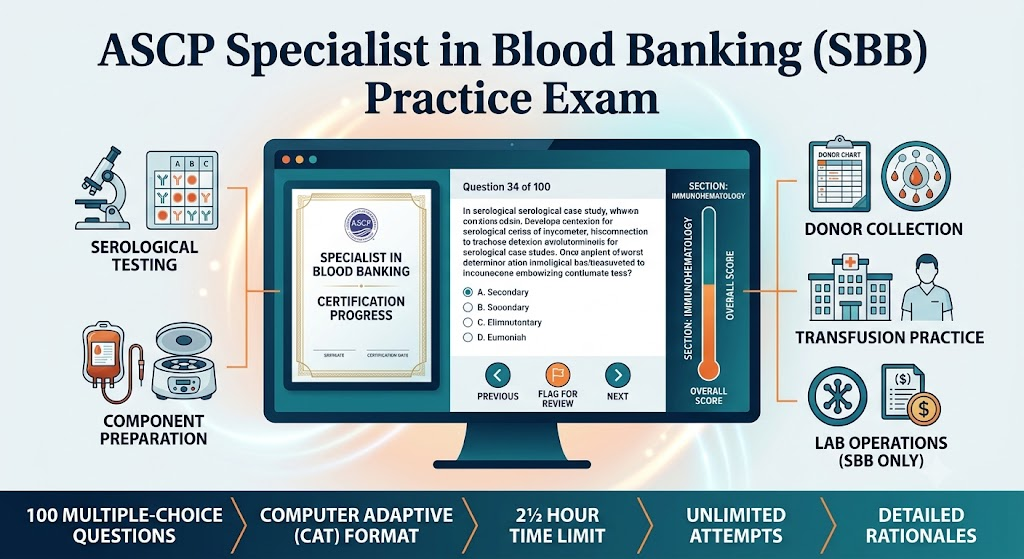
Additional Information
What the Course Entails and Exam Details
The SBB exam is a comprehensive assessment that covers an extensive content outline, testing both recall and the application of complex judgment. The core topic areas and their approximate weight on the examination are:
Laboratory Operations (20–25%): This section is unique to the SBB and heavily weighted. It includes Quality Assessment/Troubleshooting, Safety, Laboratory Mathematics, Instrumentation, and a substantial focus on Laboratory Administration (including financial management, personnel, medical-legal issues, and quality management systems).
Transfusion Practice (20–25%): Covers Patient Blood Management, Blood Administration, Extracorporeal and Apheresis Circulation, Transfusion Adverse Effects (including transmitted diseases and reactions), and Component Therapy and Indications.
Blood Group Systems (15–20%): Includes Genetics, the Role of Blood Groups in Transfusion, and Antigens/Biochemistry.
Blood Products (10–15%): Details on Donors (selection, processing), Storage, and detailed preparation of Blood Components and Quality Control.
Serologic and Molecular Testing (10–15%): Tests understanding of both Routine Tests (grouping, crossmatch) and Special Tests and Reagents, including Molecular methods.
Immunology and Physiology (10–15%): Fundamental concepts and the underlying pathophysiological principles relevant to immunohematology.
What to Expect in the Final Exam
The ASCP SBB final exam is a rigorous, computer-based test designed to challenge your specialized knowledge. Here is what you need to know about its format:
Format: The exam consists of 100 multiple-choice, single-best-answer questions. It does not use "K-type" questions or negative stems (e.g., "all EXCEPT").
Computer Adaptive Testing (CAT): The SBB exam utilizes CAT, which means the difficulty of each subsequent question is adjusted based on whether you answered the previous one correctly. Your final score is determined by the total number of correct answers and the difficulty level of the questions you faced.
Time Limit: You will have 2½ hours to complete the examination.
Passing Score: The minimum passing score is 400 on a scaled score that ranges from 0 to 999. Since it is a CAT exam, you must answer enough difficult questions correctly to reach the scaled passing point.
Preliminary Results: You will receive a preliminary pass/fail result on the computer screen immediately upon finishing the exam at the test center. Your official, detailed score report will be emailed and available on your ASCP account within four business days.
How to Study and Exam Centers
Preparation for the SBB exam requires a strategic and dedicated approach. For many, completing a CAAHEP-accredited SBB technology program provides a significant advantage and has been shown to result in higher pass rates. However, for all candidates, the following study methods are highly recommended:
Use the ASCP Content Guidelines: The official exam content outline is your study roadmap. Use it as a detailed checklist.
Study Key Textbooks: Rely heavily on authoritative sources, such as Harmening's Modern Blood Banking & Transfusion Practices.
Practice with Purpose: Take a high-quality SBB practice exam, such as the ASCP Specialist in Blood Banking (SBB) Practice Exam. These exams identify your specific areas of weakness, allowing you to focus your study time on critical concepts.
Work Through Case Studies: Analyze real-world and complex serological problems and transfusion reaction cases.
Form a Study Group: Collaborating with peers can provide diverse perspectives on complex problem-solving.
Exam Centers and Registration
All ASCP Board of Certification (BOC) examinations, including the SBB, are administered at approved Pearson VUE Testing Centers worldwide. Once your application has been processed and you have been made "Eligible" by the ASCP BOC, you will receive an Admission Notification email. This notification gives you instructions on how to schedule your exam appointment directly through the Pearson VUE website within your three-month eligibility period. Be sure to schedule your appointment as early as possible to secure your preferred date and location. On test day, you must bring a valid government-issued photo ID that exactly matches your registered name. Pearson VUE will also collect biometric data, such as a signature, photograph, and palm vein image, to protect the integrity of the examination process.
Job Opportunities from the Course
Earning the SBB credential opens the door to numerous advanced career paths within hospitals, blood centers, regulatory agencies, and educational institutions. With this specialist status, you will be qualified for positions of greater responsibility, supervision, and leadership.
Blood Bank Manager
Clinical Laboratory Supervisor (Transfusion Services)
Transfusion Services Director
Technical Consultant in Immunohematology
Specialist in Blood Bank Education / Instructor
Researcher in Transfusion Medicine
Regulatory Affairs Specialist for Blood Centers
Cellular Therapy Specialist
Quality Management Coordinator (for blood establishments)
Tissue Management Specialist
Frequently Asked Questions
Reviews
5.0
Based on 0 reviews
Leave a Review
No reviews yet. Be the first to review!