
ASCA National Model 4th Edition Practice Test
$69.00
- Buy to unlock unlimited access to all Quiz questions.
- After purchase you can print a PDF of the whole quiz at any point. The PDF will contain the questions and the correct answers.
About this Exam
Welcome, future school counselors! Are you ready to validate your understanding and elevate your practice with the American School Counselor Association (ASCA) National Model? The ASCA National Model 4th Edition is the framework that guides comprehensive, data-driven school counseling programs that lead to student success.
This study guide, and the associated practice test, is specifically designed for practicing school counselors, counseling students in graduate programs, and educators seeking comprehensive professional development. Successfully demonstrating your knowledge of the 4th Edition signifies that you are prepared to build, manage, and assess a school counseling program that supports every student's academic, career, and social/emotional development.
Prepare effectively with this guide and take a significant step toward making an impact in your school community!
Ready to test your knowledge?
Buy Now to Access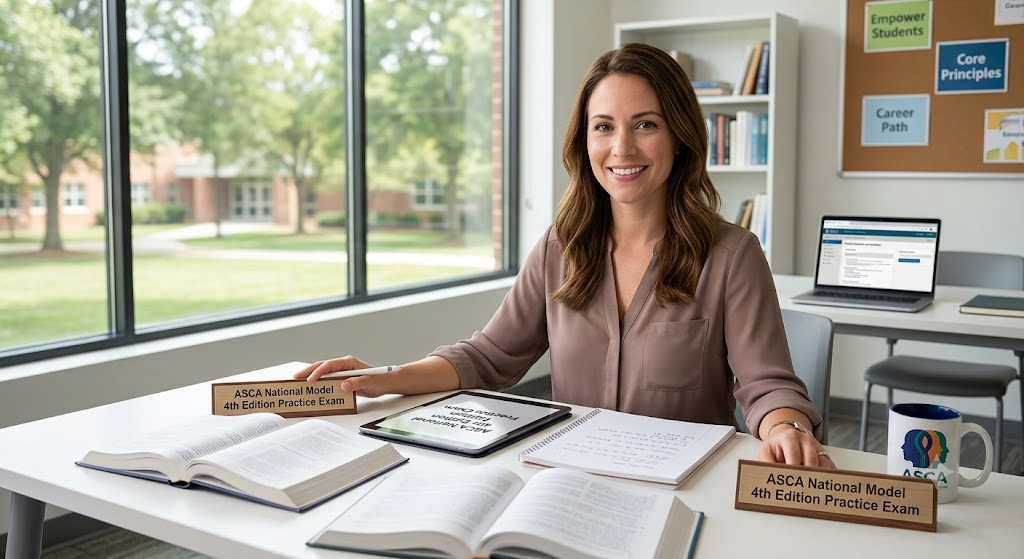
Additional Information
What the Course Entails and Exam Details
The core of the ASCA National Model 4th Edition revolves around four key components that define the role and process of modern school counseling. The knowledge assessed by the final exam—and reflected in this practice test—is derived directly from these foundational elements:
Define: This section assesses your grasp of the fundamental beliefs and philosophies of school counseling, including the creation of vision and mission statements. It covers your knowledge of student standards (such as the ASCA Mindsets & Behaviors for Student Success) and professional standards (ethics and competencies).
Manage: Here, you will be tested on organizational tools, including use-of-time analysis, annual student outcome goals, action plans, and the function of advisory councils. Understanding how to use data to inform program decisions is crucial in this component.
Deliver: This essential area focuses on the implementation of a comprehensive program. It covers direct student services (instruction, appraisal and advisement, counseling) and indirect student services (consultation, collaboration, referrals) that help students navigate challenges and achieve goals.
Assess: The final component tests your ability to evaluate the effectiveness of your school counseling program. This includes analyzing results, sharing successes, and using assessment data to continuously improve the program and advocate for the profession.
What to Expect in the Final Exam
While this guide focuses on helping you prepare with a practice exam, it is crucial to understand the format and requirements of the typical final professional assessment or comprehensive test derived from the ASCA National Model:
Format: The final exam is usually a standardized, computer-based test consisting primarily of multiple-choice questions. It may also include scenario-based questions that require you to apply model principles to real-world situations.
Time Limits: Standard time limits vary depending on the testing body (e.g., ASCA direct certifications, state-specific licensure exams), but generally range from two to three hours. It is vital to manage your time effectively between questions.
Passing Score: The required score to pass is determined by the specific certification or licensing board administering the exam. Passing scores are usually set based on a minimum competency level and can be scaled scores. Note: For many practice resources, your immediate focus is identifying weak areas rather than chasing a specific score.
Exam Environment: Standard exams are administered in professional, proctored environments, either at designated physical testing centers or through secure online proctoring services.
How to Study and Exam Centers
Your success on the ASCA National Model 4th Edition Practice Exam, and ultimately the final assessment, depends on structured preparation. Here are effective strategies and details on where to take your exam:
Study Strategies:
Deep Dive into the Source: Your single most important resource is the actual publication: The ASCA National Model: A Framework for School Counseling Programs (4th Edition). Read and re-read it comprehensively.
Practice is Key: Utilize comprehensive practice exams just like this one. They familiarize you with the question format, pacing, and areas that require further study. Analyze your incorrect answers to understand why a different choice was correct.
ASCA Professional Development: Take advantage of webinars, online courses, and resources directly from ASCA. They often offer specific training tailored to understanding the 4th Edition framework and its application.
Group Study and Peer Review: Form study groups with other school counselors or classmates. Discussing scenarios and components of the model can deepen your understanding through shared perspectives.
Exam Centers and Access:
ASCA Direct Certificates: For ASCA-administered specialist certificates, the exam is often accessed directly through the ASCA online member portal upon completion of the corresponding professional development modules.
State Licensure Exams: If the test is part of a state's educator licensure or school counseling endorsement process, the exam may be administered through major testing vendors like Pearson VUE, ETS, or state-specific educational centers.
Always verify the specific registration procedure, cost, and location with the organization issuing the final certification.
Job Opportunities from the Course
Gaining a robust understanding of the ASCA National Model 4th Edition positions you as a leading professional in educational counseling. This knowledge is not only preferred but often required for various career paths:
Certified School Counselor (K-12): Apply comprehensive program principles to support students across all educational levels.
District School Counseling Coordinator/Supervisor: Oversee and mentor counseling departments across multiple schools within a district.
Director of Guidance: Lead the school counseling team within a middle or high school.
College and Career Counselor: Specialize in guiding students through secondary and post-secondary pathways.
Educational Consultant: Advise schools and districts on implementing data-driven counseling programs.
School Counselor Educator/Professor: Prepare the next generation of counselors in higher education (requires advanced degrees).
Student Support Services Coordinator: Manage diverse support programs within educational settings.
Prepare with confidence using this ASCA National Model 4th Edition Practice Exam guide and unlock the full potential of your career in school counseling!
Frequently Asked Questions
Reviews
5.0
Based on 0 reviews
Leave a Review
No reviews yet. Be the first to review!