
ASA Sheet Metal and Non-Metallic Structures Practice Test
$69.00
- Buy to unlock unlimited access to all Quiz questions.
- After purchase you can print a PDF of the whole quiz at any point. The PDF will contain the questions and the correct answers.
About this Exam
The ASA Sheet Metal and Non-Metallic Structures exam is a critical specialized component of the broader FAA Aviation Maintenance Technician (AMT) Airframe Rating. This rating is essential for individuals who aspire to work professionally as aircraft mechanics. It certifies that a technician possesses the fundamental knowledge necessary to inspect, repair, and maintain the structural integrity of both metallic (traditional aluminum sheet metal) and non-metallic (advanced composite) aircraft structures. Successfully mastering this content is a pivotal step toward earning your full Airframe and Powerplant (A&P) license. The exam is designed to test both theoretical understanding and the practical application of structural repair concepts required for safety and airworthiness in the aviation industry.
Ready to test your knowledge?
Buy Now to Access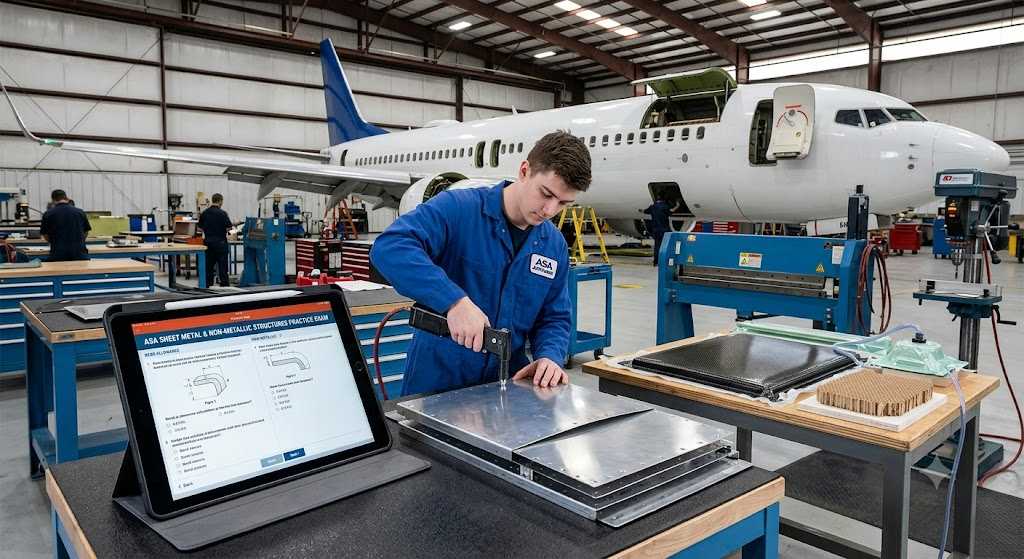
Additional Information
What the Course Entails and Exam Details
This examination assesses a candidate’s expertise in two distinct but related fields of aircraft structural maintenance. The Sheet Metal portion covers the properties and identification of aerospace-grade aluminum alloys, such as 2024 and 7075, including their temper designations and corrosion characteristics. Students must understand fabrication processes, including cutting, bending, forming, and the use of specialized tools like break presses and slip rolls. A significant emphasis is placed on fastening techniques, including rivet identification codes (AN-462), selection, layout, hole preparation, installation, and proper shop head dimensioning (1.5x diameter width, 0.5x height). Calculations for bend allowance, setback, and edge distance are core required skills.
The Non-Metallic Structures portion tests knowledge of advanced composites, transparent plastics (plexiglass), wood, and fabric coverings. Key topics include the identification and properties of composite materials (e.g., fiberglass, carbon fiber), matrix systems (epoxy, polyester resins), and core materials used in honeycomb construction. Candidates must understand different bonding methods, inspection techniques for delamination (e.g., tap testing), and various repair procedures, such as potted repairs, laminated overlays, and vacuum bagging. The exam also addresses safety practices, damage assessment, and the maintenance documentation required for structural repairs.
What to Expect in the Final Exam
While "ASA" provides study materials, the actual final certification is the FAA Airframe Written Test. The 'Structures' section, focusing on sheet metal and non-metallic, forms a significant portion of that comprehensive test. The full Airframe test typically consists of approximately 100 multiple-choice questions. It is a computer-based exam administered in English. Candidates generally have a time limit of around two hours to complete the entire Airframe test. The minimum passing score is 70%. The exam contains questions that range from direct recall of technical data to complex problem-solving scenarios, requiring candidates to interpret technical drawings, apply repair formulae, and determine correct repair procedures. A calculator, technical reference charts, and a visual manual containing images for reference are usually provided.
How to Study and Exam Centers
Preparation for this rigorous exam requires a multi-faceted approach. To build a strong foundation, you should study primary reference materials, specifically the FAA-H-8083-31A, Aviation Maintenance Technician Handbook—Airframe, and appropriate FAA Advisory Circulars, such as AC 43.13-1B. Utilize dedicated study guides, such as the ASA Airframe Test Guide, to review and practice real exam questions. Active learning strategies are highly effective: create flashcards to memorize rivet codes, material specifications, and calculation formulas. It is critical to practice mathematical calculations for bend allowance, setback, and rivet layout until they are routine. Engage in hands-on practice through an accredited FAA Part 147 maintenance school, which provides the necessary equipment and guidance for actual structural fabrication and repair work. Finally, take numerous full-length, timed practice exams to build test-taking stamina and identify any weak areas.
You cannot register to take the final FAA Airframe Written Test without explicit authorization. Before scheduling, you must obtain a tracking number from the FAA (Integrated Airman Certification and Rating Application, or IACRA) and provide proof of eligibility, such as a certificate of completion from an approved Part 147 school or documentary evidence of sufficient practical experience. Once authorized, you can schedule the exam at an official FAA-approved testing center, often managed by a third-party testing service like PSI Services LLC, which has a network of location centers across the United States. The exam must be taken in person, and strict security and identification protocols are strictly enforced.
Job Opportunities from the Course
A certification with an FAA Airframe rating, especially one demonstrating strength in structural repair, opens diverse career paths within the aviation maintenance, repair, and overhaul (MRO) sector. Below is a list of job titles and career paths available:
Aircraft Structural Technician
Sheet Metal Mechanic (Aviation)
Composite Structures Technician
Aviation Maintenance Technician (A&P Mechanic)
MRO Technician (Maintenance, Repair, Overhaul)
Airframe Specialist
Helicopter Airframe Mechanic
Quality Control Inspector (Structures focus)
Composite Repair Technician
General Aviation Mechanic
Major Airline Line Maintenance Technician
Frequently Asked Questions
Reviews
5.0
Based on 0 reviews
Leave a Review
No reviews yet. Be the first to review!