
ASA Hydraulic and Pneumatic Power System Practice Test
$69.00
- Buy to unlock unlimited access to all Quiz questions.
- After purchase you can print a PDF of the whole quiz at any point. The PDF will contain the questions and the correct answers.
About this Exam
The ASA Hydraulic and Pneumatic Power System certification is a critical credential designed for aspiring aviation maintenance technicians (AMTs) and aviators. It validates the essential knowledge required to safely and effectively maintain, troubleshoot, and repair the complex fluid power systems that underpin modern aircraft operations. These systems control everything from landing gear to flight control surfaces and utility functions. Passing this exam demonstrates professional competence and compliance with national aviation standards, paving the way for a successful career in the aviation industry.
Ready to test your knowledge?
Buy Now to Access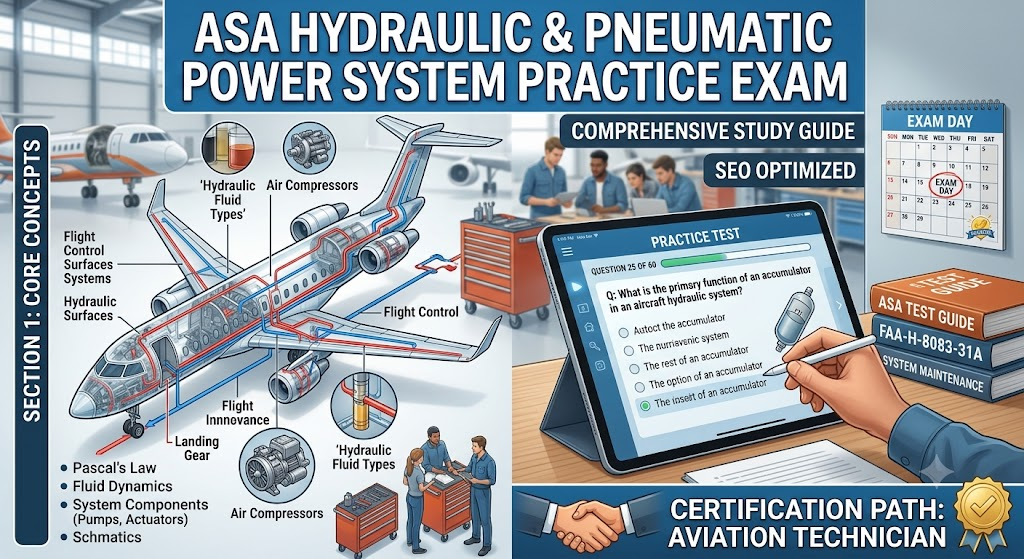
Additional Information
What the Course Entails and Exam Details
The preparatory course and the exam itself are rigorous, ensuring that a candidate can interpret schematics, understand component functions, and apply maintenance procedures in a high-stakes environment. Key topics and skills covered include:
Fluid Power Fundamentals: Detailed knowledge of Pascal’s Law, Boyle’s Law, and Bernoulli's Principle as they apply to energy transmission in closed systems.
Hydraulic and Pneumatic Components: Identification, operation, and selection criteria for critical parts, including pumps (constant and variable displacement), actuators (cylinders and motors), accumulators, reservoirs, filters, and various control valves (pressure, flow, and direction).
Aviation-Specific Systems: Understanding the unique configurations and requirements of hydraulic and pneumatic systems in aircraft, including red (hydraulic) and blue (pneumatic) line differentiation, emergency systems, and integration with other aircraft systems.
Troubleshooting and Maintenance: Proven techniques for contamination control, leak detection, component replacement, system flushing, and using diagnostic equipment like pressure gauges and flowmeters.
Safety and Regulations: Rigorous adherence to industry safety standards (like lockout/tagout), proper handling of pressurized fluids, and familiarity with relevant regulatory standards.
What to Expect in the Final Exam
The ASA Hydraulic and Pneumatic Power System Final Exam is a comprehensive assessment typically administered in a multiple-choice format. Candidates should be prepared to encounter scenarios that test practical application, not just rote memorization.
Exam Format: Multiple-choice questions.
Number of Questions: Typically around 60 comprehensive questions.
Passing Score: The passing score is set by the relevant regulatory authority, such as the Federal Aviation Administration (FAA). Candidates generally must achieve a minimum of 70% to pass.
Time Limit: A specific time limit, often around two hours, is provided to complete the exam.
Exam Rules: The exam is closed-book. Electronic devices are prohibited. Candidates are monitored to ensure the integrity of the test process.
How to Study and Exam Centers
Effective preparation for the ASA Hydraulic and Pneumatic Power System exam requires a structured study plan and the right resources. Here are actionable strategies for success:
Utilize Official ASA Guides: Start with the official ASA Test Guides for Aviation Mechanics. These are expertly organized to align with the subject matter of the actual exams and include detailed answers, explanations, and references for further study.
Review FAA Publications: Complement your study with relevant FAA Handbooks, such as FAA-H-8083-31A (Aviation Maintenance Technician Handbook—Airframe, Volume 2), which provide foundational technical knowledge.
Practice, Practice, Practice: Engage in consistent multiple-choice practice. Look for products that offer online simulated testing programs with instant feedback to help you identify and focus on your weak areas.
Join Study Groups: Form or join study groups with peers. Explaining complex concepts like the interaction of servo valves to others can deepen your own understanding.
Where and How to Take the Exam
The actual ASA Hydraulic and Pneumatic Power System exam is often taken as part of a larger aviation mechanic certification pathway (like the FAA Airframe or Powerplant knowledge tests). Candidates can register for these tests and select from authorized testing centers nationwide, such as those managed by PSI or other authorized physical testing locations. Candidates must register in advance and provide proper identification on the test day.
Job Opportunities from the Course
A certification in ASA Hydraulic and Pneumatic Power System, typically within an Airframe and/or Powerplant rating, opens the door to numerous specialized roles in the aviation sector. Career paths include:
Aviation Maintenance Technician (AMT) - Airframe Specialist
Aircraft Hydraulic Technician
Aviation Pneumatic Systems Specialist
Aircraft Landing Gear Mechanic
Flight Control Systems Technician
MRO (Maintenance, Repair, and Overhaul) Technician
Corporate Aviation Maintenance Mechanic
Aviation maintenance is a field with a very strong outlook, and those with specialized skills in fluid power systems are in high demand for maintaining the safety of the flying public.
Frequently Asked Questions
Reviews
5.0
Based on 0 reviews
Leave a Review
No reviews yet. Be the first to review!