
ASA Appraisers Practice Test & Exam Prep
$69.00
- Buy to unlock unlimited access to all Quiz questions.
- After purchase you can print a PDF of the whole quiz at any point. The PDF will contain the questions and the correct answers.
About this Exam
The ASA Appraisers Practice Test & Exam Prep guide is your comprehensive resource for navigating the path to professional appraisal certification from the American Society of Appraisers (ASA). The ASA is a world-renowned multi-disciplinary organization that sets the standard for appraisal excellence across various specializations, including Real Property, Personal Property, Business Valuation, Machinery & Technical Specialties, Gems & Jewelry, and Appraisal Review & Management. This guide is specifically designed for aspiring appraisers, current professionals looking to upskill or gain accreditation, and students preparing for any of the crucial exams required to become an Accredited Member (AM) or an Accredited Senior Appraiser (ASA). It focuses on providing essential preparation, practice strategies, and key insights to help you build confidence, master core concepts, and succeed on your final exam day. Embark on this educational journey to demonstrate your expertise and unlock significant career growth within the vital and dynamic field of valuation.
Ready to test your knowledge?
Buy Now to Access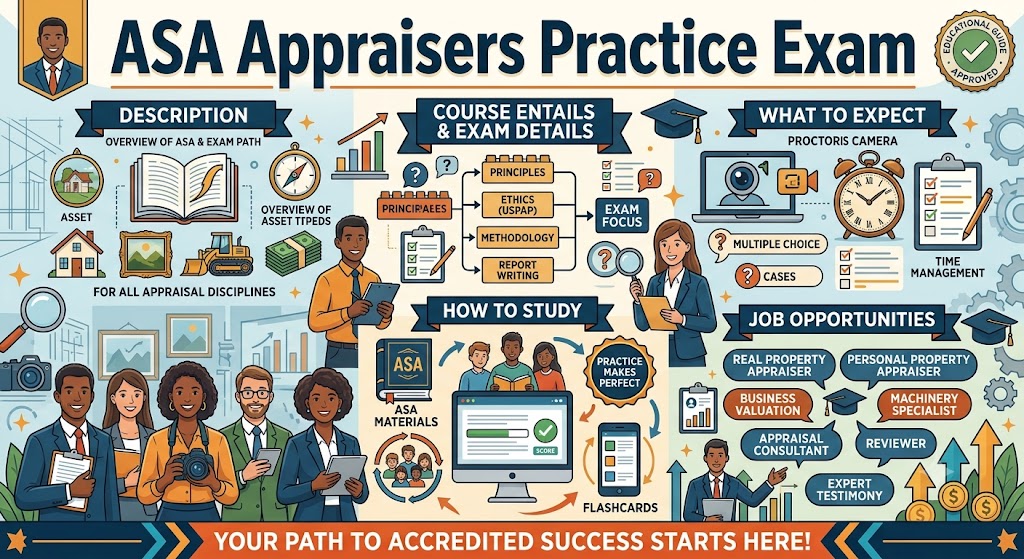
Additional Information
What the Course
Entails and Exam Details
This ASA Appraisers Practice Test & Exam Prep
guide encompasses a vital body of knowledge and practical skills that form the
foundation of professional appraisal. While the specific courses required
depend on your chosen discipline, the overarching curriculum covered by ASA
education and exams typically includes:
- Principles
of Valuation (POV): Fundamental concepts, valuation methodology (Sales
Comparison, Cost, and Income approaches where applicable), market
analysis, and highest and best use.
- Appraisal
Ethics and Standards: Deep understanding and application of ethical
codes and appraisal standards, most notably the Uniform Standards of
Professional Appraisal Practice (USPAP) in the U.S. or international
equivalent standards.
- Report
Writing: Crafting detailed, compliant, and defensible appraisal
reports that clearly communicate the value conclusion and analysis.
- Discipline-Specific
Knowledge: In-depth studies tailored to your area of specialization,
covering topics unique to real estate, art and antiques, industrial
machinery, complex business structures, or fine jewelry, including
identification, grading, and specialized valuation techniques.
- Legal
and Regulatory Environment: Knowledge of the laws, regulations, and
industry practices that affect appraisal.
- Case
Studies and Practical Application: Engaging with real-world scenarios
to apply theoretical concepts and refine problem-solving skills.
The underlying ASA exams are rigorous and designed to
assess your ability to synthesize this knowledge and apply it in a proctored
setting. The details of the exams can vary significantly by discipline and the
level of accreditation sought:
- Course-Specific
Exams: Multiple Principles of Valuation courses typically conclude
with a comprehensive final exam. These often focus on the material covered
in that specific course and are a critical hurdle in your education path.
- General
Accreditation Exams: Separate exams may be required to achieve
Accredited Member or Accredited Senior Appraiser status, covering broader
concepts and ethics.
- Challenge
Exams: Experienced professionals may be eligible for challenge exams
in certain disciplines, which consolidate multiple course-level
assessments into a larger, comprehensive exam.
- Varying
Question Types: Exams often primarily feature multiple-choice
questions designed to test knowledge and application of concepts. Some
disciplines or levels may also include case study questions or even the
submission and review of actual appraisal reports as part of the overall
accreditation process.
- Strict
Time Limits and Scoring: All exams have specific time limits,
requiring both knowledge and efficiency. Passing scores are set for each
exam and discipline; it is crucial to consult the official ASA candidate
handbook for the precise details relevant to your situation. Immediate
preliminary scores may be provided for computer-based tests, with official
results following.
What to Expect in
the Final Exam
When you sit for your official ASA appraisal exam, you can
expect a professional, well-structured, and challenging assessment. Here’s a
general overview of what you might encounter:
- Proctored
Environment: The final exam will be strictly proctored, whether taken
online with secure software or in-person at an authorized testing center.
Be prepared to present valid identification and adhere to all testing
rules.
- Focus
on Core Competencies: The exam is designed to test your mastery of the
specific principles, standards, methodologies, and technical knowledge
relevant to your chosen appraisal discipline. Questions will range from
testing foundational knowledge to requiring complex application and
problem-solving.
- Primarily
Multiple Choice: The predominant format for many ASA exams is
multiple-choice. These questions can be complex and require a deep
understanding of concepts and standards, not just memorization. Some
challenge or specialized exams may have different, longer structures or include
report evaluation components in the broader process.
- Time
Constraints: Each exam will have a specific time limit, which can vary
from a few hours for course-ending tests to longer, multi-session formats
for comprehensive or challenge exams. Effective time management is
essential to answer all questions to the best of your ability.
- Passing
Requirements: ASA exams have set minimum passing scores. The specific
passing score can differ based on the exam, discipline, and level of
accreditation. Check your candidate materials for precise details. Failing
to meet the required score will necessitate retaking the exam.
- Detailed
Explanations in Practice Material: While the final exam provides score
results, high-quality ASA practice tests offer invaluable detailed
explanations for every answer choice. This helps you understand why
a particular answer is correct and why others are not, enabling you
to learn from mistakes and strengthen your understanding, which is the
core benefit of effective exam prep.
How to Study and Exam Centers
Preparation is paramount to success on any ASA exam. This ASA
Appraisers Practice Test & Exam Prep guide recommends a robust study
strategy to build your knowledge and confidence. Effective preparation requires
both dedicated individual study and structured practice:
Actionable Study Strategies:
- Utilize
Official ASA Resources: Begin your study with official ASA course
materials, texts, and any provided candidate guidance. This content is
directly aligned with the exam curriculum and provides the foundational
knowledge you need.
- Integrate
High-Quality Practice Tests: Regular use of representative practice
exams is essential. Practice tests:
- Familiarize
you with the exam format, question styles, and pacing.
- Identify
your strengths and weaknesses through immediate feedback.
- Build
stamina and reduce exam-day anxiety by simulating the actual test
conditions.
- Refine
your understanding of concepts through detailed answer explanations.
- Create
a Study Schedule: Plan dedicated study time well in advance,
allocating more time to difficult concepts. Consistency is key.
- Form
or Join Study Groups: Colleague interaction and collaborative learning
can be powerful for reinforcing key concepts and gaining new perspectives.
- Flashcards
and Active Recall: Utilize flashcards (digital or physical) to
memorize key terms, definitions, formulas, and ethical standards through
active recall.
- Time
Management Practice: When taking practice tests, strictly adhere to
the time limits to build your speed and learn to manage your time
effectively under pressure.
- Review
Detailed Explanations: After taking a practice test, thoroughly review
the detailed explanations for both correct and incorrect answers to
understand the rationales completely.
Exam Centers and How to Take the Exam:
ASA exams are administered in professional settings, and the
specific delivery method can vary based on the exam type, discipline, and
current procedures:
- Online
Portals: Many ASA education-related exams and accreditation tests are
offered through official ASA online portals. These are typically
securely proctored using specialized software that requires a webcam,
microphone, and a reliable internet connection.
- Testing
Providers: For certain exams, ASA may partner with specialized
computer-based testing networks (like Pearson VUE or Prometric). These
would allow you to take the exam in person at an authorized testing center
located across the country.
- Authorized
Schools & Course Endpoints: Course-specific final exams may be
administered at the end of structured courses, whether those are taken
online or potentially in rare in-person classroom settings at authorized
educational locations.
- Specific
Event Locations: In limited instances, comprehensive or special exams
might be offered in conjunction with major ASA events or conferences.
Important: It is crucial to consult the official
ASA website and the specific candidate handbook for your discipline
and desired designation. These official sources will provide the most current,
detailed, and definitive information regarding study materials, registration,
fees, exam formats, passing scores, time limits, and exact instructions on
where and how to schedule and take your exam (whether online or at a specific
testing center). This guide is for general preparation context and does not
substitute official ASA directives
V Job
Opportunities from the Course
Successfully preparing for and passing the requisite ASA
exams, along with fulfilling experience and ethical requirements, unlocks a
diverse range of rewarding job opportunities and career paths across multiple
sectors. A professional ASA appraisal credential can lead to roles such as:
- Real
Property Appraiser: Specializing in valuing residential, commercial,
industrial, and specialized properties.
- Personal
Property Appraiser: Valuing fine art, antiques, collectibles,
household goods, and specialized collections for various purposes.
- Business
Valuation Appraiser: Determining the value of closely held businesses,
complex corporate entities, and intellectual property.
- Machinery
& Technical Specialties Appraiser: Valuing diverse types of
machinery, equipment, vehicles, and specialized technical assets.
- Gems
& Jewelry Appraiser: Specializing in the identification, grading,
and valuation of precious gems, diamonds, and fine jewelry.
- Appraisal
Reviewer: Reviewing appraisal reports for quality, compliance with
standards, and professional diligence on behalf of clients, financial
institutions, or regulatory bodies.
- Appraisal
Consultant: Providing expert valuation advice and consulting services
on complex valuation matters to clients, attorneys, and organizations.
- Institutional
Appraiser: Working within large organizations, government agencies,
non-profits, or financial institutions as an in-house appraiser.
- Litigation
Support Specialist: Offering expert appraisal services and testimony
in legal proceedings and disputes.
- Risk
Manager (with Valuation Focus): Incorporating valuation expertise into
risk management roles for insurance companies or financial institutions.
- Academic
and Educational Roles: Teaching appraisal principles and methodology
in university settings or through professional educational providers.
- Specialized
Appraiser Roles: Focus on unique assets like agricultural lands,
mineral rights, historical properties, or specialized technology and
industrial equipment.
Achieving an ASA designation signifies a deep commitment to
professionalism, ethics, and expertise, providing a clear path to career
advancement and recognized expertise in the crucial field of valuation.
Frequently Asked Questions
Reviews
5.0
Based on 0 reviews
Leave a Review
No reviews yet. Be the first to review!